
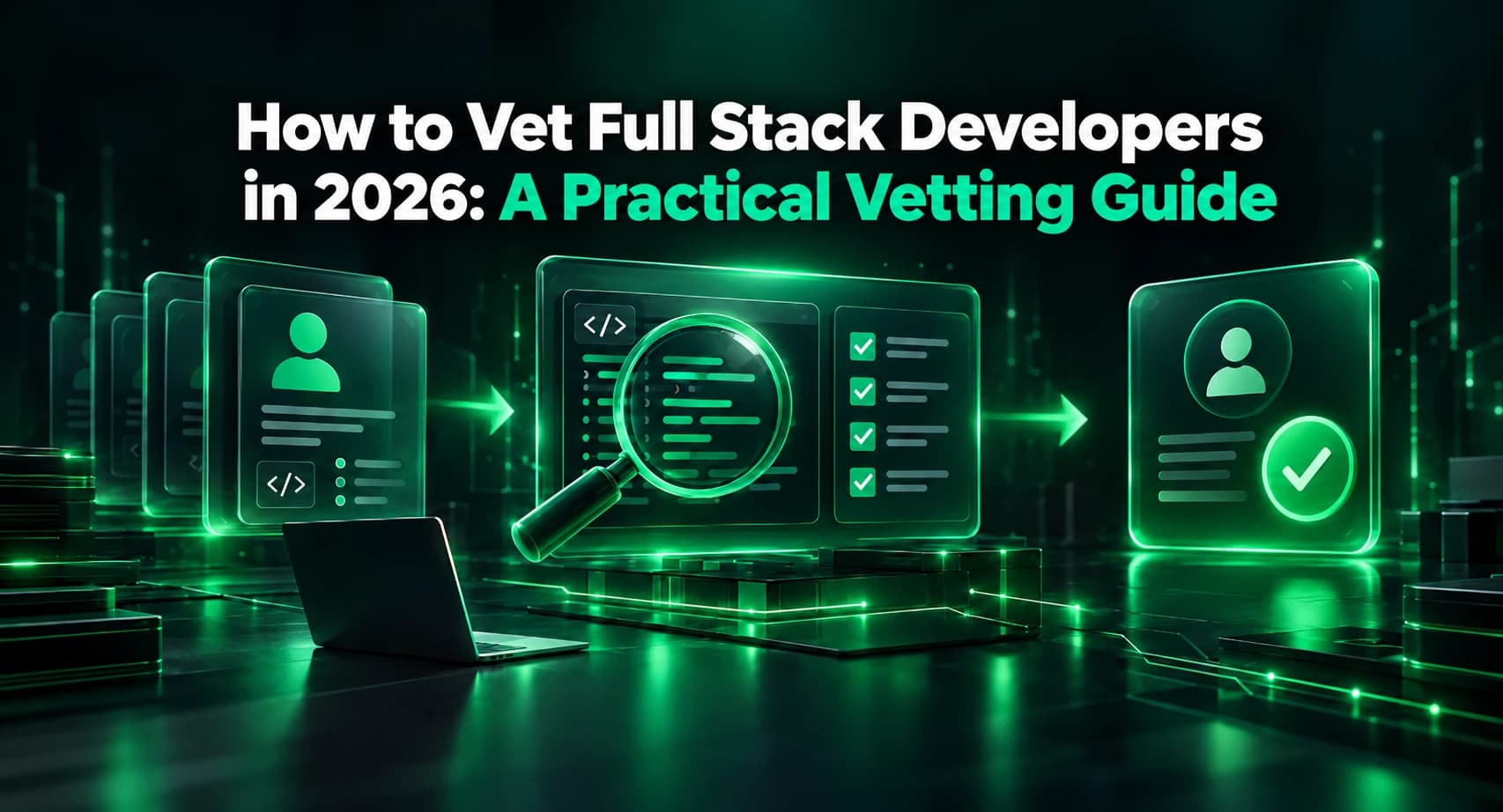
Hire Full Stack Programmer Talent in 2026: A Practical Vetting Guide
Picture the hire that looked perfect on paper. React, Node, Postgres, Docker, a bit of AWS. The interview went well. Quick answers, no hesitation. Then week three arrives and the pages look lovely while the database groans under a query nobody indexed.
It happens more than people admit. When you set out to hire full stack programmer talent, you're really buying judgment across several layers, and a résumé can't show you that. "Full stack" covers a lot of ground. Some people are great on the server and shaky in the browser. Others are the reverse. A few are mediocre at both and very confident about it.
So this guide skips the keyword bingo. We'll look at what your product needs, which kind of hire suits it, and how to test real work before you've spent real money.
Quick answer: To hire a full stack programmer who can carry a product, work out first whether one person is enough or whether you need a small team. Then test real work: a short paid task, a walkthrough of something they shipped, and a few questions about how things break. Keep the code in a repository you own from day one. Get it in writing who fixes bugs after launch.

Work Out What "Full Stack" Means for Your Product
Every product leans one way. A booking tool is mostly data and state. A storefront is mostly interface. An internal dashboard glued to five other systems? Mostly plumbing. You want someone strong where yours leans, and fine everywhere else. Decide that before you read a single profile.
Stack first, person second. If the whole thing is JavaScript, browser to server, then MERN stack developers are the natural pool. If the interface is the tricky part, you may do better with a React specialist and a Node.js engineer on the API than with one person stretched across both. Neither is better in general. They're different bets about where the difficulty lives.
Be honest about the size of the job. One programmer can own a prototype or a small internal tool. Add real traffic, payments and a second app, and that one person becomes a bottleneck and a single point of failure. Nothing wrong with generalists. The risk is asking one of them to be your developer, tester, DevOps engineer and product manager in the same month.
Write a one-page brief. What the product does, who uses it, what exists today, what must ship in the first three months, what you know is shaky. Skip words like "scalable" and use plain facts: "checkout is one long function nobody wants to touch." Good candidates will ask sharp questions, and every quote you get will be pricing the same job.
Freelancer, Employee or Dedicated Team?
Forget hourly rates for a minute. They're the least interesting difference.
A freelancer starts fast and costs little to try. Great for a contained job with an end date. But if they catch the flu, or a better gig, your project stops.
An employee will know your product best in the long run, and takes the longest to get there. Notice periods, three interview rounds, onboarding. You can burn a couple of months before the first useful commit, and you pay whether the roadmap is busy or quiet. One catch: if nobody on your side writes code, who judges their work?
A dedicated team sits in between. Dedicated full stack developers work on your product only, and the vendor deals with replacements and cover. Ask whether you'll meet the people who'll actually do the work, and what happens when one of them leaves. Thinking about going offshore? We wrote up why companies outsource software development to India, and what custom software costs in India is handy for checking whether a quote looks too good to be true.
Remote works, with habits. A remote full stack developer can be excellent if you get some overlap in working hours, clear written updates, and problems raised early. Match the time-zone gap to the work: exploratory projects need quick conversations, well-defined ones don't.
Most people compare rates and forget replacement risk. A cheap rate on one person stops being cheap the week they leave.
Test the Work, Not the Vocabulary
Anyone can memorise framework names. Judgment is harder to fake, and a few checks find it quickly:
- A small paid task. One real feature, say a form, an endpoint and a filtered table, done in a day or two. Pay for it. You're watching how they handle a vague brief and what they ask before starting.
- A walkthrough of something they shipped. Schema, API, state in the interface, deployment. People who owned it talk about trade-offs and regrets. People who touched one layer get fuzzy at the edges.
- Their pull requests, if they'll share some. Commit messages and the way they respond to review comments tell you plenty.
- Failure questions. What if the payment API times out? Two users edit the same record? The deploy breaks at 6 p.m.?

I'd trust the candidate who says "it depends" and then explains what it depends on over the one with a confident answer for everything. Total certainty about caching usually means they haven't been burned yet.
Write the task like a real client would. Small enough for a day or two, real enough to resemble your work, and slightly incomplete on purpose. You want to see whether they ask about the gap, or quietly assume and tell you what they assumed. Silent assumptions are where the expensive surprises come from.
Then make them explain it. Fifteen minutes, live. Someone who wrote the code defends it and admits where it's weak. If they used an AI assistant, that's fine in 2026, as long as they can explain every line.
The Boring Stuff That Decides Whether It Survives
Nobody enjoys this part, which is exactly why it goes wrong.
Repo ownership. The code should sit in an account your company owns from the first commit. If it lives on a vendor's server until the final invoice clears, you've got a problem waiting. The same goes for the domain, hosting and app store accounts: company name, developer added as a user, not the other way around.
Staging. Somewhere to test that looks like production, so your real users aren't the QA team.
Repeatable deployment. Ask how code gets from the developer's machine to the live site. If the answer involves someone logging into a server and copying files by hand, you've found a risk. A repeatable process, even a simple one, makes releases boring, and boring is what you want.
The README test. Could a stranger run the project from the setup notes? If not, the knowledge lives in one head.
After launch. Who fixes bugs, for how long, at what price? Get it written down. "We offer support" means nothing until there's a number attached. Ask about automated tests too. A small suite people trust beats a big one nobody does.
Start Small, Then Decide
Opening with "build the whole product" leaves you no room to fail cheaply. Pick one user flow instead, build it end to end, get it deployed. Our post on scoping an MVP for a startup shows how to choose that slice.
Weekly demos and a task board anyone can see will tell you more in four weeks than the interviews did. Silence is the first warning sign. A week with no demo and no real update deserves a direct conversation.
Pay properly for the trial and set aside a few hours a week of your own time. Projects slow down far more often because nobody on the client side is available to answer questions than because the developer is slow.
Before the trial starts, write down what would make you continue and what would make you stop. Without that, it's easy to drift into a long engagement because ending it feels awkward. Comparing agencies rather than individuals? The next thing to read is our guide to hiring a software development partner in India.
What This Looks Like With Toadster
Toadster has full stack developers available to hire, plus MERN, React and Node.js specialists, and web development services for projects that need more than one pair of hands. If you're ready to hire full stack programmer talent through us, put us through the same checklist. Ask how the work would be split, who owns the repo, what a trial task would look like, what happens after launch. Our case studies show the sort of products we've built.
Whatever route you pick, ask for real work before you ask for a contract. Half the pain in this area comes from skipping that step because the résumé looked right. If you're mid-decision and want a second opinion on whether one programmer will do, talk to our team about your product.