

How Much Do Offshore Development Services Cost in 2026? Rates, Teams & Hidden Costs
Picture the quote that looked like a bargain. $12,000 a month for "a dedicated team." Three months in, you find out the team was two developers, nobody was testing anything, and the architecture decisions were being made on the fly. The invoice was accurate. It just didn't cover the work.
It happens more than people admit. When you start looking into offshore development services cost, you find plenty of rate charts and very little about what a rate actually buys. A monthly figure tells you what you pay. It doesn't tell you what's in the box.
So this guide skips the "2026 average rate" game. We'll look at what changes the price, how to build a realistic team budget, and where a cheap quote turns expensive.
Quick answer: There's no reliable flat price for an offshore software team. Cost depends on who's on the team, how much of their time you're buying, and what they're building. Budget by role and allocation, then add QA, DevOps, management and post-launch support. Compare proposals on the same scope, not the same headline number.
Why There's No Single Price
Here's what you can actually verify. The US Bureau of Labor Statistics put the May 2025 median wage for US software developers at $135,980 a year. A published Maharashtra government staffing proposal listed ₹178,822 per senior developer per month, excluding tax, for one 2025 engagement. A Kerala government institution advertised ₹60,000–₹70,000 a month for a temporary senior developer role in September 2026.
Three real numbers, and none of them is comparable to another. One is a US wage, one is a government person-month rate, one is a short-term salary. None is a vendor invoice for a US or Saudi client. That's exactly why a single rate chart is a poor buying tool. A vendor price may also include recruitment, management, equipment and continuity, or it may leave some of those out.
What Changes the Cost
Seniority. Junior engineers do well with supervision and bounded tasks. Seniors cost more because you're buying judgment: where to draw service boundaries, what to test, when not to build something. Ask what decisions they've made on a product like yours and what happened after launch.
Team shape. One full stack engineer can handle a tight internal tool. A customer-facing product usually needs frontend and backend focus, QA, and someone accountable for releases. You don't need every specialist full time, but you do need to know who does each job.
Complexity. "Payments," "analytics" and "admin access" can each mean a small feature or a whole subsystem. A legacy app that can't go down is a different project from a fresh MVP.
Engagement model. Hourly suits shifting priorities. Fixed scope suits settled requirements. A monthly dedicated team suits a continuing roadmap. A product that's still evolving, forced into a fixed spec, gets expensive through change requests. An open-ended engagement with no budget controls gets expensive too.
Whichever you pick, ask what's included and what's billed separately. That one question explains more of the gap between two quotes than geography does.
A Simple Way to Estimate It
Monthly budget = hours or allocation for each role × its agreed rate, plus anything priced separately (infrastructure, tools, support).
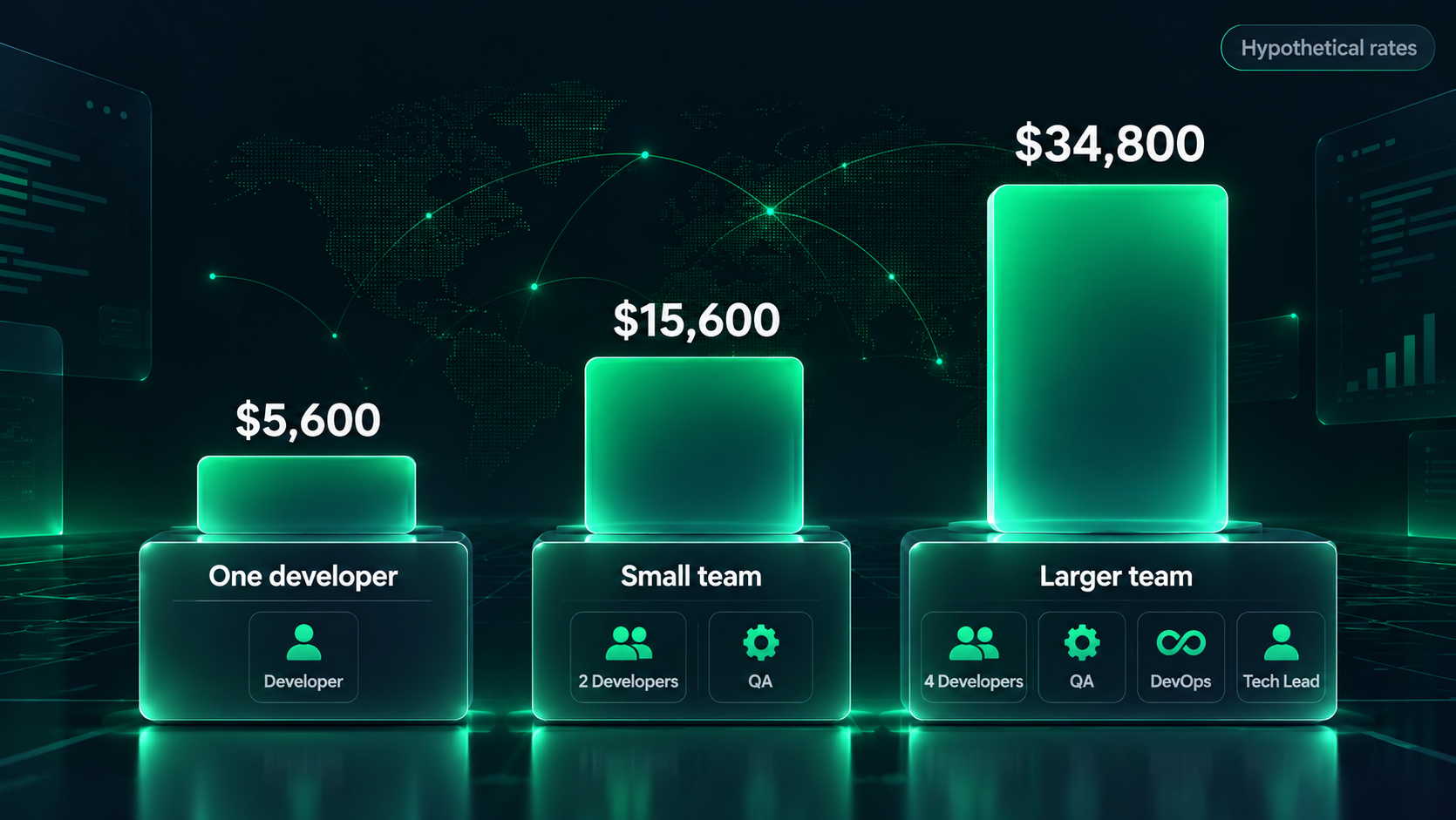
Here are three planning exercises. The rates are hypothetical, so you can see the arithmetic. They aren't market rates and they aren't Toadster quotes. Each assumes 160 billed hours for a full-time role.
Scenario | Assumptions | Monthly |
|---|---|---|
One developer | 160 h × $35 | $5,600 |
Small team | 2 developers × 160 h × $35; QA 80 h × $25; DevOps 20 h × $55; tech lead 20 h × $65 | $15,600 |
Larger team | 2 developers × 160 h × $40; specialist 160 h × $65; QA 160 h × $30; DevOps 60 h × $60; tech lead 40 h × $80 | $34,800 |
Over six months that's $33,600, $93,600 and $208,800 before any excluded costs. At the Saudi Central Bank's official rate of 3.75 riyals to the dollar, the monthly figures are about SAR 21,000, SAR 58,500 and SAR 130,500, before contract-specific taxes.
Don't anchor on those rates. Use the structure. If a vendor says $15,000 for "a team," ask how many people, at what allocation, and who does QA. A cheaper-looking team often just includes less work.
One Developer or a Full Team?
The fastest way to overpay is to buy a team when you need one engineer. The fastest way to stall is to buy one engineer and expect a team's output.
If your engineering lead already owns architecture, deployment and code review, and the backlog is simply growing, one dedicated developer may be exactly right. A managed pod would add roles you already cover.
Now picture a founder with no technical co-founder, no repository and a plan for a SaaS product with billing and permissions. One developer can start the build, but someone still has to own product decisions, testing, deployment and security. Calling it a "one-developer project" doesn't make that work vanish.
So start with the gap. If it's capacity, hire capacity. If it's coordinated delivery, budget for coordinated delivery.
Offshore vs. Hiring In-House
Comparing a vendor fee with a salary misses a lot on both sides.
Take the BLS median wage of $135,980. The employer's share of Social Security (6.2%) and Medicare (1.45%) taxes, per IRS rates, adds roughly $10,402, so salary plus those two taxes is about $146,382. That's before health benefits, paid leave, recruitment, equipment and software. It's a calculation from a wage benchmark, not a 2026 forecast of what you'd pay a particular hire.
Then add what never shows up on a payslip: months of recruiting while the work waits, the time your lead spends onboarding, and the cost of rebuilding knowledge when someone leaves.
The offshore side needs the same honesty. A provider fee may bundle recruitment and administration, but it won't automatically cover cloud bills, third-party tools or the product decisions only you can make. Moving engineering offshore doesn't remove management. It changes who does which parts.
So compare total cost over a set period, say the build plus the first months after launch. Sometimes a hybrid wins: a product owner or tech lead near your customers, an offshore team adding delivery capacity. Sometimes an in-house hire is the better call because a sensitive core system needs deep, long-term ownership. Wondering how this plays out for an India-based team? We wrote up why companies outsource software development to India, and what custom software costs in India is handy for checking whether a quote looks too good to be true.
The Hidden Costs
The most expensive arrangement isn't the one with the highest invoice. It's the one where you pay twice: once for the work, and again to understand or repair it.
Slow onboarding. A developer waiting two weeks for repository access is availability, not capacity. Settle credentials, environments and a first small task before the start date.
Vague requirements. "Build an admin dashboard" isn't a cost basis. Who uses it, what can they change, what needs an audit trail? Answer those halfway through the build and you'll pay for rework.
Missing QA. If QA isn't in the plan, it still happens. Developers, your staff or your users end up doing it. Price that rather than counting the missing line as a saving.
Decision delays. A question left unanswered for two days can hold up several people. Agree where questions go, who answers, and how blockers escalate. Projects slow down far more often because nobody on the client side is available than because the developer is slow.
Lock-in. Could another team run and release your product if you switched? Put it in the contract: code in a repository you own, infrastructure access, current documentation, a handover process.
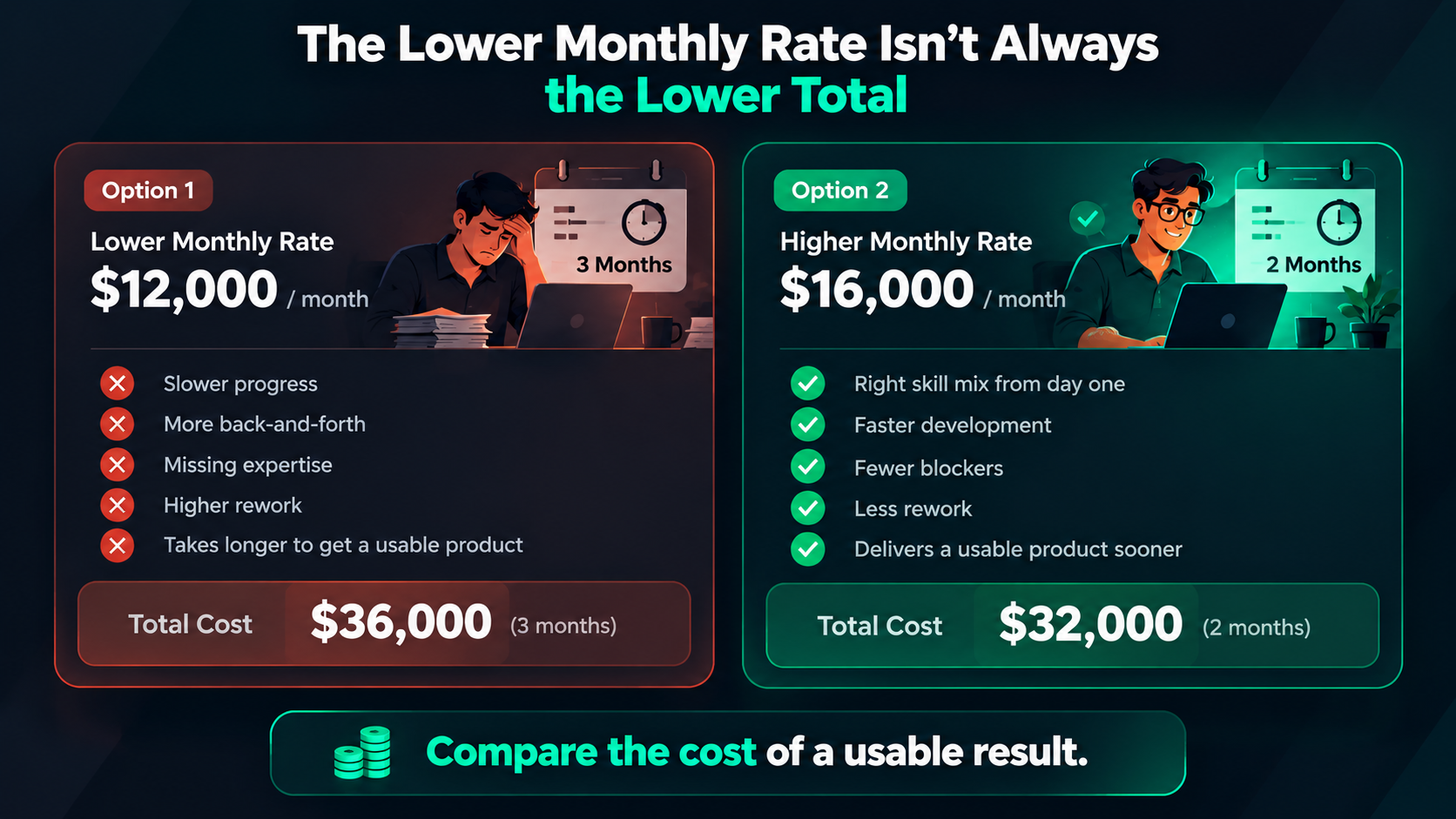
Here's the budget test. A $12,000-a-month team that needs three months costs $36,000. A $16,000-a-month team that needs two costs $32,000. Those figures are hypothetical, but the lesson isn't. Compare the cost of reaching a usable result, not the price of keeping people busy for one month. Building an MVP? Our post on scoping an MVP for a startup shows how to pick a slice that fails cheaply if it has to.
Location, Time Zones and Data
For US companies, an India-based team works well when priorities are clear and code review is planned. If your product lead can only answer a blocker after the offshore day ends, capable engineers wait on paid time. Decide who owns the backlog, the repository, cloud accounts and release decisions before onboarding.
For Saudi companies, India can offer a more convenient working-day overlap. But convenience isn't permission to give every developer access to every system. Saudi Arabia's Personal Data Protection Law and its implementing regulations, including rules on transferring personal data outside the Kingdom, can be relevant when personal data is disclosed or made accessible to a party abroad. Offshore development isn't blanket-prohibited, but the right setup depends on your data and organization. Start by working out what the team actually needs to see. Can they work with synthetic or de-identified data? Where does production sit? Who approves and logs access? Review the Saudi Data and AI Authority's guidance with a qualified local adviser, and settle this before choosing a quote, not after.
How to Judge a Provider
Rankings of the "best offshore software development companies" can't tell you whether the people assigned to your product can work in your codebase. Ask for evidence instead.
Meet the people doing the work, not just sales. Give an engineer a real problem, like an API failure or a slow query, rather than a textbook exercise.
Ask for a role-by-role plan. Who writes tests, who checks them, who handles deployment, who rolls back a bad release? "QA and DevOps included" with no hours attached isn't comparable.
Get ownership in writing. Who owns the code, what data can engineers access, and what happens to access when the engagement ends?
Send two or three providers the same brief and ask for the same format: team, allocation, assumptions, exclusions, price. Our guide to hiring a software development partner in India has more questions worth asking.
What This Looks Like With Toadster
Toadster's dedicated developers work inside a client's existing tools and workflow, and we also offer team augmentation and managed pods for projects that need more than one pair of hands. Our web development services cover builds from discovery through launch, and you can browse a few of our case studies to see the kind of products we've delivered. Toadster's pages describe month-to-month dedicated arrangements and client ownership of code, documentation and infrastructure for work we build. Confirm what applies to your engagement in the written proposal, as you should with any provider.
If you're ready to hire dedicated developers, put us through the same checklist. Ask how the work would be split, what's priced separately, who owns the repository, and what happens after launch. And if you're still deciding whether one developer or a team makes sense, talk to our team about your product. We'd rather size the team to the work than sell you more of it.