
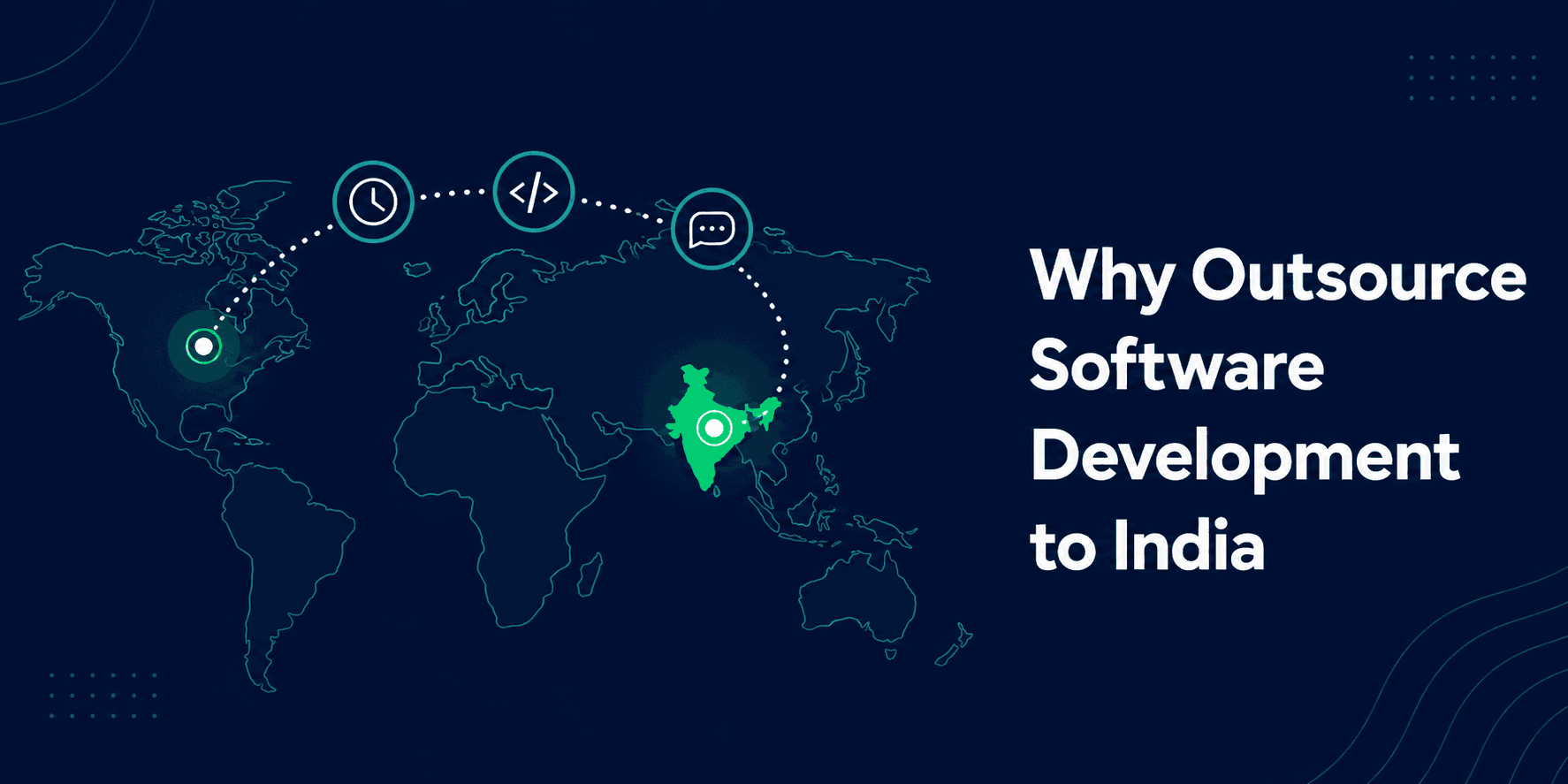
Why Outsource Software Development to India in 2026
The question most companies are actually asking by the time they search this isn't "should I outsource to India." That decision, for a large share of scaling tech businesses, has effectively already been made. The real question is narrower and more useful: how do I do it in a way that doesn't turn into a cautionary story six months from now.
India earned its position as the default destination for offshore software development the slow way - decades of technical education investment, a genuinely large English-speaking professional workforce, and delivery infrastructure that's matured well past the "cheap labor" reputation that still lingers in some boardrooms. The cost advantage is real. It's also the least interesting part of the decision, and companies that outsource purely to chase the lowest rate tend to get exactly what that framing predicts.
Quick answer: India offers genuine depth across nearly every software discipline - custom development, web and mobile, DevOps, QA, and increasingly AI - at a meaningfully lower cost than domestic hiring in the US, UK, or Western Europe, without a corresponding drop in engineering quality when the engagement is set up properly. The outcomes that actually vary aren't about the country. They come down to which engagement model you pick, how clearly you scope the work, and whether IP protection is treated as a day-one requirement instead of an afterthought.

Why India, Specifically
Framing this purely around price sets the wrong expectations from the start. India has one of the largest concentrations of ISO-certified software companies anywhere in the world, and a tech workforce that competes in the same global talent markets as its Western counterparts - not a separate, lower tier of the same skill.
A few things genuinely differentiate India as an outsourcing destination rather than just being a talking point in a sales deck: a very large pool of English-speaking technical professionals, meaning communication friction is usually a process issue rather than a language one; decades of sustained exposure to Western client relationships, which shows up as familiarity with the expectations, cadence, and documentation habits Western teams take for granted; and a tech ecosystem spread across multiple hubs, each with somewhat different specializations rather than one homogenous market.
Not All Indian Tech Hubs Specialize the Same Way
Software development capability isn't evenly distributed across India's cities, and matching your project type to the right hub can meaningfully affect both output quality and cost.
Bangalore leans heavily toward SaaS, AI/ML, and product engineering - the highest concentration of cutting-edge, emerging-tech work. Hyderabad has built real depth in enterprise software and DevOps. Pune is known for QA engineering and full-stack Agile delivery. Chennai has a strong presence in fintech and ERP-adjacent development. And Noida, alongside Gurugram, has become a genuine hub for e-commerce platforms, analytics, web development, and - increasingly - AI-native development, without carrying the higher cost premium of the most saturated metros.
None of this means the other hubs are weaker - it means the "best" city depends on what you're actually building. A software development company in Noida makes particular sense if your project sits closer to enterprise web platforms, analytics-heavy applications, or AI-integrated products, and if proximity to Delhi NCR's business and BFSI client base matters for your go-to-market.
The Engagement Models, and When Each One Fits
Choosing the wrong engagement model tends to surface problems slowly - which makes them harder to fix once the relationship is already underway. Four models cover most real-world outsourcing arrangements:
Staff augmentation embeds individual developers directly into your existing team, under your management, while the partner handles sourcing and administrative overhead. This is the lightest entry point and the right fit when you already have a product and team but need a specific skill gap filled without standing up a whole offshore operation.
A dedicated team is a purpose-built unit working exclusively on your product, with management responsibility shared between you and the partner. This suits companies building or scaling a product over a sustained stretch of time, without the infrastructure to run a full offshore center themselves.
Project-based outsourcing locks scope, timeline, and cost before work starts, with the partner owning execution and your involvement concentrated at review milestones. This model rewards genuine specificity in your requirements and punishes ambiguity hard - vague scope is where project-based engagements go wrong most often.
An offshore development center is the deepest commitment - a dedicated operational unit run under your engineering culture, with you driving hiring and architectural decisions. This fits companies with consistent, high-volume development needs that extend well past a single product cycle, not a first outsourcing engagement.
Protecting Your IP and Your Quality Bar

None of the following should wait until after work has started - they're safeguards to have in place before it does.
- IP ownership and work-for-hire terms in writing. The contract needs to state plainly that all code, designs, and deliverables belong to you from the moment they're created - not something negotiated retroactively.
- NDA scope that covers more than just "the code." Architecture, business processes the offshore team gets exposed to, and any proprietary methodology should be covered explicitly, not assumed.
- Governing jurisdiction you control. Negotiate for your own country's legal jurisdiction wherever the relationship allows it.
- Access controls on a least-privilege basis. Not every team member needs access to every repository or every piece of sensitive data - scope access to what each role actually requires.
- Real quality metrics, not just check-ins. Bug escape rate, sprint velocity consistency (not just raw speed), and automated test coverage on the production codebase are worth asking about directly - a team that can't answer these plainly hasn't been tracking them.
- Recognized compliance certifications, where relevant to your industry - ISO 27001 for information security, SOC 2 for companies handling customer data, GDPR alignment if any EU citizen data is in scope. Ask to see current certificates, not just a claim that they're "in progress."
Common Misconceptions Worth Retiring
Most objections to outsourcing in India trace back to a real experience - just usually one from an earlier era that the industry has moved past. A few worth naming directly: the assumption that quality lags domestic development doesn't hold up against the scale of ISO-certified delivery and the genuinely global talent competition Indian engineers operate in. The assumption that language will create constant friction ignores just how large India's English-speaking technical workforce actually is. And the assumption that outsourcing means losing control of the product confuses geography with governance - control is a function of the engagement model and process discipline you set up, not where the team physically sits.
What This Looks Like With Toadster
Toadster works as a software development company in Noida specifically because the hub fits the kind of work we do best - enterprise-adjacent platforms, analytics-heavy systems, and AI-native builds - without the cost premium of the most saturated markets. The same IP protection, quality tracking, and clear engagement-model structure covered above are the baseline for every engagement we take on, not an add-on negotiated after the fact.
If you're weighing which engagement model fits your situation, our software development team can walk through the options against your specific project.
The Real Decision
Outsourcing to India isn't really a yes-or-no question anymore for most companies weighing it - it's a question of which model, which hub, and which safeguards get put in place before the first line of code gets written. Get those right, and the geography stops mattering nearly as much as people assume it will going in.
If you want to talk through what engagement model and structure would actually fit your project, talk to Toadster for a real scoping conversation.