
Agile Development Framework: How to Choose the Right Approach for Your Software Project
Most teams land on Agile for one of two weak reasons: "everyone else does it" or "the client asked for sprints." Neither is wrong, exactly. But neither is a real decision either. An agile development framework has genuine strengths and genuine limits, and the gap between the two is where projects quietly go sideways.
This matters even more once you bring in outside help. Two partners can both say "we're Agile" and run completely different projects. One shows you working software every two weeks. The other holds a weekly status call and unveils the product in month five.
This piece covers how these frameworks actually work, which one fits which kind of work, where Agile clearly wins and where it doesn't, and, since this is often a partner-selection decision, how to tell whether the team you're talking to really runs this way.
Quick answer: An agile development framework is a practical structure for applying Agile principles to software delivery: you break work into short iterations, reprioritize as you learn, test early and adjust based on real feedback. Scrum works best for teams delivering planned product increments in fixed cycles, Kanban fits continuous or unpredictable workflows, and hybrid models blend iterative delivery with predictive controls for regulated or multi-vendor projects. The right choice depends on how your work arrives, how often stakeholders can review it, and whether your compliance or contract setup allows flexibility. If your project has a fixed scope, a fixed price and nothing likely to change, Agile adds overhead you don't need.
What Is an Agile Development Framework?
Four terms get used interchangeably, and they shouldn't be.
Agile methodology is the philosophy: iterative delivery, customer collaboration and a willingness to respond to change. An agile development framework is the structure wrapped around that philosophy, meaning the roles, ceremonies, artifacts and workflow rules that make it usable day to day. The agile development process is what your team actually does inside that structure. And agile project management is how you plan, prioritize, track and adapt work across the whole project.
One thing to clear up early. Agile does not mean "no planning." It means planning happens continuously and gets more detailed as the team learns about the product, the users and the technical limits. You aren't skipping the map. You're redrawing it as the terrain shows up.
How Does Agile Software Development Work?
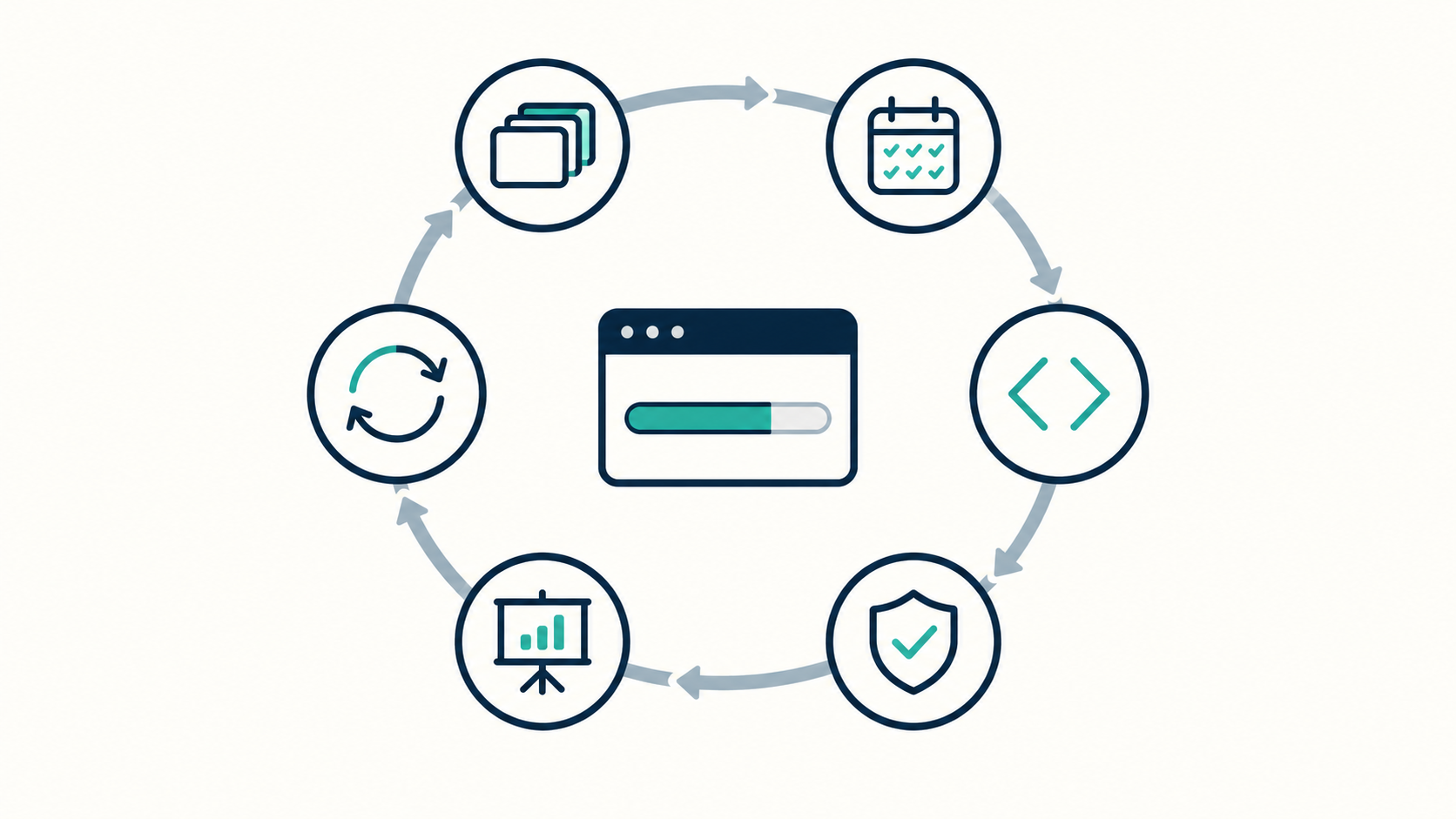
The loop looks much the same across most frameworks, even when the vocabulary changes. You define a product vision, gather and prioritize requirements, build a backlog and break the top items into user stories. Then you plan a sprint, build and test a usable increment, review it with stakeholders, run a retrospective and reprioritize for the next cycle.
Sprints usually run one to four weeks, depending on how mature the team is and how volatile the project is. Daily stand-ups keep work visible, sprint reviews check direction, and retrospectives stop the same friction from coming back.
Stage | What happens | What comes out |
|---|---|---|
Vision and backlog | Goals, users and requirements get captured and ranked | A prioritized product backlog |
Sprint planning | The team picks a realistic slice of work | A sprint goal and sprint backlog |
Build and test | Development and QA run side by side | A usable, tested increment |
Review | Stakeholders see working software | Direct feedback |
Retrospective | The team inspects its own process | One or two concrete changes |
Here's what that looks like in practice. Say you're building an e-commerce platform. Instead of spending six months on the whole thing before anyone touches it, an Agile team ships product browsing first, then user accounts, then checkout, then the advanced features. Every release works, every cycle picks up real usage data, and course corrections happen while they're still cheap.
Core Components of an Agile Development Framework
Seven pieces do most of the work, and each one is simple on paper and easy to get wrong in practice.
Component | What it does | Where it goes wrong |
|---|---|---|
Product backlog | A living, ranked list of features, improvements, technical work and defects | Everything is marked "high priority," so nothing is |
User stories | Describe requirements from the user's point of view | They turn into technical task lists |
Sprint planning | Matches capacity to scope and sets a sprint goal | Teams overcommit to look productive |
Daily stand-ups | Short coordination on progress and blockers | They become status reports for management |
Sprint review | Shows working software to stakeholders | It becomes a slide deck |
Retrospective | Picks one process improvement to test next cycle | No action items, so it's just venting |
Definition of Done | A shared quality bar for every increment | "Done" stays subjective |
A well-written user story looks like this: As a customer, I want to save my payment method so that checkout is faster on future purchases. It covers the who, the what and the why, without dictating the technical solution.
The Definition of Done deserves special attention, because it's the one most teams skip. Without it, a story gets marked done on Friday and fails QA on Monday, and technical debt builds up where nobody is looking.
Why Use an Agile Development Framework?
You see working software earlier. Small increments mean stakeholders react to something real instead of a specification, which is a very different conversation.
Feedback arrives while changes are cheap. A wrong assumption caught in week two costs a few days. The same assumption caught in month six can cost a rewrite.
Progress is visible, not reported. Demos and a shared board replace "it's going well" with something you can actually look at.
Priorities can move without derailing everything. When the market shifts or a customer asks for something new, the backlog gets reordered. The whole plan doesn't get thrown out.
Here's where people get this wrong. They assume Agile fixes broken product ownership, absent stakeholders, unrealistic deadlines or weak engineering habits. It doesn't. It amplifies what's already there. If communication is poor, Agile makes that visible faster. If technical quality gets ignored, velocity becomes an illusion. The framework works when the team treats it as a delivery system, not a performance.
Popular Agile Development Frameworks
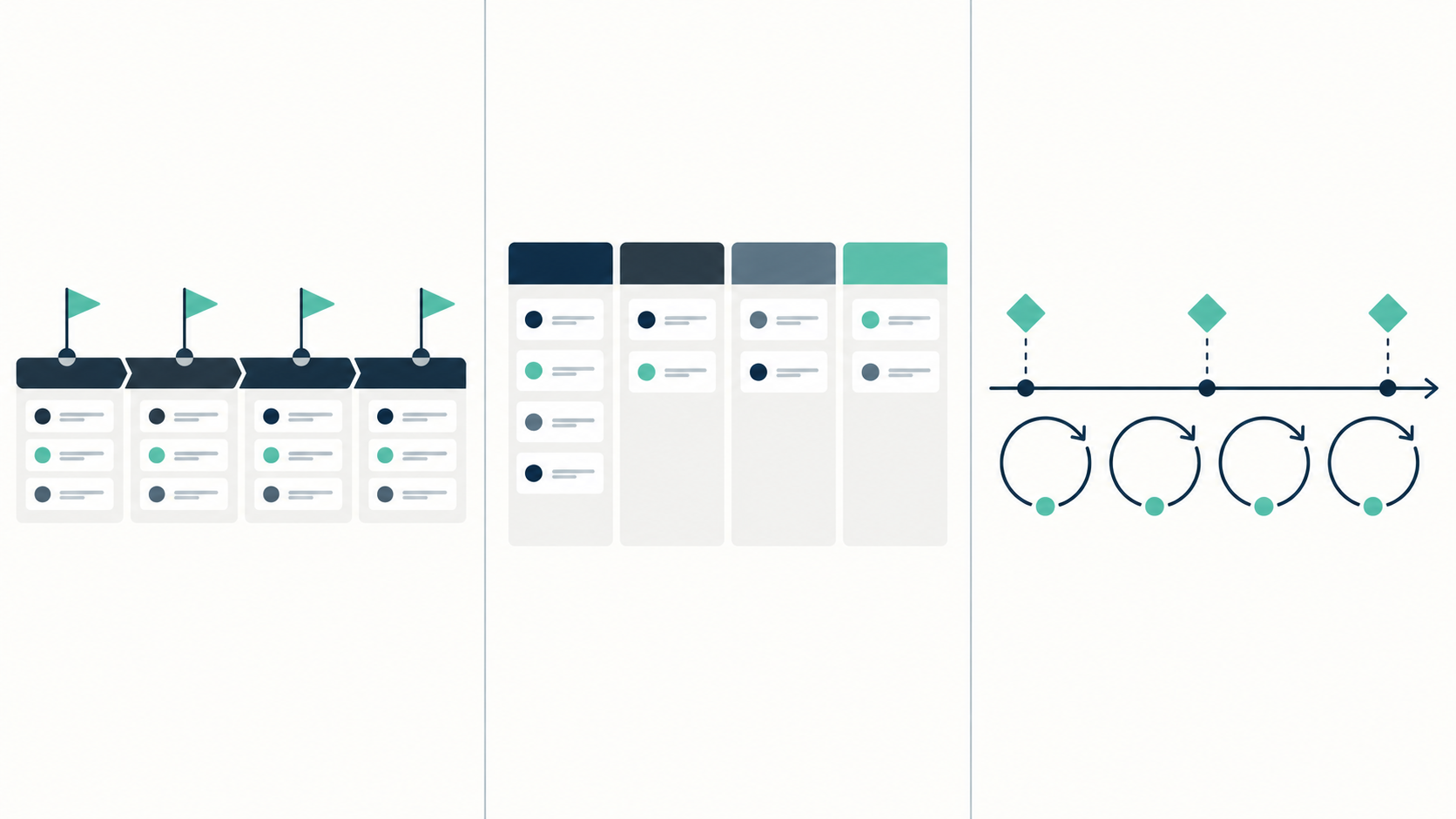
Six frameworks cover most real-world cases, and each has a clear sweet spot and a clear weak spot.
Framework | How it works | Best suited for | Main limitation |
|---|---|---|---|
Scrum | Fixed-length sprints, defined roles, sprint planning, reviews and retrospectives | Product teams building software in regular increments | Can become meeting-heavy or rigid if applied mechanically |
Kanban | Visualizes workflow, limits work in progress, continuous flow | Support teams, maintenance work, unpredictable incoming requests | Less built-in structure for long-term product roadmaps |
Extreme Programming (XP) | Emphasizes engineering practices: automated testing, pair programming, CI | Projects demanding high code quality and rapid technical feedback | Needs strong engineering discipline and cultural buy-in |
Lean development | Focuses on eliminating waste and maximizing customer value | Teams optimizing workflow efficiency and cutting unnecessary work | Hard to apply without reliable process measurements and baseline data |
SAFe | Coordinates Agile practices across multiple teams and organizational layers | Large enterprises with complex cross-team dependencies | Adds significant process and governance overhead |
Hybrid Agile | Blends iterative delivery with selected predictive planning practices | Regulated, enterprise or multi-vendor projects with fixed milestones | Needs clearly defined responsibilities and governance boundaries |
Scrum is still the default most teams reach for, and for product work with a steady rhythm that's usually fine. The trouble starts when it gets applied mechanically. Scrum, Kanban and SAFe aren't competing religions. They're different tools for different shapes of work, and the mistake isn't picking the "wrong" one in some absolute sense. It's using a framework built for predictable product increments on a team drowning in unplanned support tickets, or the other way round.
How to Choose the Right Agile Project Management Framework
Start with how your work arrives. That one question settles most of the decision.
Choose Scrum when your team can work in defined sprints, the product benefits from regular stakeholder review, and a product owner can actively prioritize the backlog. Choose Kanban when work arrives continuously, priorities shift often, the team handles support or operational requests, and limiting work in progress matters more than fixed timeboxes. Choose a hybrid model when you have fixed compliance or contractual milestones, several vendors or departments involved, and some phases that need predictive planning, but the developers still need iterative delivery and feedback loops. And consider scaled Agile only when several teams build one product, dependencies are significant and cross-team governance is mandatory.
Here's a quick scenario, and it's illustrative, not a real client. Picture a six-person team running two-week sprints while a support queue lands on them every day. By Wednesday the sprint plan is already wrecked. That team doesn't have a discipline problem. It has Kanban-shaped work trapped in a Scrum setup, and moving to Kanban with a work-in-progress limit usually calms things down faster than any amount of "better estimating."
A simple rule of thumb: if your team delivers planned product increments, start with Scrum. If work arrives continuously, lean toward Kanban. If you're balancing fixed governance requirements with iterative delivery, use a hybrid Agile model.
Agile Project Planning: What to Plan and When
This is the most misunderstood part of Agile, and the myth that Agile means no planning probably sinks more projects than any technical problem. Agile planning is progressive, not absent. You make broad plans for the far future and detailed plans for the near term.
Product planning defines the vision, business goals, target users and success metrics. Release planning decides which capabilities ship in the first milestone. Roadmap planning connects major goals to a sequence of initiatives while leaving room to reprioritize. Sprint planning picks the specific backlog items for the next iteration, and daily planning coordinates immediate work and clears blockers.
That isn't indecision. It's risk management. Detailed plans for work six months away go stale before anyone starts them, and the team has spent real effort on guesses.
The practical test is simple. Can everyone on the team say what the next two weeks look like, and roughly what the next quarter is aiming for? If yes, your planning is working. If the answer to the first part is vague, you're improvising. If the answer to the second is vague, you're drifting.
Agile Project Management Methodology vs Agile Development Methodology
They overlap, but they answer different questions, and a successful project needs both.
Agile project management methodology covers scope prioritization, timelines and milestones, resource planning, risk management, stakeholder communication, progress tracking and release planning. It answers: What should we deliver, when, and why?
Agile software development methodology covers turning requirements into stories, coding standards, testing strategies, continuous integration, technical quality and software releases. It answers: How do we build and validate it reliably?
Project management keeps the team aligned on business outcomes and delivery windows. The development process makes sure the software gets built, tested and shipped without collapsing under its own complexity. A team strong on one and weak on the other usually shows it quickly, either as a beautifully tracked project that ships unreliable software or as excellent code that nobody can plan around.
Agile Development Process From Idea to Release
The process moves through eight stages, and the last one feeds straight back into the first.
It starts with discovery, where you identify users, business objectives, pain points, technical risks and measurable success criteria. Backlog creation turns requirements into epics, features, user stories and technical tasks, and prioritization ranks them by customer value, revenue potential, urgency, complexity, dependencies and risk.
Then comes iterative development, where the team builds a small, usable slice each cycle, with continuous testing running alongside it: automated tests, manual checks and performance checks inside the sprint, not after it. Stakeholder review shows working software and shapes the next backlog. Release and monitoring deploys the validated increment and tracks real usage. Finally, continuous improvement uses retrospectives, customer feedback and delivery metrics to adjust the next cycle.
Incremental delivery beats big-bang releases almost every time. For early-stage products, that usually starts with scoping an MVP for a startup. The process also changes as the product does, so what worked in month one may need adjusting by month six. Teams that treat their process as fixed tend to be the ones saying "Agile isn't working for us."
Measuring Progress and Quality in Agile
Good measurement in Agile is about outcomes and trends, not individual output.
The Definition of Done is your first quality gate, covering code review, passing tests, updated documentation and met acceptance criteria. Beyond that, most teams track a small set of signals: how much planned work gets finished each sprint, how long items take to move from started to released, how many defects escape into production, and how often stakeholders actually see working software.
The most common trap is using velocity as a performance target. Velocity is a planning tool. It helps a team estimate how much it can take on, and the moment it becomes a number to hit, people start inflating estimates or cutting corners on testing. You get a pretty chart and worse software.
Measuring individual developer output has the same problem, and it works against collaboration. Agile delivers as a team or not at all. If a metric makes people protect their own numbers instead of helping each other, drop it.
Common Agile Implementation Mistakes
Most failures come from a short list of repeat offenders, and almost none of them are the framework's fault.
Teams treat Agile as a fixed set of meetings instead of a delivery system. They start development without a clear product goal, let the backlog become an unprioritized dumping ground, and overcommit in sprint planning to "look productive." Priorities change mid-sprint so often that focus and predictability disappear.
On the engineering side, testing gets pushed to the end of the sprint, which guarantees carryover. Retrospectives happen without a single improvement being implemented. Technical debt gets ignored until it paralyzes delivery. And teams build in isolation, with no real user or stakeholder feedback, then wonder why the demo falls flat.
One more worth naming: forcing Scrum ceremonies onto a team that actually needs Kanban. It looks like a discipline problem, and it usually isn't.
Most of these are habit failures, and habits can change. Pick the one that sounds most familiar and fix it next sprint.
When an Agile Development Framework Is NOT the Best Choice
Agile is a strong default, but it isn't a universal answer.
Projects with a genuinely fixed scope, a fixed price and a stable specification, such as a small one-off migration or a well-understood integration, often don't need sprint ceremonies at all. A clear plan and a straightforward build can be cheaper and faster.
It also struggles where stakeholders can't engage. Agile depends on regular feedback, and if nobody with decision-making power can review work every couple of weeks, you've kept the ceremonies and lost the point. The same goes for organizations that want the flexibility of Agile but won't change fixed-deadline, fixed-scope commitments they've already made.
Heavily regulated environments can use Agile, and many do, but usually through a hybrid model with documented approvals and predictable milestones. Forcing a pure Scrum setup there tends to cause friction. And very large programs can become buried in coordination if a scaled framework gets adopted before it's needed.
Agile vs Waterfall: How the Two Compare
Factor | Agile | Waterfall |
|---|---|---|
Requirements | Evolve as the team learns | Defined up front |
Delivery | Small, working increments | One main release near the end |
Stakeholder involvement | Continuous | Mostly at the start and end |
Handling change | Expected and planned for | Costly once a phase is done |
Best fit | Uncertain or changing products | Stable scope, fixed contracts |
Neither is categorically better. The right choice depends on how well you understand the problem up front and how much it's likely to change. Many real projects end up somewhere in between, which is exactly why hybrid models exist.
Do You Need an In-House Team, a Freelancer or a Development Partner?
This is often the harder question, and it matters more than the framework debate.
An in-house team gives you the most control and the deepest product knowledge, but it's the slowest and most expensive to build. A freelancer works well for a small, bounded task and is risky for anything you'll need to maintain and extend for years. A development partner, whether local or offshore, sits in between, giving you a team that's already used to working in sprints. If you're weighing that route, our breakdown of what offshore development services cost in 2026 covers rates, team structures and the hidden costs people miss. Looking at India specifically? Read why companies outsource software development to India and how to hire a software development partner in India. For a broader look at the options, our hiring resources compare the models side by side. And if your project runs on a JavaScript stack, our guide on when to hire a Node.js developer shows when a specialist is worth the extra cost.
For US startups, SaaS companies, SMBs and enterprises, Agile also works as a risk-reduction strategy. Markets move fast, funding cycles are tight and user expectations reset constantly. A good framework gives you faster validation of ideas, more predictable communication with partners and clearer visibility into progress, and it supports distributed teams while surfacing technical risks earlier.
Whichever model you pick, there's no universally right answer. Anyone claiming otherwise is probably selling something. What matters is whether the team can show you how it actually works.
What to Look for When You Hire an Agile Software Development Partner
Look for evidence of a working process, not the vocabulary.
A lot of general vetting advice carries over here, and we've covered it in detail in our guide on how to vet developers in 2026. But Agile adds a few specific tells.
Ask how sprint goals are defined and measured, and who owns backlog prioritization and how often it's refined. Ask how frequently you'll see working demos, which tools track progress and who has access to them. Ask how scope changes get handled mid-cycle, and what QA and testing happens inside each sprint instead of after it. Then ask how documentation is kept up without slowing delivery, and what happens after the first release: handoff, support or continued iteration.
Teams that can answer these clearly usually run mature Agile processes. Teams that deflect or fall back on vague promises usually don't. Listen for specifics, like "we demo every second Thursday," not "we're very transparent."
What This Looks Like With Toadster
Most of the Agile work we take on falls into a fairly consistent pattern: either a new product that needs a delivery rhythm set up correctly from the start, or an existing project that adopted the ceremonies without the substance and is running into the problems above.
The starting point is always the same. We work out how the work will actually arrive, who can review it and how often, and whether the project has compliance or contract constraints, before choosing between Scrum, Kanban or a hybrid. The framework follows the project, not the other way around.
If you want a partner that structures delivery this way from day one, our Agile software development services are built around exactly this workflow: transparent sprints, continuous testing and stakeholder reviews in every cycle. And if you need to add developers to an existing team, you can hire software developers who are used to working in sprints. To discuss your project, contact us.
Closing Thought
The real question was never "Scrum or Kanban" in the abstract. It's whether your work, your stakeholders and your constraints match the framework you're about to adopt, and whether the people running it understand it well enough to adapt it when reality pushes back.
Get both of those right, and an agile development framework stops being a process you follow and becomes a way of finding out what to build next.
If you're trying to work out which approach fits your project, or whether your current setup is helping or slowing you down, we're happy to talk it through. Tell us what you're building, how your work arrives and who can review it, and we'll give you an honest view of the framework that fits.