
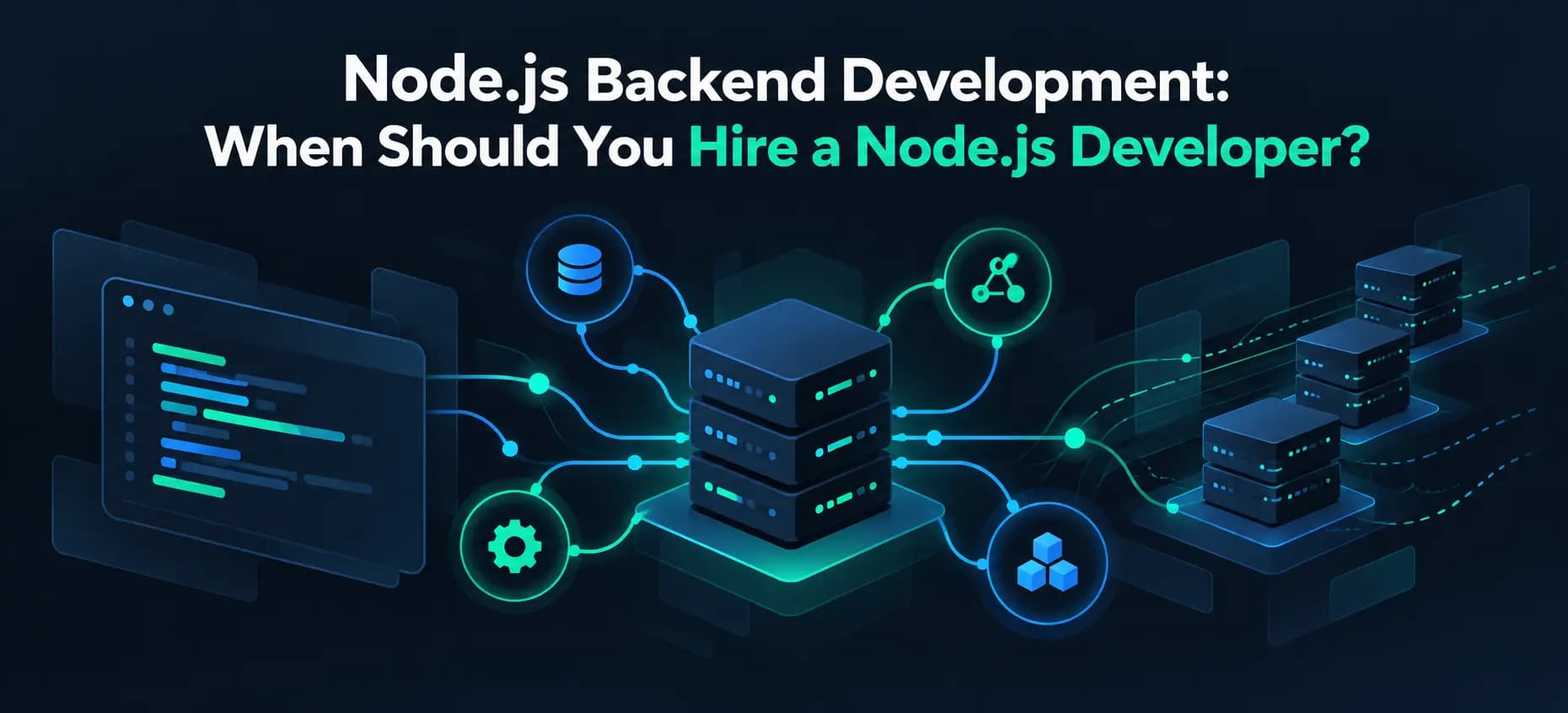
Node.js Backend Development: When Should You Hire a Node.js Developer?
Most teams land on Node.js for one of two bad reasons: "our frontend devs already know JavaScript" or "it's what the last developer used." Neither is wrong, exactly — but neither is a real technical decision either. Node.js backend development has genuine, specific strengths. It also has genuine, specific limits. Knowing which side of that line your project falls on matters a lot more than knowing that Node.js is popular.
This matters even more once you're hiring. A generalist who's "used Node a bit" and a developer who actually understands its event loop, async patterns, and scaling behavior will build very different backends from the same spec — one of them will hold up under real traffic, and one of them might not. Figuring out which one your project needs is really the second half of this decision, right after figuring out if Node.js is the right fit at all.
This piece covers how a Node.js backend actually works, which frameworks fit which jobs, where Node.js clearly wins, where it clearly doesn't, and — since this is also a hiring decision — how to tell when it's time to bring in a dedicated Node.js developer instead of leaving it to whoever's available.
Quick answer: Node.js backend development means building server-side applications and APIs using Node.js — a JavaScript runtime built for handling many concurrent operations efficiently through a non-blocking, event-driven model. It's an excellent fit for real-time features (chat, live dashboards, notifications), high-concurrency APIs, and microservices, especially when a team wants to share JavaScript or TypeScript across frontend and backend. It's a weaker fit for CPU-heavy workloads like video processing or complex data computation, where languages built around multi-threading handle the load more naturally. You should hire a dedicated Node.js developer once your project involves real concurrency, real-time behavior, or production-scale API traffic — a simple CRUD app usually doesn't need one, but anything beyond that benefits from someone who understands the event loop deeply, not just the syntax.
What Is Node.js Backend Development?
Let's clear up something people mix up constantly: Node.js is not a framework. It's a JavaScript runtime — built on Chrome's V8 engine — that lets JavaScript escape the browser and run on a server instead. That's it. That's the whole trick. Once you can run JS server-side, "Node.js backend development" just means building the actual server logic on top of it, usually with help from a framework like Express, NestJS, or Fastify, to handle things like APIs, authentication, database calls, and whatever business rules your app needs.
Here's the part that actually gets people excited, and for once, the hype is earned: one language, both ends of the stack. Your frontend team writes JavaScript. Your backend team writes JavaScript (or, these days, TypeScript — more on that in a second). Suddenly validation logic, type definitions, even entire utility functions can be shared instead of rewritten twice. It sounds like a small thing until you're the developer who used to maintain the same date-formatting function in two languages and now doesn't have to.
Quick aside on TypeScript, because skipping it would be dishonest: almost nobody's shipping plain JavaScript on serious Node backends anymore. TypeScript's added type-checking catches a whole category of "wait, why is this undefined" bugs before they ever reach production. It's not a silver bullet, and it won't save you from bad architecture — but if you're evaluating Node.js in 2026, assume TypeScript is part of the deal, not an optional add-on.
How Does a Node.js Backend Work?
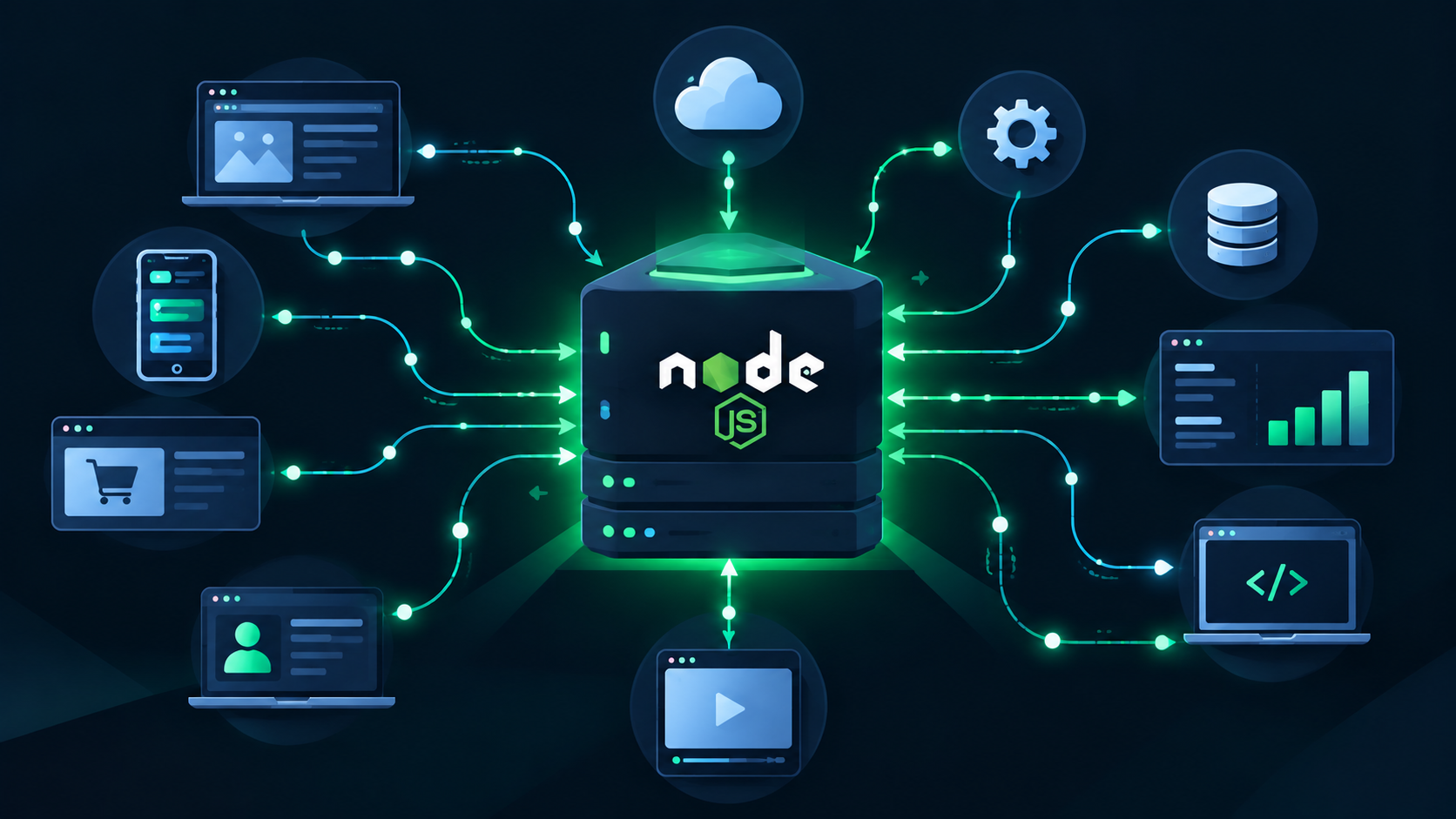
Here's the thing that actually makes Node different — not trendy, not "modern," just mechanically different from most other backend languages: the event loop.
Node runs on a single thread by default. Say that to someone who's never used it and they'll assume it's a weakness. It's not — it's the whole point. Instead of locking that one thread up while it waits on a slow database query or a sluggish third-party API, Node hands the task off, moves on to the next request, and circles back once the slow thing is actually done. Nothing sits around twiddling its thumbs. That's what people mean when they say Node is "non-blocking" — it's not doing more work, it's just refusing to waste time waiting.
Compare that to the old-school thread-per-request approach, where every incoming connection gets its own dedicated thread. That model's fine right up until it isn't — somewhere around a few thousand concurrent connections, the memory and CPU overhead of juggling all those threads starts to add up fast, and performance degrades in a way that's annoying to diagnose and expensive to fix. Node sidesteps that problem entirely by never spinning up all those threads in the first place. One thread, handling a lot of waiting, very efficiently.
This is also, worth saying now, where Node's limits start to show — if the "waiting" is actually "computing," the event loop stops helping you. We'll get to that later. For now, just know this: Node's single thread is a deliberate design choice, not a corner someone cut.
Layer | Role |
|---|---|
Frontend / Client | Where the user interacts with the application |
API Layer | Receives and routes incoming requests |
Node.js Backend (Event Loop) | Processes logic without blocking on slow operations |
Database / Cache / External APIs | Supplies and stores data, handles third-party calls |
Cloud Infrastructure | Hosts, scales, and monitors the running application |
Why Use Node.js for Backend Development?
One language, less context-switching. A team that already builds its frontend in JavaScript or TypeScript can use the same language on the backend, which reduces the mental overhead of jumping between syntaxes and occasionally allows shared types or validation logic across both layers.
Non-blocking I/O handles concurrency well. For workloads that are mostly about waiting on other systems — API calls, database queries, file operations — rather than heavy computation, Node's event loop lets a single process serve a large number of simultaneous connections efficiently.
The npm ecosystem is enormous. Node has access to the largest package ecosystem of any backend language, which is a genuine productivity advantage. It's also a real caveat worth naming now rather than later: more packages means a larger dependency surface to manage and secure, and that gets its own attention in the security section below.
Real-time features are a natural fit. WebSockets and similar persistent-connection patterns pair unusually well with Node's architecture — enough that it gets its own section further down.
Here's where people get this wrong fairly often: teams pick Node.js because "the frontend team already knows JavaScript," not because the workload is actually I/O-heavy or concurrency-driven. That's a people-convenience reason, not an architecture reason, and it can work out fine for simple apps — but it stops working once the app needs to handle real concurrency or real-time behavior, and nobody on the team actually understands why Node behaves the way it does under load.
Node.js Backend Frameworks: Express vs NestJS vs Fastify
Framework | Best suited for |
|---|---|
Express | Small-to-mid APIs, teams wanting full control and minimal structure, the most widely used Node framework with the largest community |
NestJS | Larger, structured applications — TypeScript-first, Angular-inspired architecture with modules and decorators, strong fit for enterprise-style teams that need enforced convention |
Fastify | High-throughput APIs where raw performance matters, lower overhead than Express |
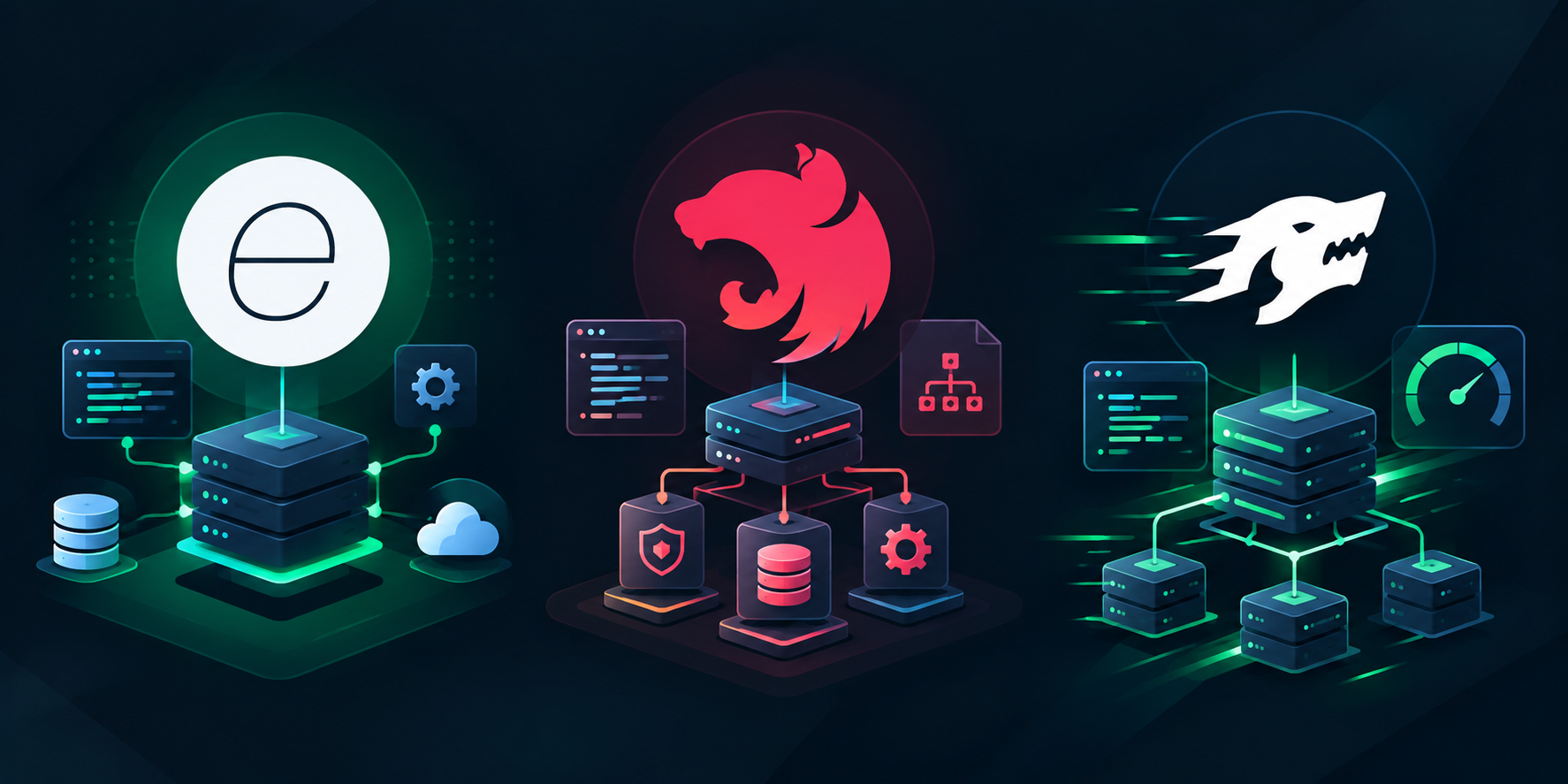
Express is still the default a lot of teams reach for, and for smaller APIs that's usually fine — it's flexible and well documented. But that flexibility becomes a liability on larger, multi-team projects without enforced structure; this is where people get it wrong, choosing Express by default for an enterprise-scale application that would actually benefit more from NestJS's opinionated, enforced architecture. Fastify sits in a narrower lane — pick it specifically when benchmark-level performance matters more than ecosystem size.
When Should You Choose Node.js for Backend Development?
Node.js tends to be the right call for real-time applications like chat systems, live notifications, collaborative tools, or live dashboards, and for APIs that need to serve multiple clients — web, mobile, and partner integrations — from one backend, which is a big part of why it shows up so often in SaaS application development. It also fits microservices architectures well, since Node processes start quickly and stay lightweight, and it's a strong choice for streaming data applications and generally I/O-heavy systems that spend more time waiting on databases and external APIs than doing heavy computation. Startups that want one language across the entire stack, with a smaller team moving fast, also tend to benefit — particularly when building an MVP, where shipping speed matters more than squeezing out every last millisecond of throughput.
Node.js for Real-Time and Event-Driven Applications
This is Node's clearest, most defensible strength, and it deserves its own section rather than a bullet point.
WebSockets and libraries like Socket.io enable persistent, two-way connections between client and server — the kind of connection a chat application, a live tracking feature, a collaborative editing tool, or a live trading-style dashboard needs. A traditional request-response model, where the client asks and the server answers and the connection closes, doesn't fit that pattern well. A persistent connection does, and Node's event loop is built to handle a large number of those open connections at once without the overhead of spinning up a thread for each one.
This is the point in the article worth being direct about: if real-time or event-driven behavior is a core requirement of your product, Node.js is one of the strongest backend choices available right now — not "a fine option," genuinely one of the strongest. That confidence doesn't carry over to every use case, but it's earned here specifically.
Node.js Backend Database Options
Database | Best For |
|---|---|
PostgreSQL | Strong relational default; works well with Node via Prisma, Sequelize, or TypeORM |
MongoDB | Document-based, JSON-native data that maps naturally to JavaScript objects; very common Node pairing |
MySQL | Solid, widely supported relational alternative |
Redis | Caching and session storage, paired alongside a primary database rather than used as one |
MongoDB plus Node.js is the pairing most tutorials push — it's the M and the N in the MERN stack, and if your frontend runs React, MERN stack developers are a common way to staff the whole thing with one skill set. The pairing works largely because JSON documents map so cleanly onto JavaScript objects. That doesn't make it automatically correct, though. Data that's genuinely relational — with real structure, constraints, and relationships between entities — often still belongs in PostgreSQL, regardless of which backend language is writing the queries. Worth deciding based on the shape of the data, not the perceived convenience of matching formats.
Building APIs with Node.js
Node.js handles both REST and GraphQL well, and its GraphQL ecosystem — particularly Apollo Server — is genuinely mature if your API needs flexible, client-driven queries rather than fixed REST endpoints.
Beyond that choice, the same production fundamentals apply as with any backend: authentication handled through JWTs, OAuth2, or sessions depending on the use case; request validation enforced consistently through middleware (libraries like Zod or Joi are common in the Node ecosystem); centralized error handling so failures return a predictable shape instead of scattered try/catch logic across routes; API versioning built in from the start rather than retrofitted later; and rate limiting on any endpoint that's publicly reachable or computationally expensive.
How to Build a Scalable Node.js Backend
The single most important thing to understand about scaling Node.js is also its biggest limitation: Node runs on one thread by default, so CPU-intensive work blocks that thread and slows everything else down until it finishes. Scaling a Node backend well means designing around that constraint rather than ignoring it.
In practice, that means using clustering, worker threads, or process managers like PM2 to run multiple Node processes and actually use multiple CPU cores. It means caching with Redis in front of expensive or frequently repeated operations, and offloading heavy or slow background work to message queues like BullMQ or RabbitMQ instead of processing it inline. Horizontal scaling behind a load balancer handles traffic growth more reliably than trying to make a single instance do more. Database optimization — indexing, connection pooling — still matters as much here as in any other stack. And containerized deployment through Docker, combined with proper logging, tracing, and monitoring, makes scaling and debugging predictable rather than reactive. Node doesn't get a pass on observability just because it's fast to write.
This is also the point where DevOps engineers start earning their keep — clustering, containers, and observability are as much infrastructure problems as code problems, and a Node.js developer who's great at writing handlers isn't automatically great at running them in production.
Node.js Backend Security Checklist
Authentication and authorization should be treated as separate concerns — confirming who a user is doesn't automatically determine what they're allowed to do. Input validation needs to run on every endpoint accepting user data, not just the obviously risky ones. Secrets — API keys, database credentials, tokens — belong in environment variables or a secrets manager, never committed to source control.
Dependency security deserves extra weight specifically in the Node ecosystem. npm's package ecosystem is enormous and loosely vetted compared to some other languages, and it's easy for a project to accumulate dozens of dependencies — including transitive ones nobody on the team chose directly — without anyone tracking their security status. Regular dependency audits matter more here than in most other backend ecosystems. Beyond that: rate limiting and CORS configuration on public endpoints, and logging practices that capture enough detail to investigate incidents without leaking sensitive data into logs themselves.
When Node.js Is NOT the Best Backend Choice
CPU-intensive workloads are Node's clearest weak spot. Video processing, heavy data science computation, complex image manipulation — anything that spends most of its time computing rather than waiting — runs into that single-threaded constraint directly. Languages built around genuine multi-threading, or Python with multiprocessing for data-heavy work, typically handle this better.
Teams building products that are deeply integrated with AI and machine learning pipelines also tend to find Python's ecosystem a more natural fit for that specific layer of the stack, even if the rest of the application runs on Node. In practice, that usually looks like a Node.js backend handling the API and real-time side, with dedicated AI/ML developers working in Python on the model and data side — two runtimes, each doing what it's good at, rather than forcing everything through one.
And very large, long-lived enterprise systems where strict typing and rigid architectural conventions are an organizational requirement can absolutely be built in Node — especially with NestJS and TypeScript — but a team already standardized on Java or .NET may get more value from staying consistent than switching for a single new service.
Node.js vs Python for Backend Development
Factor | Node.js | Python |
|---|---|---|
Concurrency / real-time workloads | Strong advantage | Workable, not the default strength |
AI/ML and data-heavy ecosystem | Weaker, often calls out to Python services | Strong, industry-standard tooling |
Typical CRUD/API development speed | Fast | Fast |
Talent availability | Strong, broad pool | Strong, broad pool |
Shared language with frontend | Unique advantage (JS/TypeScript both sides) | Not applicable |
Neither one is categorically "better" — the right choice depends on whether your workload leans toward concurrency and real-time behavior, or toward data processing and AI integration.
Do You Need a Full-Time Node.js Developer, a Generalist, or an Agency?
This is usually the harder question, and it's often more important than the framework debate.
A generalist full-stack developer is genuinely enough for a simple CRUD application, low concurrency, no real-time features, a small user base, and a short timeline. There's no need to overcomplicate a straightforward build by insisting on deep Node.js specialization nobody will actually use.
The signals that point toward a dedicated Node.js specialist look different: real-time features already in the spec, high-concurrency APIs, a microservices architecture, performance problems that have already started surfacing, or a need for someone who genuinely understands async patterns and the event loop rather than someone who can write working Express routes without fully knowing why they work. A specialist costs more per hour, but the alternative — a generalist-built Node backend that hits concurrency or scaling limits it was never designed around — tends to cost more later, in re-architecture.
Whether that specialist sits in-house, comes in through outsourcing, or is sourced through an agency depends on internal capacity, timeline, and how central backend performance is to the product. There's no universally right answer here, and anyone claiming otherwise is probably selling something. If you're still working through that decision, our hiring resources walk through the tradeoffs in more depth.
What to Look for When You Hire a Node.js Developer
A lot of general developer-vetting advice carries over here — we've covered how to vet full-stack developers separately — but Node.js has a few specific tells worth checking for.
Framework familiarity is the easy part to check and, honestly, the least important. What matters more is real experience with async patterns and the event loop — ask how they'd handle a slow external API call inside a high-traffic endpoint, and listen for whether they actually understand why it matters, not just what code to write.
Look for framework depth that matches your actual use case: Express experience for flexible, lighter builds; NestJS experience for larger, structured applications; Fastify experience if raw throughput is the priority. If your use case involves real-time or high-concurrency work, ask to see it in their portfolio specifically — generic CRUD app examples won't tell you much about how they'll handle your actual problem. Testing discipline matters too; working code and well-tested code are not the same thing. And for anything involving scale, ask directly about their experience with clustering, queues, and caching — this is usually where the gap between junior and senior Node.js developers shows up most clearly. If you're outsourcing the work, their communication process and code review habits matter almost as much as their technical skill.
What This Looks Like With Toadster
Most of the Node.js backend development work we take on falls into a fairly consistent pattern: either a product with a genuine concurrency or real-time requirement that needs to be architected correctly from the start, or an existing Node backend that was built quickly by a generalist and is now hitting the scaling limits nobody planned around early on.
The starting point is always the same — understanding whether the workload actually fits Node's strengths before assuming it does, then matching the framework and architecture to what the product needs over the next year or two, not just what's fastest to set up today.
If your project's concurrency, real-time requirements, or API load suggest it's time to bring in someone who works in this specifically, you can hire a Node.js developer through our team. For projects that need broader stack coverage alongside Node — a different backend language, additional frontend work, or a mixed-stack team — our broader software developer hiring options cover that as well.
Closing Thought
The real question was never "Node.js or something else" in the abstract — it's whether your project's concurrency and real-time demands actually match what Node.js is built for, and whether the person building it understands that model well enough to use it properly. Get both of those right, and Node.js tends to be a genuinely strong choice, not just a popular one.