
Fintech AI Solutions: Use Cases, Costs, and Implementation Guide
A payment company wants to flag suspicious transactions without declining legitimate purchases. A lending platform needs faster application review while preserving fair and explainable credit decisions. A fintech support team wants faster answers, but its assistant must never expose another customer's account information. These organizations could all invest in artificial intelligence, yet each needs a different design, level of oversight and success measure.
The difficulty with choosing fintech AI solutions is not identifying possible applications. It is deciding which workflow deserves investment, whether rules, predictive models or generative AI are appropriate, and whether the result can be safely integrated with financial systems. For payments, lending and financial operations leaders, those questions should be answered before selecting a vendor or assigning a project budget.
This guide compares seven practical use cases and explains implementation architecture, build-versus-buy choices, cost ownership, regulatory considerations and measurable results. The examples are illustrative unless a cited source explicitly supports a factual claim.
What Are Fintech AI Solutions?
Fintech AI solutions are software capabilities that analyze financial information, support decisions or perform controlled operations within payments, lending, banking and financial workflows. They may combine conventional machine learning, deterministic rules, document extraction, generative AI or tool-using agents. These approaches are not interchangeable.
Machine learning can predict fraud risk or estimate credit outcomes from structured data. Intelligent document processing extracts fields from statements and forms, ideally with validation against original documents. Generative AI can help summarize case notes or answer grounded questions. RPA follows a defined workflow and may require no machine-learning model. Agentic systems can coordinate steps and invoke approved tools, but must remain subject to permission boundaries and appropriate human approval.
The useful starting principle is to choose the least complex technology that can reliably meet a defined business requirement at acceptable risk and total cost.
Seven Fintech AI Solutions and Their Business Use Cases
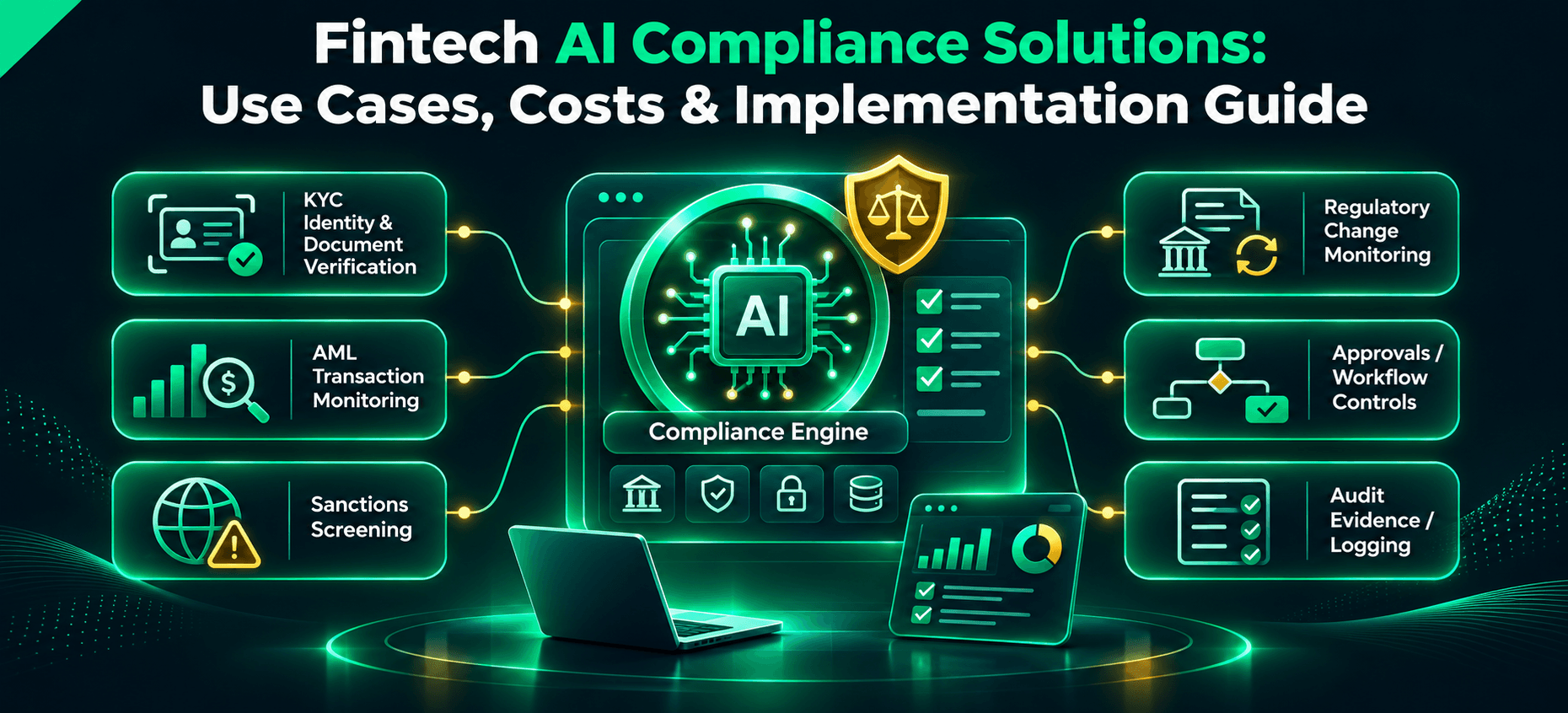
Solution | Starting approach and required inputs | Performance measure | Key risk |
|---|---|---|---|
Fraud detection | ML scoring plus rules; Payment events, labels, permitted context | Fraud loss, false positives and decision latency | False declines and drift |
KYC/AML workflows | Document AI, screening, selective ML; Identity systems, screening data, case tools | Review time, alert quality | False matches and incomplete investigations |
Customer support | Retrieval-grounded LLM with restricted tools; Knowledge base, CRM, authenticated APIs | Verified resolution, escalation accuracy | Unapproved disclosure or action |
Credit scoring | Validated statistical or ML model; Applications, lawful credit data, repayment outcomes | Calibration, risk and fairness | Leakage, discrimination, poor explanations |
Payment reconciliation | Rules and matching with selective ML; Settlement files, ledger and payment identifiers | Accurate auto-match rate | Incorrect or duplicate posting |
Financial document processing | OCR/extraction plus validation; Documents, records systems, review queue | Field-level accuracy and exception rate | Misread values or missing pages |
Forecasting and risk analytics | Time-series models and analytics; Historical financial and operational data | Out-of-time forecast error | Unstable assumptions |
1. AI Fraud Detection and Transaction Monitoring
A fraud-scoring system assesses a payment event against permitted contextual signals, historical outcomes and current patterns. The model should return a risk score and its version; a separate policy layer then determines the action. The distinction matters because a prediction is not authorization to block a transaction or move money.
Consider a hypothetical online payment. The transaction service checks the required fields and retrieves permitted signals. The risk model assigns a score. The policy engine then selects approve, challenge, or queue for review under documented rules. If the model service times out, a pre-approved fallback policy determines whether the payment proceeds, receives a challenge or is held. That choice must fit the business's risk tolerance and payment-rail constraints; automatically approving or denying everything is not a universal safe default.
Reviewers should be able to document overrides. Subsequent fraud outcomes can be compared with model decisions, including false declines, fraud losses, review volume and latency. Because fraud labels can arrive late, teams should not evaluate a new model solely using immediate outcomes. The practical acceptance gate is performance on representative historical and controlled pilot traffic, including operational failure cases.
Inputs: transaction history, reliable outcomes, authorized device or behavioral context, scoring infrastructure and review operations.
Risks: class imbalance, changing patterns, latency, false positives and delayed labels.
KPIs: fraud-loss rate, legitimate approval rate, false-positive rate, time to decision and investigator workload.
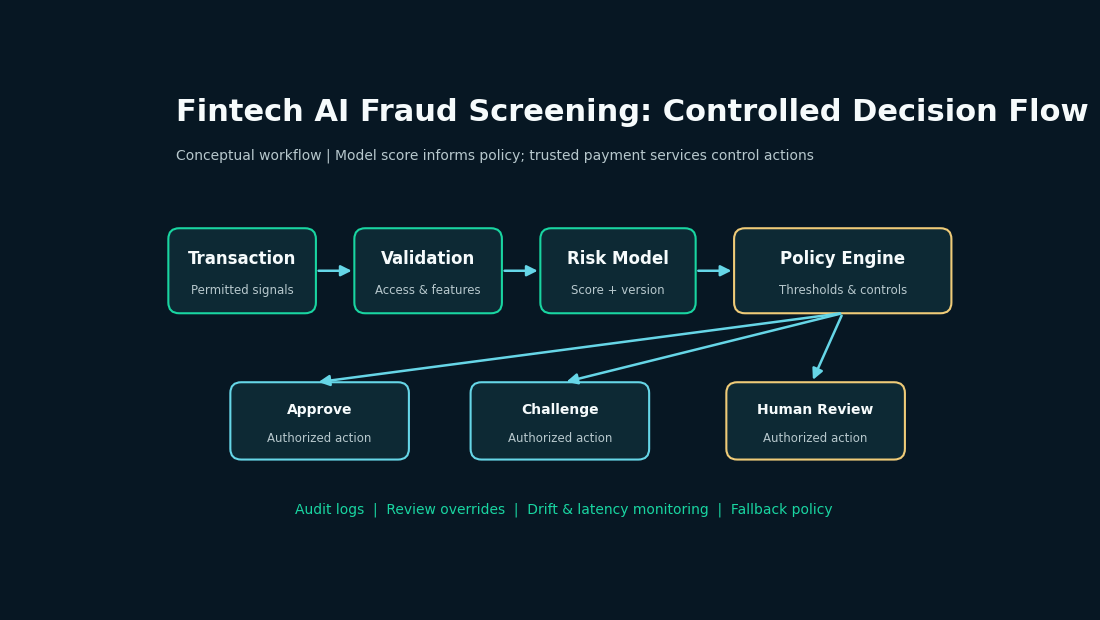
Figure 1. Conceptual workflow. The model informs a trusted policy engine; authorization and audit controls remain outside the model.
2. KYC and AML Workflow Automation
KYC onboarding and AML monitoring overlap operationally, but solve different problems. KYC may involve identifying an applicant, checking document authenticity, validating customer details and handling onboarding exceptions. AML monitoring may involve transaction surveillance, alert triage, investigation and escalation over the customer relationship.
KYC onboarding | AML monitoring |
|---|---|
Identity and customer-information checks | Ongoing transaction surveillance |
Submitted document validation | Alerts and case prioritization |
Onboarding exceptions | Investigation and escalation |
Verification decision documentation | Case evidence and reporting workflow |
AI may extract identity details or summarize an AML case, but a generated summary must not itself decide whether a legal reporting threshold is met. A trained, authorized professional and the institution's policy remain responsible for the review and reporting process. For an initial pilot, test not only throughput but also the quality of flagged exceptions and the completeness of the investigation record.
Inputs: lawful identity and transaction data, screening services, case-management integrations, retention controls and reviewer access.
Risks: false matches, personal-data exposure, omitted evidence and weak auditability.
KPIs: review time, rework, false-alert burden, exception quality and case completeness.
3. AI Customer Support Agents for Financial Services
An AI assistant can explain a card fee, locate a published policy or help an authenticated customer check a payment status. However, the LLM should not be the component that decides whether a customer is allowed to view an account or perform a sensitive action.
A concrete read-only payment-status workflow works as follows. The user authenticates through the institution's normal identity system. The assistant requests an approved getPaymentStatus tool. The backend checks that the session is valid and that the payment belongs to the authenticated account. The backend returns only the minimum authorized fields, such as status and reference, and the assistant explains the result in plain language. A request to reverse the payment is routed to an authorized workflow requiring appropriate confirmation or human review.
For evaluation, test ordinary queries alongside attempts to elicit another customer's data, prompt injection in retrieved content, unavailable tool responses and ambiguous transaction references. Keep sensitive state-changing tools inaccessible unless explicit authorizations and controls exist.
Inputs: curated knowledge, authentication, permission-checked APIs, CRM or ticketing, escalation routes and quality review.
Risks: hallucinated explanations, data leakage, unapproved tool use and weak escalation.
KPIs: verified resolution rate, escalation accuracy, unsafe-response incidents and cost per correctly resolved case.
4. AI Credit Scoring and Underwriting Support
Credit models can support risk assessment, documentation checks and application triage, but must be designed around lawful data, appropriate validation and explainable decisions. Evaluation should use a historical or out-of-time sample that mirrors what was actually known at decision time. If training features accidentally include later repayment or collection information, the reported model quality will be misleading because of data leakage.
Relevant checks include calibration across time, model drift, fairness testing, reason-code quality and comparison with a credible baseline. For applicable US adverse-action decisions, ECOA and Regulation B require sufficiently specific and accurate reasons even when complex algorithms are used. The CFPB's Circular 2022-03 explains that technical complexity does not remove that obligation.
Inputs: application data, permitted credit signals, repayment outcomes, model documentation and decision workflows. Risks: bias, leakage, drift, poor explanation and invalid evaluation. KPIs: calibration, appropriate default-risk measures, time to decision, fairness measures and reasons accuracy.
5. AI-Powered Payment Reconciliation
Reconciliation compares payment events, settlement files and internal ledger records. Begin with deterministic matching when transaction identifiers and amounts permit it. Apply probabilistic matching or ML only to well-defined exception cases where it adds measurable accuracy.
Preserve immutable original transaction identifiers and raw evidence. Use idempotency controls so a retry cannot post a duplicate financial entry. A proposed match should be traceable to the original records, confidence or matching rule, reviewer decision, and any resulting journal action. Ambiguous matches should move into a review queue, and incorrect automated matches must have a documented reversal or correction process.
Inputs: payment and ledger feeds, settlement records, reference identifiers, exception queues and authorized posting services.
Risks: duplicate posting, falsely matched balances and untraceable corrections.
KPIs: accurate automatic match rate, unresolved breaks, exception resolution time and value of unexplained differences.
6. AI Financial Document Processing
Document AI can extract fields from bank statements, invoices, tax forms and lending applications. The engineering objective is not merely reading text; it is producing validated financial facts that the downstream workflow can trust.
A practical extraction pipeline classifies the document, extracts fields and table values, checks their consistency, flags low-confidence or incomplete records, and routes exceptions for review. A summary may help a reviewer understand the content, but financial calculations should reference verified extracted values rather than unsupported generated prose.
Inputs: secure document storage, extraction service, validation rules, reviewers and source traceability.
Risks: missing pages, scan errors, currency confusion and inappropriate data retention.
KPIs: field accuracy, exception rate, correction time and validated processing cost.
7. Financial Forecasting and Risk Analytics
Predictive analytics can support cash-flow planning, transaction volume forecasting, liquidity monitoring or operational demand planning. Start with a baseline model and compare more complex approaches on meaningful data that was unavailable to the training process.
Test forecasts by time horizon and market conditions rather than quoting one average accuracy percentage across every environment. Monitoring should identify structural change, unstable assumptions and differences between prediction and actual results. A forecast is decision support, not a guarantee.
Inputs: relevant time series, historical outcomes, forecast horizons and operating context.
Risks: regime shifts, unstable inputs and misuse of certainty.
KPIs: appropriate forecast error, stability and improvement in the business decision against a baseline.
Which Fintech AI Solution Should Your Business Prioritize?
Select the first project using five factors: business value, data readiness, integration difficulty, decision risk and operational ownership. A useful pilot should have a measurable baseline and a responsible team that can act on its results.
For example, a hypothetical payments startup facing avoidable fraud losses may first examine its processor's existing scoring capability before commissioning a custom model. A lender with inconsistent credit data may need data validation and adverse-action reason controls before increasing model complexity. A finance operations team with a large reconciliation queue may benefit from rules-based matching before deploying ML. These are examples of reasoning, not a universal ranking.
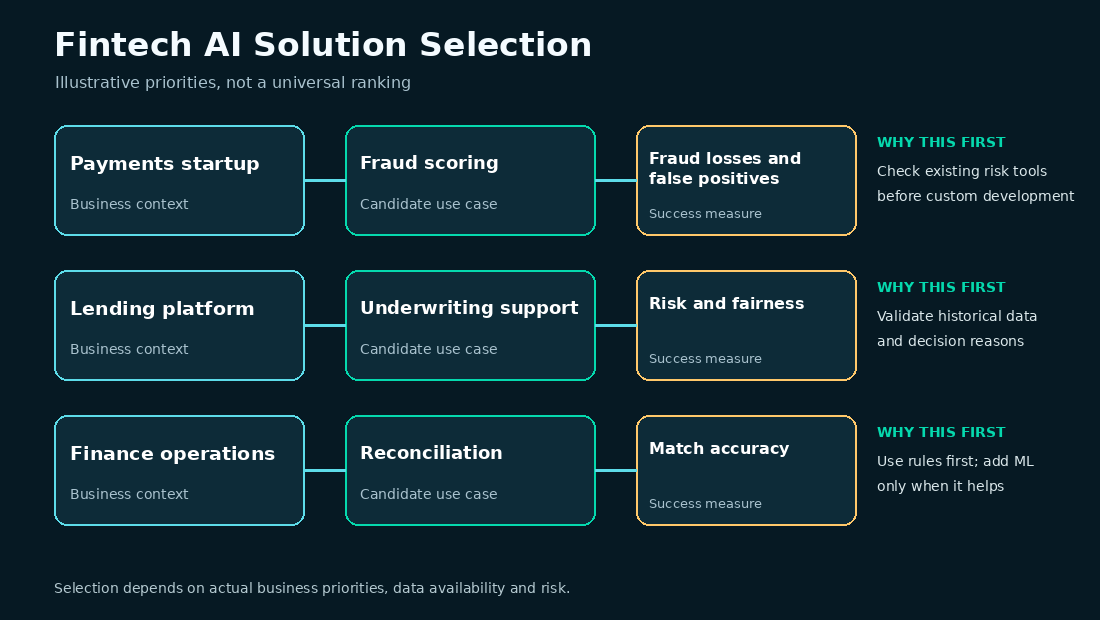
Figure 2. Different business contexts justify different starting projects. The decision is conditional on data, integrations, risk and current capability.
Decision factor | Evidence to request before approving investment |
|---|---|
Business value | Current loss, cost, delay or customer problem, with a measurable baseline |
Data readiness | Data rights, lineage, quality, representativeness and missing fields |
Integration | System owner, API availability, latency limits and failure behavior |
Decision risk | Harm if the output is wrong, approval boundary and recovery plan |
Ownership | Named reviewers, monitoring operator, budget owner and escalation contact |
How Fintech AI Solutions Work: Architecture and Integrations
A production AI capability usually sits between controlled data sources and trusted business applications. Its predictions or generated text must be evaluated by a service layer that applies permissions, policies and approval requirements. For transaction screening, the architecture is: payment event → validated features → model score → trusted policy engine → approve, challenge or review. An audit stream records relevant model and policy versions, overrides and eventual outcomes.
Real-time constraints: Payment-related decisions often have strict time budgets. Define an approved maximum scoring duration, timeout handling, degraded-mode controls and service reliability targets before deployment. Do not let a stalled model silently block an entire transaction pipeline or bypass required checks.
Decision logging: Record correlation IDs, authorization context where appropriate, model and policy versions, score bands, chosen action, reviewer override and subsequent feedback, subject to privacy and retention rules. Separate sensitive raw data from diagnostic logs and restrict access to both.
Agentic workflows: A dispute investigation assistant may retrieve evidence, summarize competing records and propose next steps. Read-only retrieval can be automated within permissions; issuing refunds, updating account ownership or submitting reports needs an explicitly authorized workflow. This distinction matters more than whether the interface is called an agent.
Build vs Buy vs Integrate: Which Approach Is Better?
Approach | Most appropriate when | Important trade-off |
|---|---|---|
Buy existing software | Workflow is standardized and product fit is good | Licensing, customization and vendor dependence |
Integrate a third-party API | Narrow capability can be added to an existing platform | Per-use fees, privacy and availability dependence |
Build custom AI | Proprietary risk logic or specialized integrations justify ownership | Engineering, validation and continued maintenance |
Hybrid | Commodity services plus institution-specific policy or workflow | Additional orchestration and accountability |
Before buying or integrating, ask for evidence of data portability, audit-log access, operating availability, incident escalation, provider and model changes, data retention and deletion, contract termination, and safe export of work product. Check what happens to your application if a vendor retires a model or changes an endpoint. A well-designed system should isolate providers behind an integration interface where practical.
Custom development is justified only when its extra control or differentiation outweighs the burden of operating it. See software development services when assessing custom platform or integration requirements.
How Much Do Fintech AI Solutions Cost?
A fintech AI budget includes data preparation, workflow engineering, integration, testing, security and evaluation, plus ongoing model/API usage, monitoring, human review and maintenance. Estimates from one vendor or use case should not be presented as universal fintech pricing.
Illustrative Implementation Cost Plus 12 Months of Operations
The following is a hypothetical support-agent example, not a surveyed benchmark or a company quotation. The model assumes the initial implementation is completed before the twelve-month operating period begins. Accordingly, $72,400 is the sum of initial build costs and one full post-launch operating year, not necessarily cash spent in the first twelve calendar months from project kickoff.
Cost component | Assumption | Amount |
|---|---|---|
Discovery and knowledge preparation | One-time | $8,000 |
Application and workflow integration | One-time | $24,000 |
Security testing and pre-launch evaluation | One-time | $8,000 |
AI inference/API charges | $600/month × 12 | $7,200 |
Hosting and monitoring | $350/month × 12 | $4,200 |
Human post-launch quality review | $1,000/month × 12 | $12,000 |
Maintenance and updates | $750/month × 12 | $9,000 |
Implementation plus 12 months of operations | $40,000 + $32,400 | $72,400 |
The $8,000 security and evaluation line includes pre-launch testing and pilot checks. The separate $12,000 human-review allowance covers post-launch conversation sampling, exception review and quality monitoring only. This separation avoids assuming the same review work is purchased twice. The example excludes acquisition, taxes, exceptional legal review, unmodeled incidents and major scope changes.
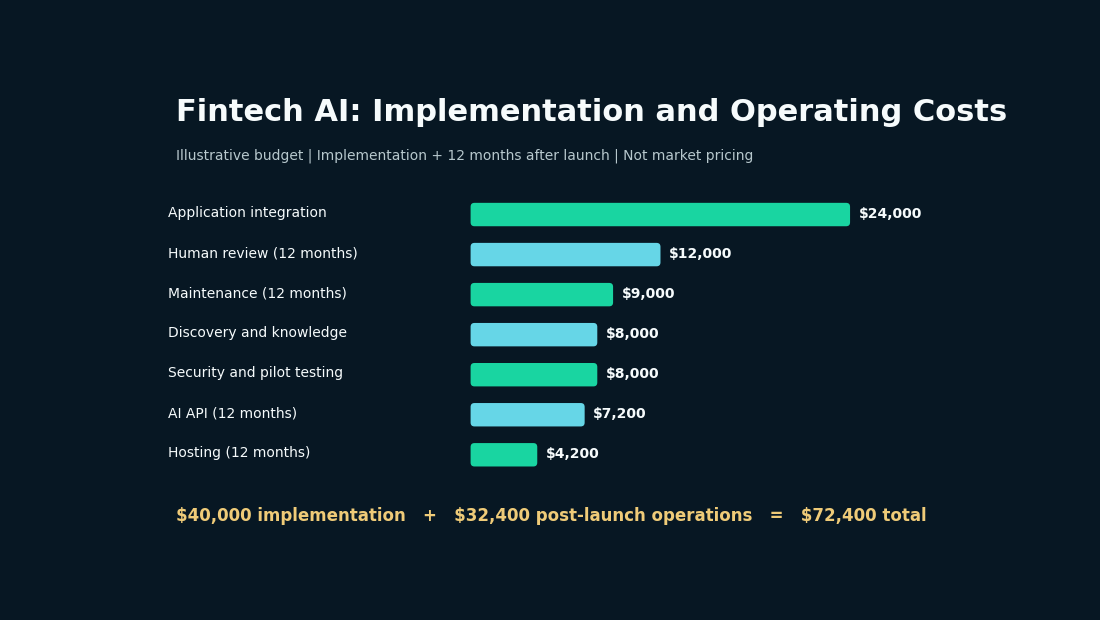
Figure 3. Disclosed hypothetical costs. Initial implementation: $40,000. Twelve full post-launch operating months: $32,400.
How Costs Differ by Procurement Model
Buying software shifts more cost toward licenses, setup, implementation and vendor dependence. API integration adds variable usage costs and operational dependence on an external provider. Custom development increases initial engineering, validation and maintenance responsibility. Hybrid approaches add integration and governance overhead. Compare similar capability, service level, data handling and support obligations before claiming one approach is cheaper.
How to Implement an AI Solution in Fintech
The implementation process should have a deliverable and explicit approval gate at each stage, rather than moving to production because a demo looks convincing.
Stage | Expected deliverable | Approval gate |
|---|---|---|
1. Define problem | Baseline KPI, decision owner and scope | Sponsor approves measurable success criteria |
2. Assess data | Data inventory, rights and quality findings | Data and risk owners approve usable inputs |
3. Select approach | Rules/ML/LLM/buy/API decision record | Architecture and procurement agree on trade-offs |
4. Pilot | Tested narrow workflow with failure cases | Business and technical owners review results |
5. Risk review | Security, privacy, compliance and human-control plan | Required reviewers approve operating constraints |
6. Controlled deployment | Monitoring, access controls, rollback and incident playbook | Named release authority approves production |
7. Outcome review | Costs, counter-metrics and results vs baseline | Continue, revise or stop decision is documented |
Pilots for consequential financial decisions should not grant unsupervised production authority before validation. The release plan should cover alert thresholds, exception ownership, safe fallback behavior and post-release reviews.
Security, Compliance and AI Governance
Geographic scope: The regulatory examples below focus on the United States and European Union. They are not a complete summary of requirements worldwide. Obligations depend on the financial activity, institution type, operating jurisdiction, customer market and the role the organization plays in the AI system. Obtain qualified legal and compliance review for the actual implementation.
United States: Model Risk Management and Credit Decisions
On April 17, 2026, US banking agencies issued revised supervisory model-risk management guidance. Federal Reserve SR 26-2 replaced SR 11-7 and is expected to be most relevant to Federal Reserve-regulated banking organizations with over $30 billion in assets. Smaller banking organizations with significant model-risk exposure may also find it relevant. It is supervisory guidance, not a universal fintech AI certification standard, and should not be indiscriminately applied to every startup.
Generative and agentic AI models are outside SR 26-2's specifically defined model scope. This is not permission to operate such systems without governance. Organizations still need controls suitable for their risks and all other applicable obligations. Traditional quantitative and non-generative, non-agentic models can fall within the guidance's model definition.
For US credit decisions subject to ECOA and Regulation B, lenders still need accurate, specific adverse-action reasons when applicable, including where the decision uses a complex algorithm. The CFPB's guidance discusses the obligation.
European Union: AI Act Classification and Timing
The EU AI Act does not classify every fintech AI product as high risk. The classification depends on the intended purpose, whether the use is covered by its risk provisions, any exceptions, and whether the organization acts as a provider or deployer. Certain creditworthiness assessments can fall within Annex III. An ordinary support chatbot or reconciliation tool does not automatically have the same classification.
Under the revised timetable in Regulation (EU) 2026/1744, specified Annex III high-risk provisions apply from December 2, 2027, and certain Annex I product-related high-risk provisions from August 2, 2028. These dates apply to the specified provisions, not the whole AI Act. Other provisions, privacy requirements and financial-sector obligations may already apply.
Payment Data and AI Governance
Where payment-card data is stored, processed or transmitted, assess the applicable PCI DSS scope. NIST's AI RMF and Generative AI Profile provide voluntary governance tools, not compliance certificates. Security testing should cover role permissions, prompt injection where relevant, secrets, logging, data retention and human escalation.
How to Measure Fintech AI ROI
Business evaluation must track helpful outcomes and counter-metrics that expose harm. A fraud system should be assessed on losses and legitimate-customer declines. A support assistant should track correct resolution alongside privacy incidents and inappropriate escalation. A reconciliation system must track accuracy, not only the volume of automatic matches.
Solution | Business KPI | Counter-metric |
|---|---|---|
Fraud | Fraud loss avoided | False declines, review burden, latency |
KYC/AML | Cost and time per completed review | False alerts, missed evidence and audit gaps |
Customer support | Cost per correctly resolved query | Incorrect advice, privacy incidents |
Credit | Risk calibration and operating efficiency | Fairness, adverse-action explanation failures |
Reconciliation | Accurate auto-match rate | Wrong posting, unresolved differences |
Document processing | Validated processing cost per document | Field error and rework |
Forecasting | Forecast value for actual decisions | Error under changing conditions |
Illustrative Annual Savings and Simple Payback Calculation
Suppose a fintech company’s existing operational workflow costs $180,000 annually. After introducing an automation solution, its annual operating cost falls to $115,000, including ongoing software expenses, human oversight, and maintenance. The annualized operating-cost saving is $180,000 − $115,000 = $65,000. If the one-time implementation cost is $80,000, the simple payback period is $80,000 ÷ $65,000 = approximately 1.23 years (14.8 months).
This is a hypothetical calculation, not an observed market result or a complete return-on-investment analysis. It assumes the annual savings continue at the modeled level once the solution is operating. A full investment appraisal may also account for implementation delays, transition costs, discounting, financing assumptions, changes in financial risk, and the actual timing of savings.
Common Fintech AI Implementation Mistakes
A capable model will not rescue a poorly defined workflow. Avoid choosing AI before establishing the baseline; relying on labels that will not exist in production; handing an agent unrestricted financial actions; accepting a successful demo without representative failure tests; and omitting ongoing human review or provider-exit costs. The preferred response is concrete: define decision boundaries, test the expected exception cases, and name the person accountable for every operational control.
How to Choose a Fintech AI Development Partner
A credible proposal should specify the required data, integration design, testing method, security controls and operating responsibilities, not only a list of models and dashboards. Request explicit acceptance criteria for the pilot: representative test-set coverage, policy and access checks, latency limits, unsafe-response or incorrect-action review, fallback tests, audit records, and a documented release decision.
Area | What to request from the provider |
|---|---|
Scope | Defined workflow, excluded operations and accountable owners |
Architecture | Data flows, decision layer, external tools and integration boundaries |
Evaluation | Baseline, sample definition, error analysis and counter-metrics |
Security | Access-control design, retention, secrets and incident response |
Procurement | Ownership, portability, provider changes, uptime and exit conditions |
Operations | Monitoring, rollback, review workload and total cost |
A good partner should be willing to recommend buying an existing product or implementing deterministic rules when custom AI does not justify its costs and risks.
Fintech AI Production-Readiness Checklist
☐ Business problem, baseline and acceptance criteria are documented.
☐ Data is available, suitable and legally usable.
☐ System owners, integrations and permissions are identified.
☐ Human review, escalation and sensitive-action controls are explicit.
☐ Relevant legal, privacy and security obligations are assessed.
☐ Failure modes, fallback behavior and rollback are tested.
☐ A monitoring and incident-response owner is named.
☐ Total operating cost and exit arrangements are approved.
This is a practical project checklist, not a regulatory certification.
Conclusion: Invest in the Workflow, Not the Technology Label
A fintech company does not need the most sophisticated AI system to achieve a meaningful result. It needs a solution that improves a defined financial workflow, works with its existing technology, respects authorization and compliance boundaries, and remains economical to operate after launch.
The seven applications in this guide differ significantly in data requirements, integration effort and decision risk. Before committing to an implementation, establish the baseline, choose the least complex credible approach, assess the total cost of ownership and agree on measurable acceptance criteria. Financial success must include the cost of mistakes and the quality of human oversight, not just throughput or model accuracy.
Exploring AI for Your Fintech Platform?
Choosing the right AI approach starts with your workflows, data readiness, systems and operational constraints. Toadster Technologies works with fintech businesses on AI integration, intelligent automation and custom financial software development. Whether you are evaluating fraud screening, support automation or a specialized financial workflow, explore our fintech AI engineering and software development capabilities to discuss the technical approach and implementation requirements.