
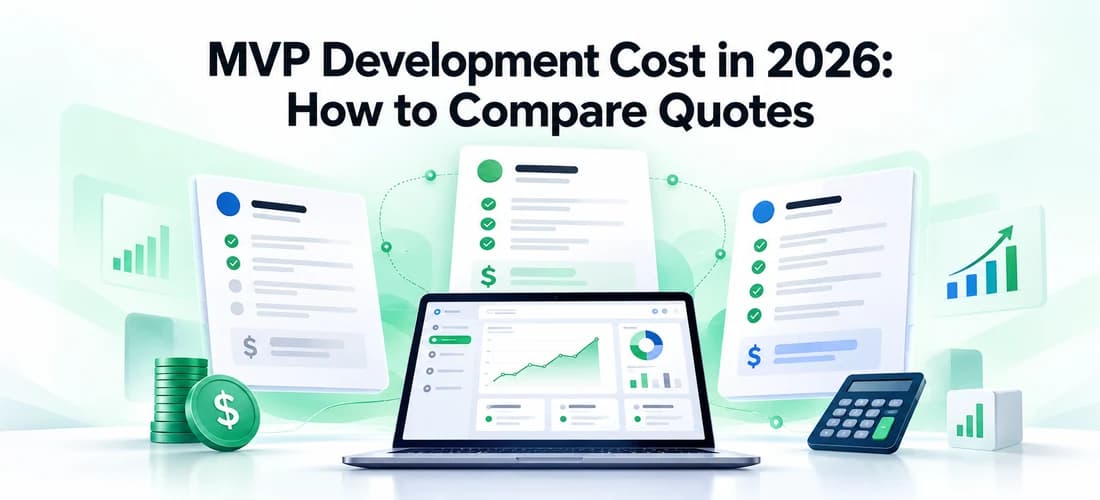
You've got an MVP idea, a list of features, and a few development companies ready to build it.
Then the quotes arrive.
One company asks for $39,000. Another estimates $52,000. A third quotes $64,000.
Same product idea. Three very different prices.
So who's getting it right?
That's where understanding MVP development cost becomes important. For US startup founders, the challenge isn't just finding an affordable team. It's figuring out what each company is actually offering, what might cost extra, and whether the investment makes sense for the business.
A cheaper quote might leave out testing or post-launch support. A more expensive one might include services you don't need yet.
This guide explains what MVP development costs in 2026, what goes into those costs, and how to compare proposals without paying for unnecessary work.
How Much Does MVP Development Cost in 2026?
Published agency estimates for custom MVPs commonly start around $10,000 and can exceed $200,000 for complex products. A tightly scoped no-code experiment may cost less, but it is not the same delivery scope as a custom-built application.
That's a wide range, but there's a reason for it.
A simple booking platform doesn't require the same development effort as a SaaS product with multiple user roles, payment systems, and third-party integrations. The development approach, complexity, team location, and scope all influence the final price.
MVP Development Cost by Complexity
For a starting point, the following cost-breakdown offer pricing estimates by complexity. Their categories aren't necessarily identical, so use these ranges for early budgeting-not as official US market averages.
MVP complexity | Helpware Tech estimate | High-On Innovation estimate |
|---|---|---|
Simple MVP | $10,000–$40,000 | $15,000–$30,000 |
Medium-complexity MVP | $40,000–$100,000 | $30,000–$70,000 |
Complex MVP | $100,000–$200,000+ | $70,000–$150,000+ |
These figures are useful for initial planning, but they can't tell you exactly what your MVP will cost.
Two startups may each need a customer dashboard. One only displays account information, while the other pulls data from several systems, processes payments, and manages complex permissions. The screens might look similar, but the work behind them is very different.
That's why a reliable estimate starts with understanding what needs to be built.
Does Hiring US Developers Cost More Than Offshore Development?
Location can make a noticeable difference in development costs.
US developer salaries help explain why delivery costs can differ, although employee wages aren't the same as agency billing rates. We'll look at the US wage benchmark when comparing in-house teams below.
Working with an offshore team may offer a different cost structure, particularly for startups operating on limited budgets. But don't compare hourly rates alone.
Look at who's managing the project, how testing is handled, whether communication is clear, and how much additional work you may need to manage yourself.
If you're considering that route, our guide to offshore development services costs explains the factors worth comparing.
The real question isn't simply who charges less per hour. It's who can deliver the required product at a reasonable total cost.
What Should Be Included in an MVP Development Quote?
When a development company sends you a quote, you should be able to understand where the money is going.
A single figure such as "$50,000 for complete MVP development" isn't enough to make an informed decision. You need to know what's included.
A typical custom MVP project may involve:
- Discovery and planning: Defining requirements, user journeys, and the technical approach.
- UI/UX design: Designing how users navigate and interact with the product.
- Frontend development: Building the screens customers and administrators use.
- Backend development: Creating databases, APIs, authentication, and business logic.
- Third-party integrations: Connecting payment providers, email systems, or other services.
- Quality assurance: Testing workflows, security-related requirements, and fixing defects.
- Deployment: Preparing the production environment and launching the application.
- Project management: Coordinating work, reviewing progress, and managing changes.
Not every MVP needs the same amount of work in each area. A product with complicated workflows may require more backend development. An application with several customer-facing screens could involve more design and frontend work.
Example: What a $52,000 SaaS MVP Budget Could Include
Imagine you're launching a SaaS product that helps companies manage internal approval requests.
Your initial proposed scope includes secure login, two user roles, a request-and-approval workflow, a dashboard, subscription billing, one external integration, and basic administration. The founder also asks for advanced administrative reports, enhanced automated notifications, and nonessential data exports. Those three extras are part of the original estimate below, even though we'll consider deferring them later.
You don't need a native mobile app or AI functionality at this stage.
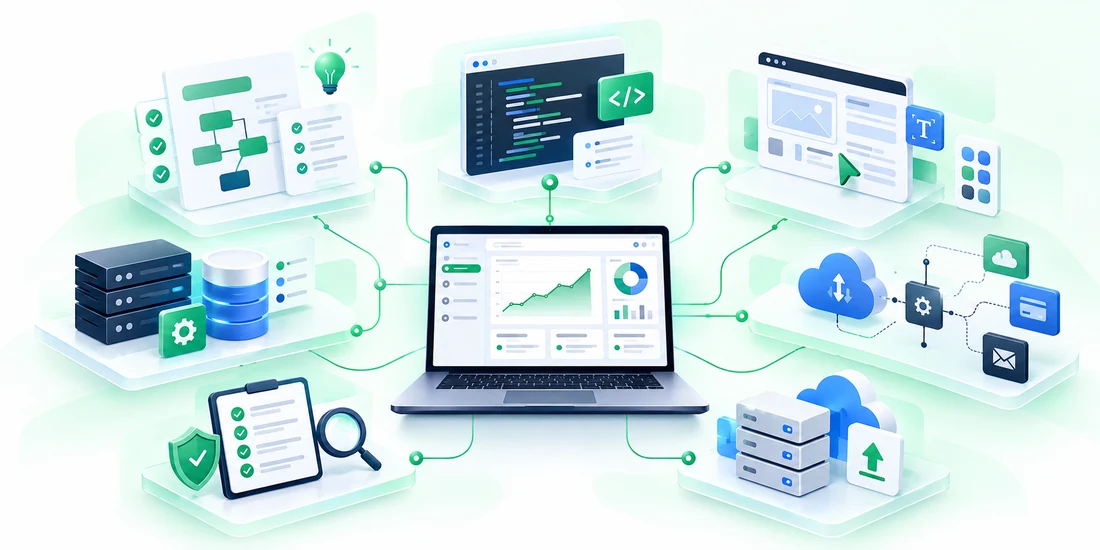
Here's an illustrative breakdown of the development effort.
Development component | Estimated hours | Estimated cost |
|---|---|---|
Discovery and technical planning | 45 | $2,925 |
UI/UX design | 70 | $4,550 |
Frontend development | 170 | $11,050 |
Backend development | 200 | $13,000 |
Integrations and billing | 90 | $5,850 |
Quality assurance and security checks | 105 | $6,825 |
Deployment and documentation | 55 | $3,575 |
Project management | 65 | $4,225 |
Total | 800 hours | $52,000 |
Estimated MVP cost = Development hours × Blended hourly rate
In this example, 800 hours × $65 = $52,000. Those are combined hours across roles, not 800 hours of calendar time.
Within the original 800-hour estimate, we have allocated 40 hours for advanced administrative reports (20 frontend + 20 backend), 30 hours for enhanced notifications (within integrations), and 20 hours for nonessential exports (within backend). All three items are included in the workstream totals-not extra hours added to the $52,000 estimate.
For a deeper look at where those hours come from, see this step-by-step approach to estimating SaaS MVP development hours. It breaks user stories into engineering tasks and explains why estimates need ranges and clearly stated assumptions.
The estimate doesn't automatically cover future hosting, recurring subscriptions, maintenance, or major changes to requirements. That's why asking for a detailed breakdown matters: it helps you spot missing work before it becomes an unexpected expense.
For founders building subscription products, understanding the scope of SaaS application development can also help clarify what should appear in the quote.
Why Do Three Development Companies Quote Different Prices for the Same MVP?
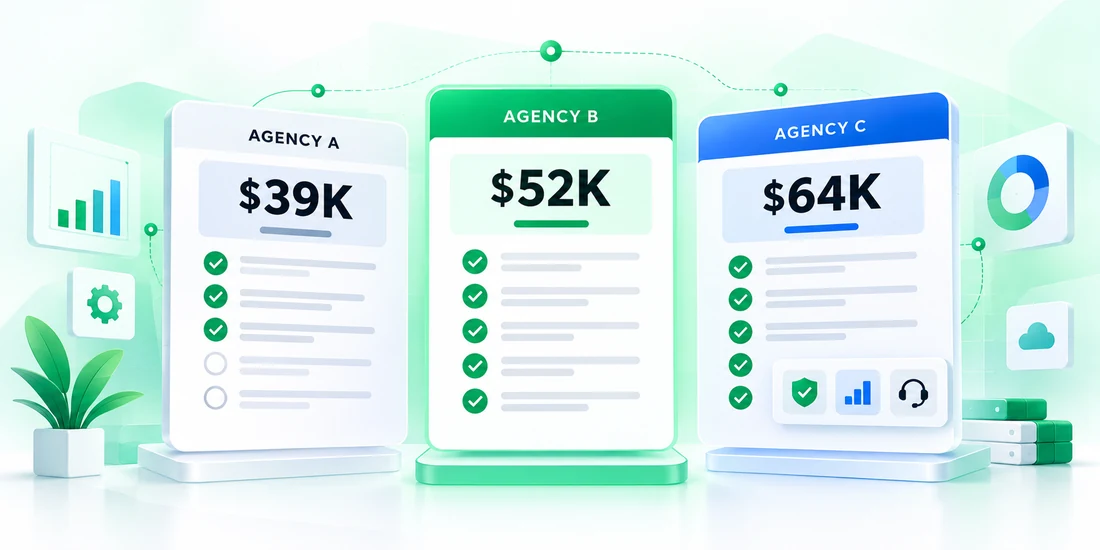
Let's say you've approached three companies with that same SaaS product idea. Here's what their proposals look like.
Comparing Three MVP Development Quotes
What's included? | Agency A | Agency B | Agency C |
|---|---|---|---|
Initial quote | $39,000 | $52,000 | $64,000 |
Technical discovery | Extra charge | Included | Included |
Core development | Included | Included | Included |
QA testing | Limited | Defined testing scope | Expanded automated testing |
Production deployment | Extra charge | Included | Included |
Source-code handover | Unclear | Specified | Specified |
After-launch coverage | Optional paid support | Limited defect warranty | Extended support package |
Documentation | Basic | Standard | Comprehensive |
At first glance, Agency A looks like the obvious choice. It's $13,000 cheaper than Agency B.
But take a closer look. Agency A hasn't included several services that your product may need before and after launch.
What Happens When You Add the Missing Work?
Work missing from Agency A's build proposal | Illustrative cost |
|---|---|
Technical discovery | $3,000 |
Additional QA and security checks | $5,000 |
Production deployment | $2,000 |
Adjusted build quote | $49,000 ($39,000 + $10,000) |
Agency A's more complete build price is now $49,000, much closer to Agency B's $52,000. But they're still not fully comparable: source-code handover remains unclear, the testing commitments differ, and Agency B includes a limited defect warranty.
Agency A also offers an optional $3,000 post-launch support package, bringing its potential total to $52,000 if purchased. That optional support contract should be compared separately with Agency B's defect warranty-not treated as the same service.
All extra amounts are fictional, for illustration only.
Does this make Agency B better? Not necessarily. Agency A may still be a good fit, and Agency C may justify its higher price if you genuinely need more extensive testing or support. The goal is to compare equivalent deliverables and contract obligations before choosing.
The problem isn't that companies charge different amounts. It's that their proposals may not include the same work.
Before comparing prices, ask who handles testing and deployment, who owns the code, how changes are priced, and what happens after launch. You don't need every vendor to follow the same process. You do need enough detail to compare what you're buying.
How Can Startups Reduce MVP Development Costs Without Sacrificing Essential Features?
One of the easiest ways to increase an MVP budget is to keep adding features before the first version launches.
It usually starts with good intentions. A dashboard needs reporting. Reporting needs exports. Then come more automated notifications and settings. Suddenly, a small validation project starts looking like a full product.
The solution isn't to remove features randomly. It's to decide what users genuinely need for the first release to serve its purpose.
Which Features Should You Build First?
For an approval-management application, the core job is letting employees create requests and managers approve or reject them. Advanced reports, elaborate notifications, and exports may be useful later-but aren't necessarily required to test whether people want the product.
Feature category | Recommended action |
|---|---|
Essential to the core user workflow | Build now |
Useful but not required for validation | Review carefully |
Advanced reporting or convenience features | Consider later |
Features with no clear user need yet | Defer |
Security, reliability, and other essential quality requirements shouldn't be removed merely to make a budget look smaller.
Example: How Deferring Features Changes the Budget
Let's return to the same original $52,000 SaaS MVP. Its 800-hour estimate already included the three extra features we're now considering for a later release.
Feature originally included | Where its hours sat in the $52,000 estimate | Hours deferred |
|---|---|---|
Advanced administrative reports | Frontend (20) + backend (20) | 40 |
Enhanced automated notifications | Integrations and billing | 30 |
Nonessential data exports | Backend development | 20 |
Total removed from original scope | 90 |
At the same assumed blended $65/hour rate:
Original scope | Revised scope | |
|---|---|---|
Estimated hours | 800 | 710 |
Illustrative development cost | $52,000 | $46,150 |
Difference | $5,850 (11.25%) |
Removing three features doesn't necessarily remove 30% of your budget. Some features take a few hours; others require far more engineering effort.
Ask yourself: If we launch without this feature, can customers still use the product to solve its main problem?
If yes, there's a good reason to consider it for later. For more on defining and validating the first version of your product, read How to Build an MVP for Your Startup.
Which MVP Development Model Offers the Best Value?
Should you hire freelancers, build an internal team, use no-code tools, or work with an agency? There's no single answer that works for every startup.
Approach | Main advantage | Main consideration | Best suited for |
|---|---|---|---|
No-code or low-code | Faster experimentation with less custom engineering | Platform limitations and subscriptions | Simple products and early validation |
Freelancers | Flexible access to specific skills | You may need to manage delivery and testing | Small, well-defined projects |
In-house team | Direct control and long-term product knowledge | Recruitment, salary, and management costs | Ongoing engineering needs |
Development agency | Coordinated design, engineering, and testing capabilities | Requires careful proposal and contract review | Founders seeking external delivery support |
If you're testing a straightforward workflow, no-code might be enough. If your product depends on unusual integrations or business logic, custom engineering may be more suitable.
Freelancers can work well when requirements are narrow. An agency may make more sense when several disciplines need to work together.
What Does an In-House Team Cost in the USA?
The Bureau of Labor Statistics' software developer wage data puts the median annual wage at $135,980 in May 2025. That's not the full cost of employment.
Under the IRS's 2026 employer payroll tax rules, employers generally pay 6.2% Social Security tax on applicable wages up to the annual wage base and 1.45% Medicare tax. Benefits, recruiting, equipment, and management can add to the total.
This doesn't mean agencies are always cheaper. It means founders should compare the complete financial commitment, not only advertised rates.
Fixed-Price or Time-and-Materials: Which Is Better?
With a fixed-price contract, you agree on defined work and a price. It can suit projects with clear requirements, but changes may require a new agreement.
With time-and-materials pricing, you pay for actual work at agreed rates. That gives you flexibility, but you need visibility into hours, progress, and remaining budget.
If requirements are still taking shape, a short discovery phase before committing to the full build can reduce uncertainty. Whichever model you choose, make sure change approvals and charges are documented.
Which Costs Are Commonly Excluded From MVP Development Quotes?
You've paid for development. The application is live. Is your spending finished? Usually not.
Hosting and Cloud Infrastructure
A SaaS MVP may need servers, databases, backups, and monitoring. Costs depend on the architecture and how much the product is used. The AWS Pricing Calculator can help model a specific setup. Ask who will own the cloud account, manage deployments, and monitor usage.
Payment Gateway and API Charges
Many products rely on paid third-party services. For example, the standard US card-processing fees published by Stripe are 2.9% + $0.30 per successful domestic card transaction, with additional fees possible in some circumstances.
A quote may include integrating Stripe without covering future processing fees. The same distinction applies to messaging tools, maps, and AI model APIs.
Security and Compliance
Security also affects the scope of work. The NIST Secure Software Development Framework outlines practices intended to reduce software vulnerabilities. Ask how the team handles authentication, permissions, sensitive data, dependencies, and testing. Products in regulated industries may have extra legal and technical requirements.
Post-Launch Maintenance
Real users discover bugs. Services change. Software needs updates. Check whether your quote includes a defect warranty or ongoing maintenance, and what each covers. A short bug-fixing period isn't a complete long-term support agreement.
Think Beyond the Initial Development Price
First-year MVP investment = Initial development + Deployment + Infrastructure + Third-party services + Support and maintenance + Approved changes
A $50,000 quote that excludes essential launch work may not be cheaper than a $60,000 quote that includes it.
For advanced applications, recurring usage costs can matter as much as infrastructure. Toadster Technologies' Juristo AI case study describes a legal research platform involving AI models and retrieval workflows. It illustrates operating-cost considerations for complex software, not a typical MVP price.
How Should You Compare MVP Development Quotes Before Hiring an Agency?
Comparing proposals isn't just about choosing the lowest number. Start by asking every vendor to estimate the same written requirements. Then use a checklist that makes their differences visible.
Practical MVP Vendor Comparison Checklist
Check before signing | What to request from each vendor | Agency A | Agency B | Agency C |
|---|---|---|---|---|
Same feature scope | Written user stories and explicit exclusions | ☐ | ☐ | ☐ |
Itemized pricing | Workstream hours/rates or fixed-price deliverables | ☐ | ☐ | ☐ |
Technical approach | Architecture, integrations, and key assumptions | ☐ | ☐ | ☐ |
QA and security | Test approach, defect handling, security responsibilities | ☐ | ☐ | ☐ |
Delivery milestones | Demo dates, acceptance criteria, payment schedule | ☐ | ☐ | ☐ |
Ownership and access | Source code, repositories, hosting accounts, handover | ☐ | ☐ | ☐ |
Change control | Approval process and change-pricing method | ☐ | ☐ | ☐ |
Support after launch | Defect warranty, response times, maintenance scope | ☐ | ☐ | ☐ |
References and staffing | Relevant examples, named roles, team availability | ☐ | ☐ | ☐ |
How to use it: First, compare like-for-like scope and total cost. Next, review any unchecked items. Finally, decide which differences matter most for your product. A fintech MVP, for example, may need more security scrutiny than a basic scheduling tool.
Red Flags Worth Investigating
A proposal can sound complete while leaving important terms undefined. This walkthrough of questions hidden inside a cheap MVP development quote explains what founders should clarify when vendors promise testing, production readiness, code ownership, or support.
Be cautious if a company offers an unusually low price but can't explain its assumptions. Vague feature descriptions, unclear ownership, unspecified testing, or delivery timelines nobody can justify deserve follow-up questions.
Before signing, make sure you know what happens if requirements change, milestones slip, or the software doesn't meet agreed acceptance criteria.
A useful development proposal should make the project clearer, not leave you with more unanswered questions.
How Can You Get an Accurate MVP Development Estimate?
You don't need a complete technical specification before your first development call. But the clearer you are about the business idea, the more useful the conversation will be.
Prepare a short project brief explaining the problem you're solving, who will use the product, its core workflow, the must-have features, integrations, your budget constraints, your preferred launch window, and what success looks like.
A good scoping conversation may reveal that your first version is too complicated. Or it may uncover requirements you'd missed, such as permissions or integration reliability. Both outcomes help you make a better investment decision.
Planning Your MVP With Toadster Technologies
Toadster Technologies helps businesses build applications and software platforms through its custom software development services.
Its Fleet Management Web & Mobile Platform case study shows how role-based portals and connected workflows can come together in a software product. A startup won't necessarily need that breadth in its first release; its requirements should determine the scope.
If you're planning an MVP or comparing quotes, contact Toadster Technologies to discuss your project and request a scoped development estimate.
Final Takeaway: Compare What You're Buying, Not Just the Price
When you're building your first MVP, every dollar matters. But choosing the lowest quote without understanding what's included can create problems later.
Two agencies may quote different prices because they're planning different levels of engineering, testing, deployment, and support. Before deciding, define your essential features, compare equivalent deliverables, and account for the responsibilities that continue after launch.
The right MVP budget isn't necessarily the smallest one. It's the investment that gives your startup a practical way to test its idea without building more than it needs.