
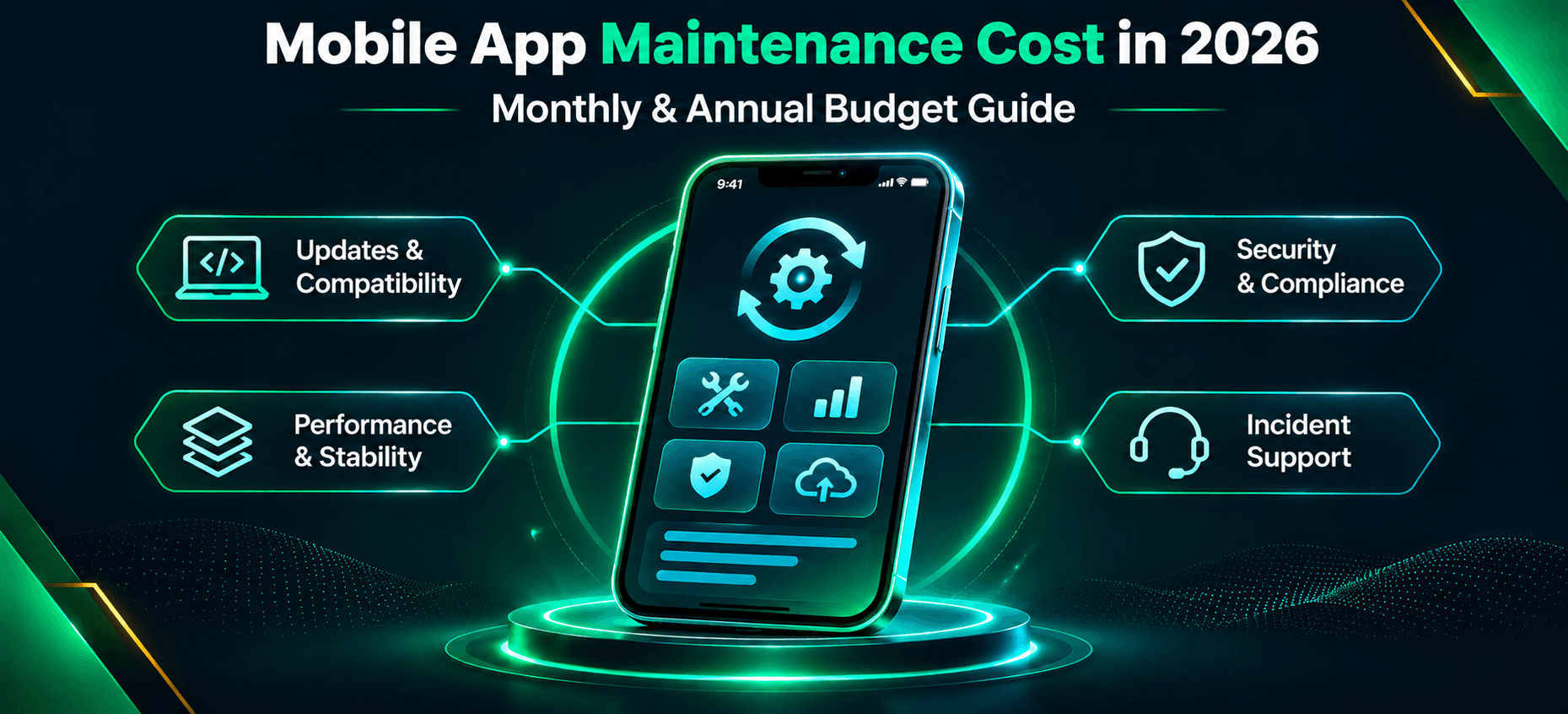
Mobile App Maintenance Cost in 2026: Monthly & Annual Budget Guide
Launching an app creates an ongoing obligation: keeping it compatible, secure, reliable and useful after real users begin depending on it. Yet mobile app maintenance cost is often missing from an initial development quote, or reduced to a percentage that hides what the owner will actually receive.
A sensible post-launch budget accounts for engineering and QA time, incident coverage, operating services, platform and third-party changes, and a reserve for unexpected work. The right amount depends less on the app's original price than on the systems it relies on, the risk of downtime, its user base and the support agreement.
This guide explains how to build a defensible 12-month budget, compare maintenance providers and decide which expenses belong in maintenance versus product enhancement. The labor scenarios are illustrative, not observed US market averages or Toadster quotations.
How Much Does Mobile App Maintenance Cost in 2026?
Mobile app maintenance cost depends on complexity, supported platforms, infrastructure, update frequency and support coverage. There is no reliable universal US market average. As a concrete illustration, a hypothetical customer-facing iOS and Android app with business-hours support could need $3,507.50 per month, or $42,090 over twelve months, under the explicit assumptions below. This is a planning example, not a market benchmark or provider quote. Apps needing continuous on-call support, complex integrations or specialist security testing require a different estimate.
Instead of promising a universal annual percentage, start with a scope-based formula:
Monthly maintenance budget = (engineering hours × agreed rate) + (QA/release hours × agreed rate) + hosting and monitoring + third-party services + incident coverage + contingency.
If incident support is already included in engineering or a retainer, do not count it twice. Account separately for app-store program fees and large enhancement projects. For reliable comparisons, every provider must estimate the same coverage hours, platforms, included work and exclusions.
An illustrative monthly budget
The following example describes a hypothetical growing customer-facing iOS/Android application. It assumes business-hours response, planned monthly releases, no dedicated 24/7 on-call team and a stable backend. The rates and allocations are invented for budgeting illustration, not statistical findings or current Toadster prices.
Budget component | Assumption | Monthly amount |
|---|---|---|
Engineering and preventive fixes | 24 hours × $75/hour | $1,800.00 |
QA, regression and release testing | 12 hours × $50/hour | $600.00 |
Hosting, monitoring and error tracking | Assumed service allowance | $450.00 |
Third-party SDKs and services | Assumed subscription allowance | $200.00 |
Subtotal | $3,050.00 | |
Contingency | 15% of subtotal | $457.50 |
Illustrative monthly budget | $3,507.50 | |
Illustrative 12-month budget | 12 × monthly figure | $42,090.00 |
Coverage and contingency: The 24 monthly engineering hours include planned preventive maintenance, routine bug fixes and incident investigation during agreed business hours. They do not include a dedicated 24/7 on-call commitment. Work beyond the allocated hours requires a pre-agreed overage rate, additional retainer capacity or separate approval. The 15% contingency is an owner-side planning reserve, not automatically a monthly provider charge. Whether unused retainer hours roll over, expire or remain available depends on the agreement.
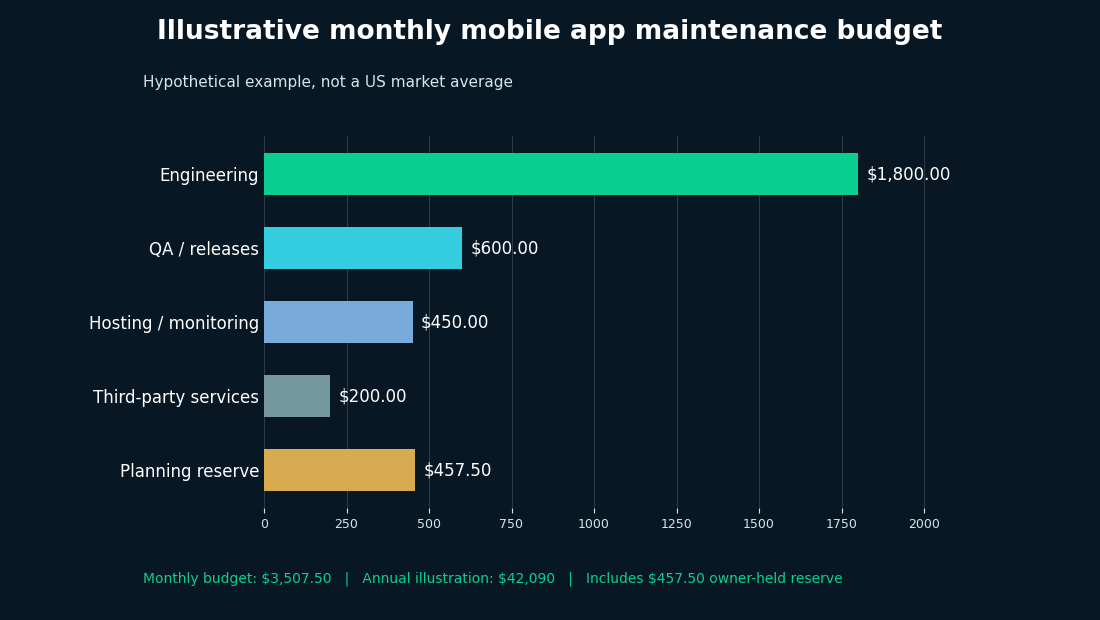
Monthly maintenance cost breakdown (illustrative)
What the example excludes: major features and redesigns, a new backend architecture, unusual incident surge, payment processing commissions, sales tax, devices, customer-service staff and specialist compliance audits. A 24/7 SLA would require a different coverage and staffing calculation. The assumptions must change before this figure is used for procurement.
A published provider-pricing example, not a market average
Toadster Technologies publicly lists indicative application support and maintenance ranges of approximately $2,500–$5,000 per month for Essential support, $5,000–$15,000 per month for Professional support, and individually scoped Enterprise support. These figures are one provider's advertised ranges, not independent US market averages or a quote for your app. Final scope, technical coverage, SLA and rates need confirmation before contracting. The $3,507.50 illustrative model happens to fall within the Essential range numerically, but that does not establish equivalence of contracted services. See the published service description.
What Counts as Mobile App Maintenance?
Mobile app maintenance is the work needed to preserve or improve the security, compatibility, stability and operational performance of an existing application. It spans the client app and the services on which the app depends.
Maintenance category | Typical activities | Buyer question |
|---|---|---|
Corrective | Fix crashes, broken journeys, regressions and defects | Are defect fixes included or charged separately? |
Adaptive | Update for OS, SDK, store-policy and third-party API changes | Who tracks platform deadlines? |
Preventive | Upgrade dependencies, rotate credentials, improve monitoring and run security checks | What work happens when there are no tickets? |
Perfective | Improve existing performance, accessibility and usability without changing core product scope | Which improvements count as maintenance rather than new features? |
These categories are useful for defining a contract, not rigid accounting rules. A small performance fix might be included while a complete checkout redesign is a new development initiative. Agree on boundaries in writing.
A mobile app also depends on backend APIs, cloud resources, authentication providers, notification delivery, analytics, databases and external integrations. An app can appear healthy on a test device while a failed backend queue or expired third-party credential prevents users from completing critical tasks.
Why the 15–25% Rule Is Not Enough
Many agency articles describe annual maintenance as a fixed fraction of the original build budget. That shortcut may help start a conversation, but it is not a government-derived industry average and can be misleading.
A costly one-time launch may produce a relatively stable app with modest upkeep. Conversely, a relatively inexpensive MVP connected to fragile APIs, frequent compliance changes and 24/7 customer operations may require substantial ongoing support. The first build cost is therefore an imperfect proxy for production risk.
An enterprise application also needs a budget for the years after initial delivery. The distinction between enterprise mobile app build and operating budgets is a useful way to separate one-time engineering from recurring support, integrations and platform updates.
A more defensible estimate combines: the app and backend inventory; supported devices and OS versions; dependency health; monthly incident history; planned releases; security obligations; expected service availability; and known upcoming migrations. Where historical ticket or monitoring data exists, use it instead of generic percentages.
Seven Cost Drivers Owners Should Budget For
1. Platform compatibility and app-store requirements
Apple and Google change tooling, target-level requirements and submission policies over time. These changes can trigger engineering updates, dependency compatibility checks and new binary submissions. For example, Apple's published requirements include Xcode and SDK minimums for App Store uploads, so maintenance must include periodic review of release tooling. Apple upcoming requirements.
For Google Play, assess the current target API requirements against the release calendar. Since April 28, 2026, Apple has required App Store Connect uploads to be built with Xcode 26 or later using the applicable SDK 26 or later. Beginning August 31, 2026, Google Play generally required new apps and updates to target Android 16 (API level 36), with different levels for Wear OS, Android Automotive OS, Android TV and Android XR, plus specified exceptions. Existing-app availability requirements are different from new-submission rules. Check the Apple requirements and Google Play requirements before each release, since policies may change.
2. Security and dependency maintenance
Mobile security includes secure local storage, network communication, authentication, platform integration, privacy and resilience, not merely a periodic vulnerability scan. The OWASP Mobile Application Security Verification Standard provides a practical control baseline, while NIST's Secure Software Development Framework emphasizes managing vulnerabilities across the software lifecycle.
Budget for dependency review, patch testing, secret rotation, security configuration, remediation and regression testing. A subscription to a scanning tool is not a substitute for engineering fixes. Risk-based testing may also require specialist assessments beyond ordinary maintenance.
3. Backend and cloud operations
Hosting bills vary with traffic, storage, compute, database usage and architecture. App owners may also pay for monitoring, backups, log retention, CDN usage and managed message services. Use actual cloud invoices and vendor calculators where possible, rather than copying an average from another company's blog.
4. External SDKs and integrations
Payment services, maps, identity providers, customer communications, analytics and enterprise APIs can change versions, permissions, pricing or contracts. Maintaining an integration involves reading release notices, testing workflows and validating failure behavior. Third-party fees and engineering labor should appear on separate budget lines.
5. Support availability and incident severity
A business-hours support agreement is not equivalent to a 24/7 production SLA. Higher availability commitments may need on-call coverage, alerting, incident management, backups and stronger handover procedures. Ask how severity is defined, when the response clock starts and what constitutes restoration versus a permanent fix.
6. Device and release testing
Maintenance includes verifying new versions on an agreed iOS/Android device and OS matrix, reproducing crashes, testing login and purchase paths, validating accessibility and smoke-testing releases. Testing effort grows with hardware specialization, offline workflows and the number of supported OS versions.
7. Product changes and technical debt
A small enhancement may fit inside an agreed change allowance; an entirely new feature usually should not. Untested modules, outdated dependencies and poor documentation increase the effort needed for even routine patches. Budget some preventive engineering rather than spending every maintenance hour on reactive tickets.
How to Calculate a 12-Month App Maintenance Budget
A quote becomes defensible when it starts with operational assumptions. Use the following process before requesting a proposal.
- Inventory the production system. List mobile apps, backend services, cloud resources, databases, third-party SDKs, certificates, monitoring tools and repositories. Record owners and renewal dates.
- Define coverage. Specify supported platforms, normal support hours, holidays, critical incident handling, target availability and permitted maintenance windows.
- Estimate monthly work. Use past incidents, patch schedules, release cadence and known technical debt to estimate engineering and testing hours. Separate one-time stabilization work from recurring support.
- Add direct vendor expenses. Include cloud, monitoring, notification services, identity, analytics and approved security tools at actual contracted prices when available.
- Price incidents and uncertainty. Decide whether urgent incident work is included in a retainer, has a capped allowance or is billed separately. Keep a clearly defined contingency rather than hiding it in an unexplained percentage.
- Model expected changes. Allow for upcoming OS and SDK changes, a planned app-store update, contract renewals and any anticipated API deprecation.
- Compare at least two scenarios. Evaluate ordinary business-hours support against a higher-coverage option. Compare annual cost and potential operational exposure, not price alone.
Budget scenarios by app operating model
The ranges below are not quoted market prices. They describe which expenses tend to dominate different illustrative operating models.
Operating model | Main maintenance work | What usually increases the quote |
|---|---|---|
Stable MVP | Compatibility updates, crash fixes, basic monitoring and occasional releases | Fragile dependencies, poor handover, unpredictable bugs |
Growing customer app | More frequent releases, analytics, peak-load support, integrations and stronger regression coverage | Large active user base, payment flows, broad device coverage |
Enterprise or high-risk app | Auditability, critical incident response, security review, SSO, integrations and change control | 24/7 availability, regulated workflows, specialist systems |
Separate predictable commitments, such as retained support capacity and contracted monitoring, from variable charges such as cloud usage, notification volume, third-party transactions and incident overages. Budget a base case and a higher-usage scenario rather than assuming every expense is fixed.
An owner's budget should explain its service scope. Without it, a $1,500 monthly quote and a $7,500 monthly quote may not describe comparable offerings.
Costs That Are Easy to Miss
Some fees are small compared with development labor, but still belong in a complete lifecycle budget. Apple's official enrollment information lists the standard Apple Developer Program fee as US$99 per membership year, subject to local currency and regional differences. Google Play Console lists a US$25 one-time registration fee, subject to its account rules. These are verified platform fee figures, not monthly maintenance rates. Apple membership and Google Play Console registration.
Also verify recurring DNS and certificate costs if applicable, paid monitoring, communications credits, staging environments, backup restoration testing, data retention, localization, accessibility verification, and third-party vendor minimum commitments. Payment processing and marketplace commissions require separate commercial modeling and should not be mixed into engineering maintenance rates.
An existing app may also need an initial stabilization project before a provider can quote predictable monthly support. That can include resolving critical issues, documenting deployments, repairing CI/CD and establishing observability. Ask that this initial fee be quoted separately from the steady-state retainer.
Flutter, React Native, Native iOS and Android: Does the Framework Change Maintenance Cost?
Yes, but not through a simple universal multiplier. Frameworks differ in dependency ecosystems, native integration boundaries, tooling and developer skills. For all approaches, platform upgrades, store policies, backend APIs, security fixes and real-device testing remain necessary.
A shared Flutter or React Native codebase can reduce duplicated UI work, but a critical native SDK may still require platform-specific changes. Native Swift and Kotlin codebases can take more separate platform effort while offering direct access to platform capabilities. Team familiarity and application architecture often influence actual costs more than the framework name.
For framework-specific decisions, consult Toadster's Flutter mobile app development guide and native mobile app development business guide.
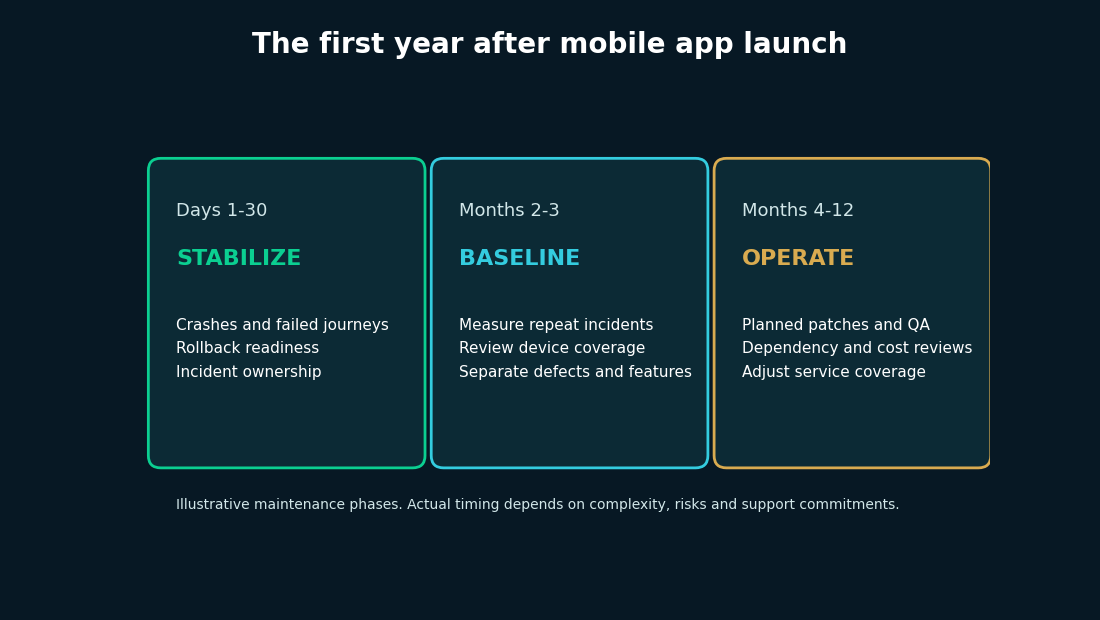
Post-launch maintenance lifecycle (illustrative)
How Maintenance Changes During the First Year After Launch
First 30 days: Stabilization
Prioritize crash monitoring, failed purchases or sign-ins, performance regressions, store feedback and release rollback capability. Establish incident ownership and fix critical defects identified through real usage. A launch warranty may cover defined defects, but it rarely covers every future change. The handover should include deployment instructions, repository access and an ownership map; see Toadster's custom software development process for the broader deployment lifecycle.
Months 2–3: Establish the baseline
Measure incident frequency, response time, error-free sessions, release success, backend capacity and recurring support hours. Document known issues and refine the device matrix. Separate product-feature requests from maintenance tickets so costs are comparable.
Months 4–12: Predictable operations and planned improvements
Move to a repeatable patch, testing and release rhythm. Review dependency and platform notices, security controls, cloud cost trends and the effectiveness of monitoring. Re-estimate the contract if traffic, integration complexity, user expectations or uptime requirements change substantially.
There is no universal calendar that fits all apps. A regulated payment service and an internal information app should not automatically follow the same cadence.
In-House Team vs Freelancer vs Maintenance Agency
Delivery model | Advantages | Constraints | Suitable when |
|---|---|---|---|
In-house engineers | Deep product knowledge and direct prioritization | Recruiting, specialist coverage and on-call overhead | Maintenance is continuous and strategically important |
Freelancer or specialist | Flexible targeted expertise | Limited backup coverage and continuity risk | Work is bounded and risk is manageable |
Agency/managed support | Potential access to QA, operations and multiple engineering skills | Scope and SLA must be carefully documented | The owner needs predictable multidisciplinary support |
Hybrid model | Internal ownership with external specialist capacity | Requires clear responsibility boundaries | The business wants flexibility without losing technical ownership |
Before changing providers, arrange an initial technical handover covering repositories, build and deployment processes, open incidents, architecture diagrams, dependency inventories, credentials and production-access permissions. Use least-privilege access, record approvals and specify who can deploy and roll back releases. The outgoing provider should return company-owned assets and revoke obsolete access as agreed.
Evaluate ownership of repositories, credentials, cloud accounts, documentation and release pipelines before selecting a model. The lowest monthly offer can become expensive if no one can recover from a production incident or hand over the code when the relationship ends.
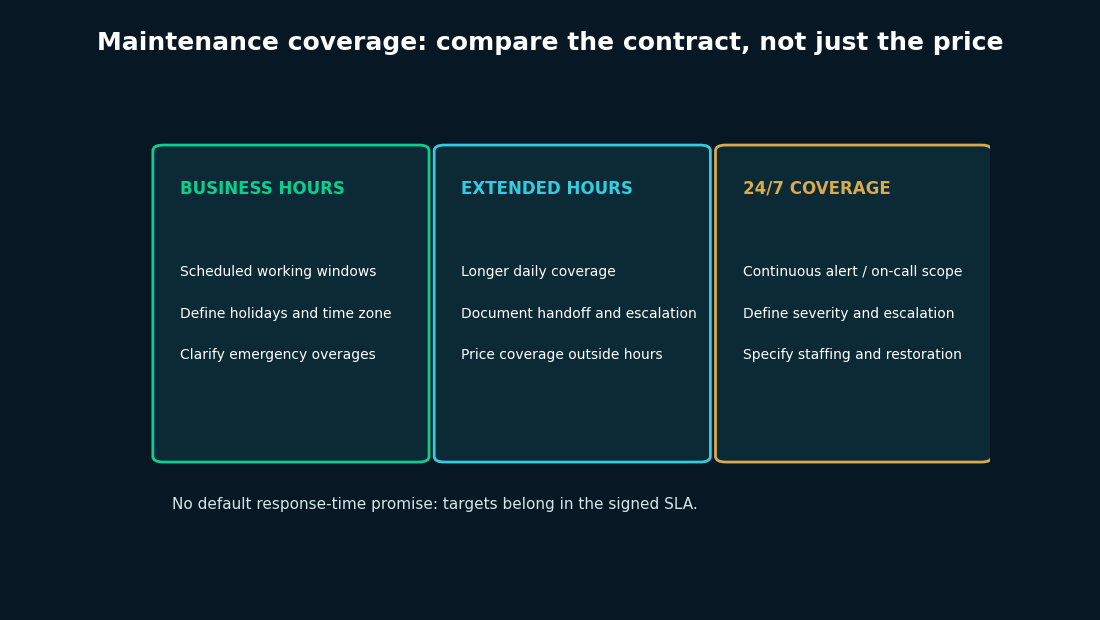
Maintenance SLA and coverage comparison (illustrative)
What to Include in a Mobile App Maintenance Agreement
A useful agreement should define what support actually means and how performance is assessed.
Contract item | What to clarify |
|---|---|
Covered systems | Mobile apps, backend, APIs, admin panels, infrastructure and third parties |
Included activities | Patches, bug fixes, monitoring, security maintenance, releases and QA |
Exclusions | New features, redesigns, migrations, penetration tests and unrelated third-party failures |
Service hours | Time zone, business hours, weekends and holiday coverage |
SLA | Severity rules, acknowledgement targets, restoration targets and escalation |
Commercial model | Retainer hours, rollover, overage rate, emergency rates and annual increases |
Change control | Approval method for work beyond scope and expected estimates |
Security and access | Least privilege, confidentiality, logging and incident notification |
Ownership and exit | Code, documentation, cloud tenancy, credentials and handover assistance |
Reporting | Ticket trends, release history, risk register and monthly review |
Example severity definitions: A P1 incident could mean a widespread outage or broken payment flow without a workable alternative; a P2 incident could mean significant degradation with a viable workaround. These are illustrative labels only. The agreement must set actual severity thresholds, response coverage and restoration objectives without implying an invented response-time guarantee.
Planned versus unplanned work: Routine dependency updates, scheduled QA and compatibility testing can be allocated into a monthly plan. A production outage, suspected compromise or broken external dependency may require unplanned triage, escalation and work outside the ordinary allowance. Confirm who authorizes overages and how urgent changes are documented.
Do not confuse a fast response target with guaranteed resolution. A vendor may acknowledge a critical incident quickly without being able to restore a failed external payment provider. Define both obligations realistically, with dependencies and exclusions.
When assessing a provider, request a sample monthly report and a sample incident escalation workflow. These artifacts often reveal more than a generic promise of proactive support.
How to Reduce App Maintenance Cost Without Increasing Risk
First, prevent repeat incidents through tests, monitoring and documented root-cause fixes. Second, keep dependency updates manageable by applying them routinely rather than accumulating years of incompatibility. Third, use a small, intentional supported-device matrix supported by actual user needs. Fourth, monitor cloud and third-party spend against real usage, while retaining sufficient security and recovery coverage.
Avoid false economies: removing automated tests, delaying critical patches or giving a single freelancer exclusive access to production can reduce an invoice now while increasing future risk. Cost control should improve the unit economics of reliable operation, not weaken the system's ability to recover.
If a system is consistently expensive to maintain, investigate architectural causes. A recurring patch cycle on unsupported libraries or a fragile release pipeline may justify a targeted modernization project. That decision should be based on incidents, effort and risk, not a blanket recommendation to rebuild.
When Should You Request a New Maintenance Quote?
Review the scope when the app adds a new market or payment flow, adopts 24/7 operations, expands to additional platforms, inherits a new backend, accumulates security findings or experiences recurring release failures. Also revisit the agreement after a major traffic increase or when a critical SDK approaches end of support.
Ask prospective providers to itemize stabilization, routine planned work, emergency response, vendor services and enhancement rates. Compare scenarios on equivalent assumptions. A proposal that exposes exclusions, unused-hour rules and handover responsibilities is more useful for procurement than an unexplained monthly number.
The same scope discipline applies before a company signs a new mobile development contract. Reviewing warning signs in enterprise mobile app proposals can help buyers identify unclear ownership, integration assumptions and missing operational commitments before those issues become maintenance costs.
Conclusion: Budget for Operating the App You Actually Have
Mobile app maintenance cost is not a universal percentage of the development budget. It is the price of operating a particular product under defined service expectations. A transparent estimate should state engineering and QA effort, direct vendor costs, incident coverage, exclusions and the assumptions that could change the price.
Compare providers on the same scope and service levels, including handover, reporting and incident coverage. That makes maintenance a manageable business commitment rather than an unpredictable expense after launch.
If your team needs help defining support scope or stabilizing an existing application, explore Toadster Technologies' application support and maintenance services. The service covers application support across mobile applications, APIs and related systems, with the actual plan and commercial terms determined through scoping.