
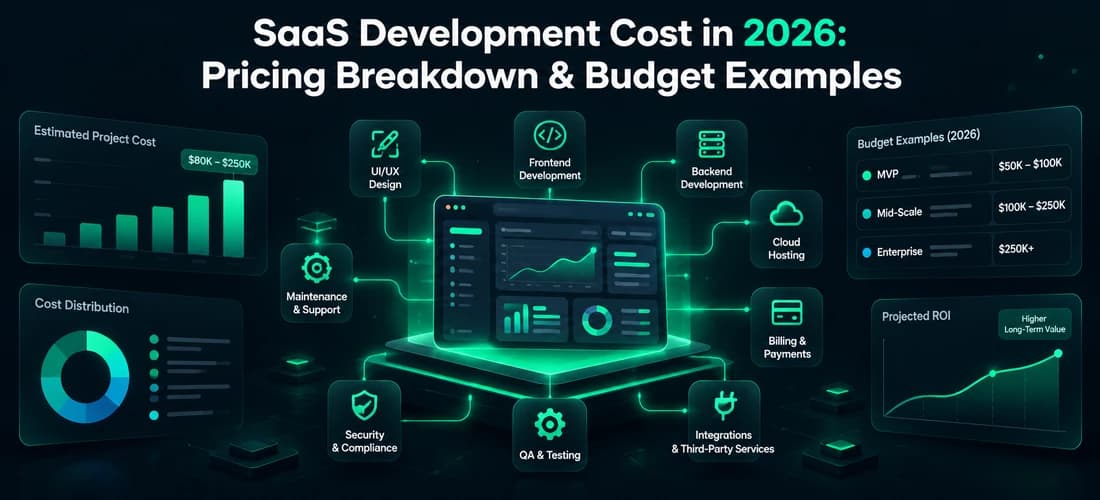
SaaS Development Cost in 2026: Pricing, Breakdown & B Budget Examples
A SaaS estimate can look precise while leaving out the engineering that makes subscription software work: tenant boundaries, metered billing, permission rules, production monitoring and ongoing support. SaaS development cost is therefore a build-and-operate budgeting decision, not just a number attached to a feature list.
For an initial cost discussion, Brillminds publishes a $18,000–$45,000 range for a focused SaaS MVP with three to five core features. RED SAG publishes a $15,000–$60,000 range for a focused SaaS MVP built by an Indian team. Both figures are provider-published 2026 estimates, not independent market averages. The scope, delivery geography, testing, support, and architecture assumptions differ, so they should not be compared as equivalent offers. Sources: Brillminds 2026 SaaS cost guide; RED SAG 2026 SaaS cost guide.
A better approach is to choose a product scenario, write down its assumptions, and ask vendors to price the same deliverables. The examples below show how to do that without mistaking an illustrative budget for a binding quote.
How Much Does It Cost to Build a SaaS Product?
The cost to build SaaS software is usually driven by the number and difficulty of workflows, customer accounts, integrations, billing rules, access controls, reliability targets, and the work needed to operate the product. A lightweight proof of value and a customer-ready subscription platform may both be called an “MVP”, but they are not equivalent.
For early budgeting, two published provider examples put narrowly scoped Indian-delivery SaaS MVPs at $15,000–$60,000 (RED SAG) and $18,000–$45,000 (Brillminds), based on different definitions of scope. Production-ready SaaS may cost much more once tenant isolation, subscription states, integration reliability, security, and post-launch obligations are included. These ranges cannot establish a universal US market price, and the worked $80,600 model later in this article is a separate fictional planning example.
The word “cost” also causes confusion: a customer’s monthly SaaS subscription fee is not the same as the engineering investment required to build and operate a SaaS product.
SaaS application development servicesIf you are planning a build, review Toadster Technologies’ SaaS application development services for the relevant scope and delivery capabilities.
Cost by Project Type: MVP, Market-Ready, and Enterprise
Scenario | Indicative scope | Main cost multiplier | Budget framing |
|---|---|---|---|
Lean validation MVP | One high-value workflow, basic roles, modest UI, light integrations | Product uncertainty and rework | Scope and estimate core workflow first |
Market-ready B2B SaaS | Multiple user roles, production-grade tenant boundaries, plans/billing, onboarding, support tooling | Permissions, billing states, observability | Budget launch and operations explicitly |
Enterprise SaaS | SSO/SAML, audit trails, complex integrations, contractual security and availability requirements | Assurance, integration, procurement and resilience | Use paid discovery and phased delivery |
A deliberately simple product may not need an elaborate multi-tenant architecture on day one. Conversely, a solution sold to multiple customer organizations cannot leave cross-tenant authorization to chance. Match the isolation design to real risk, tenancy model, and likely growth rather than buying “enterprise architecture” as a slogan.
SaaS Cost Components: What Your Build Budget Pays For
For SaaS cost planning, break the build into measurable engineering workstreams. The important question is not which agency has the most attractive package, but whether the estimate includes every component required to launch and operate the product. For the separate vendor-evaluation checklist, see https://toadster.ai/blogs/how-to-choose-a-saas-development-company-in-usa-a-buyers-checklist.
- Discovery: user journeys, must-have features, risk assumptions and prioritized backlog.
- UX/UI: supported devices, number of workflows, accessibility expectations and design revisions.
- Application development: frontend, APIs, data model, tenant scoping, authentication and permissions.
- SaaS operations: pricing plans, subscription lifecycle, payment failures, admin controls, notifications and reporting.
- Integrations: named external systems, API limits, sandbox access and responsibility for vendor fees.
- Quality and assurance: automated and manual tests, security verification, load assumptions and remediation scope.
- Delivery: infrastructure setup, CI/CD, staging, production deployment, backups, logs, documentation and handover.
- Costing boundary: keep one-time delivery costs separate from recurring cloud, subscription, support and third-party charges. Specify which costs are assumptions and which must be quoted after discovery.
The price drivers below are specifically SaaS-related. Generic MVP quotation comparison, contracting and code ownership are treated in the linked companion resources.
Which Requirements Change the Price Most?
Tenancy, data isolation and permissions
Single-tenant and multi-tenant designs create different authorization and operational trade-offs. Shared databases can reduce duplicated resources but require reliable tenant isolation and testing. Dedicated resources can simplify some operational boundaries while increasing provisioning, monitoring and migration work. Assess isolation requirements alongside the expected infrastructure and engineering budget. These architecture choices also shape the estimate because they affect what engineering work must be delivered. A concise discussion of this relationship appears in how SaaS product decisions influence cost estimates.
Subscription billing and entitlement rules
A basic subscription integration is not the same as pricing by seats, metered API calls, prorated upgrades, free trials, failed-payment recovery, refunds and tax handling. Define your billing events and the capabilities each plan unlocks before asking for a reliable SaaS app development cost estimate. Managed billing tools can reduce custom code, but their usage charges and suitability must still be evaluated.
Integrations, security and compliance
A dependable CRM integration needs authentication, retries, rate-limit handling, error visibility and a plan for API changes. Security work should include authorization testing, secret management and secure deployment, not just a checkbox that says “secure.” OWASP ASVS provides a structured baseline for selecting and testing web application security controls; NIST SSDF outlines secure development practices. Formal audit, legal compliance work or a particular certification must be scoped separately if applicable.
Reliability, scale and support
A system serving 100 trial users has different availability, backup, incident response and monitoring obligations from a platform under enterprise service-level agreements. Ask what traffic assumptions the estimate uses and what happens when those assumptions change. Architecture choices such as queues, caching, background jobs and data partitions should follow workload evidence. Shared infrastructure also creates product-tier decisions when heavy users affect other customers; see this discussion of the noisy-neighbor problem and SaaS pricing.
A Worked SaaS Development Cost Estimate
The following model is illustrative, not a quote from Toadster Technologies or a claim about a typical 2026 market rate. Assume a B2B web SaaS with one core workflow, three user roles, a shared application with tenant isolation, basic subscription billing, one third-party integration, staging and production deployment. Exclude native mobile apps, regulated compliance certification, enterprise SSO and complex AI features.
Workstream | Illustrative hours | At assumed $65/hour |
|---|---|---|
Discovery and architecture | 80 | $5,200 |
Product design | 110 | $7,150 |
Frontend application | 240 | $15,600 |
Backend and tenancy | 320 | $20,800 |
Billing and integration | 140 | $9,100 |
QA and security verification | 170 | $11,050 |
DevOps and handover | 90 | $5,850 |
Delivery management | 90 | $5,850 |
Total | 1,240 | $80,600 |
Calculation: 1,240 combined role-hours × an assumed $65 blended hourly rate = $80,600. These are hours across multiple roles, not 1,240 elapsed hours, 31 calendar weeks, or a fixed delivery schedule. Backend development and tenancy account for an assumed 320 hours; frontend development accounts for 240 hours. These are the largest modeled workstreams, not industry averages. QA and security verification here mean planned functional, authorization and basic security checks, not a certified audit or comprehensive penetration test. A discovery phase should validate the estimates against named user stories and acceptance criteria.
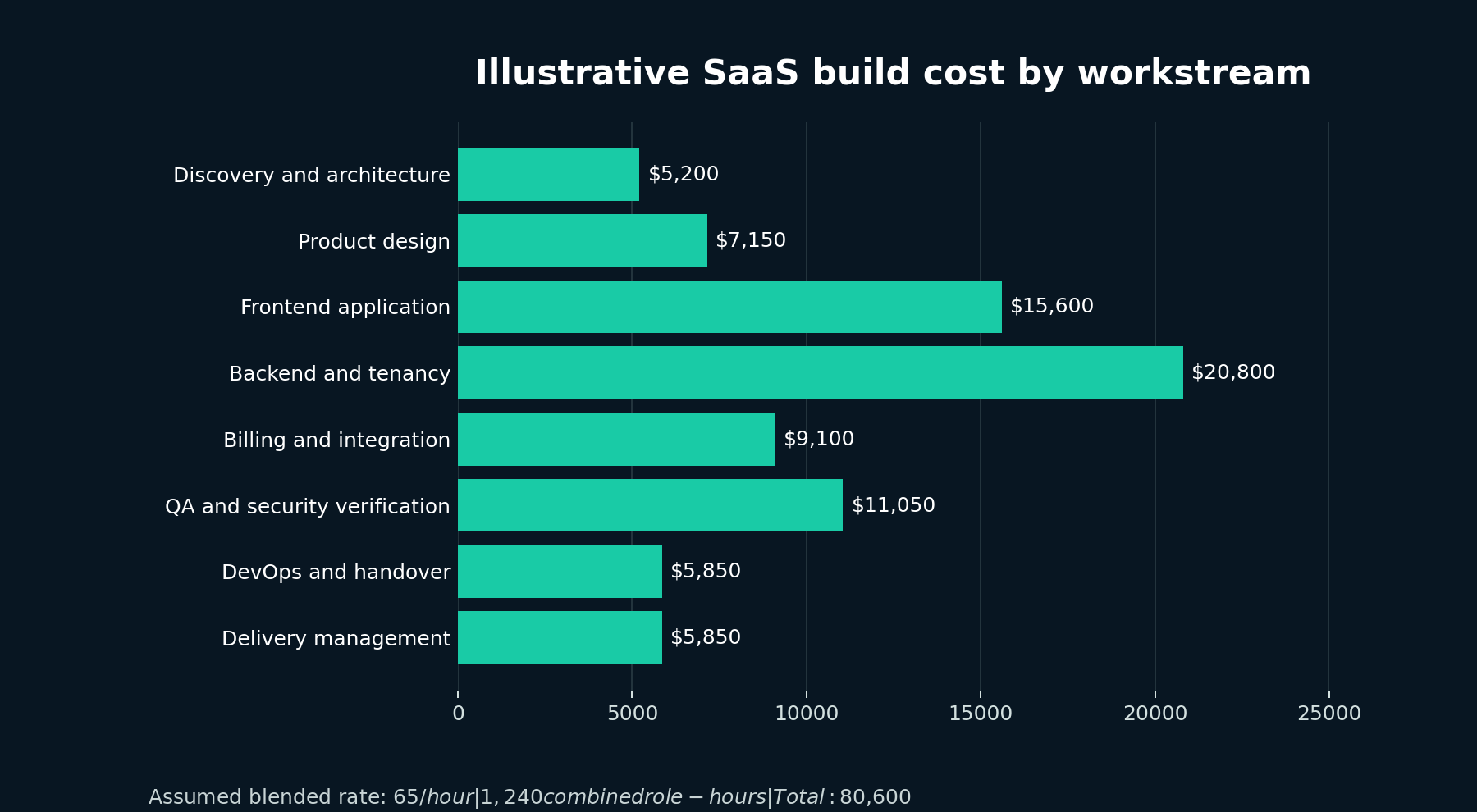
Illustrative workstream cost breakdown, based on the assumptions in the table above.
If stakeholders later request enterprise SSO or a second complicated integration, the estimate should change through a transparent, approved change request. Likewise, removing an entire nonessential workflow can reduce scope more predictably than negotiating down the hourly rate while keeping every requirement.
How Pricing Models Affect Budget Predictability
Model | Best when | Buyer advantage | Watch for |
|---|---|---|---|
Fixed price / fixed scope | Acceptance criteria and exclusions are stable | Defined baseline deliverables and price | Ambiguous change provisions or compressed QA |
Time and materials | Requirements need discovery or iteration | Flexible priorities and transparent effort | Unbounded burn unless governed by budgets |
Dedicated team | You have an ongoing roadmap and product ownership | Continuity and control of priorities | Monthly commitments without measurable outcomes |
A fixed-fee estimate is easier to budget when requirements are stable, while time-and-materials or a dedicated team can accommodate changes but needs an agreed spend cap, review cadence and change-control rules. The pricing model affects predictability, not the underlying amount of product engineering. For a detailed partner-selection discussion, see https://toadster.ai/blogs/how-to-choose-a-saas-development-company-in-usa-a-buyers-checklist.
SaaS Maintenance Costs and First-Year Total Cost of Ownership
A development quote is not the complete operating budget. After launch, separate contracted support obligations from usage-based cloud charges, payment processing, Billing subscription-management fees, and future feature work. Cloud compute, databases, backups, monitoring, email, and incident response should each have a named budget owner. A defect warranty is not the same as an ongoing maintenance contract, and compliance audits should be separately scoped where applicable. A related budgeting perspective is to separate the build budget from the operating budget before approving the total investment.
Stripe currently lists a pay-as-you-go Billing fee of 0.7% of eligible Billing volume on its published US pricing page. This is a Billing product fee, not the same as a card payment-processing fee. Both price and eligibility can vary by country, contract and product configuration, so check the applicable official Stripe Billing pricing and Stripe payment pricing before budgeting.
Line item | Baseline question | Budget owner |
|---|---|---|
Cloud infrastructure | What monthly traffic, database size and backups are assumed? | Engineering/Finance |
Payments and billing | What processing and billing fees apply to our region and product? | Finance/Product |
Monitoring and support | Who handles alerts, incidents, patches and escalation? | Operations |
Security and compliance | What verification, audits or legal review are required? | Security/Legal |
Product iteration | What roadmap spend is separate from defect warranty? | Product |
The following example combines the $80,600 illustrative build with assumed recurring expenses for twelve full months after launch. It is not a Toadster Technologies quotation or a representative industry benchmark. The period begins after the product is deployed, not at project kickoff.
Component | Illustrative cost |
|---|---|
Initial development | $80,600 |
Cloud infrastructure and tooling, $1,200 × 12 | $14,400 |
Maintenance and support, $2,000 × 12 | $24,000 |
Total: build plus 12 months after launch | $119,000 |
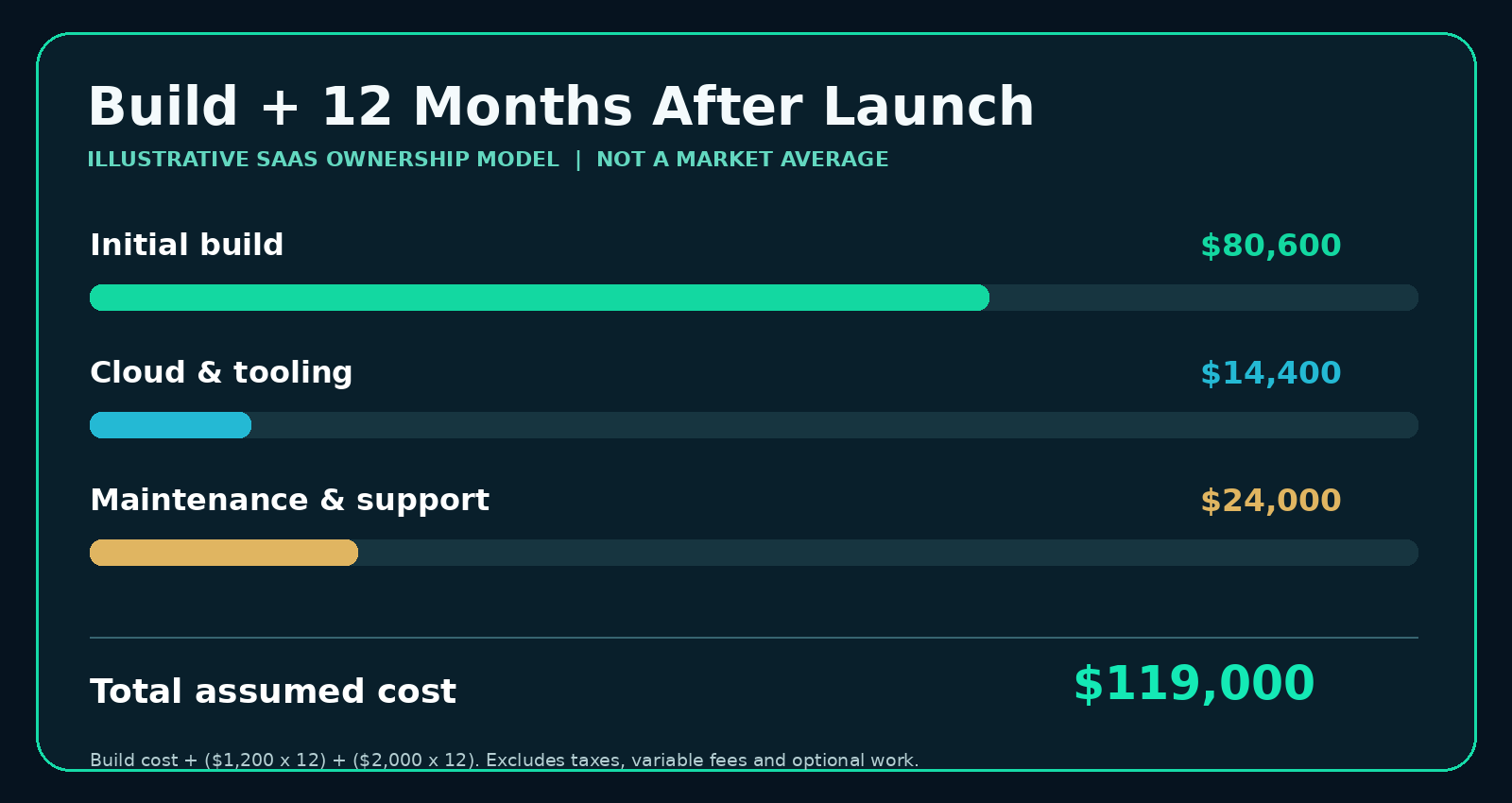
Illustrative ownership cost: initial build plus twelve months of post-launch operations.
What the illustrative ownership model does and does not cover
The $14,400 cloud and tooling allowance may contain both fixed subscriptions and volume-sensitive usage charges. The $24,000 maintenance assumption represents contracted post-launch support, not every future product enhancement. Vendor terms, actual load, incident coverage, third-party API pricing, taxes and compliance obligations must be assessed separately before treating this model as a forecast.
Budget calculation: $80,600 + ($1,200 × 12) + ($2,000 × 12) = $119,000 for the build plus twelve months of post-launch operations. This excludes optional features, variable payment-processing fees, taxes, external compliance audits and unapproved change requests.
How to Reduce SaaS Development Cost Responsibly
Reduce the first release to one complete paying-customer workflow, not a scattered collection of prototypes. Defer advanced analytics, extra integrations and secondary channels when customer validation does not yet require them. Reuse well-maintained identity, payment and observability services when their terms and architectural constraints fit. However, do not remove tenant authorization, data protection, backup recovery or essential testing just to advertise a lower initial price.
How to Get a More Accurate SaaS Cost Estimate
For a SaaS-specific estimate, define the number of customer organizations, users and roles; tenancy and isolation design; subscription tiers and billing events; integration inventory; data sensitivity; expected peak traffic; reporting workflows; performance and availability expectations; and what level of support starts at launch. Estimate each workstream, then identify uncertain assumptions and planned exclusions.
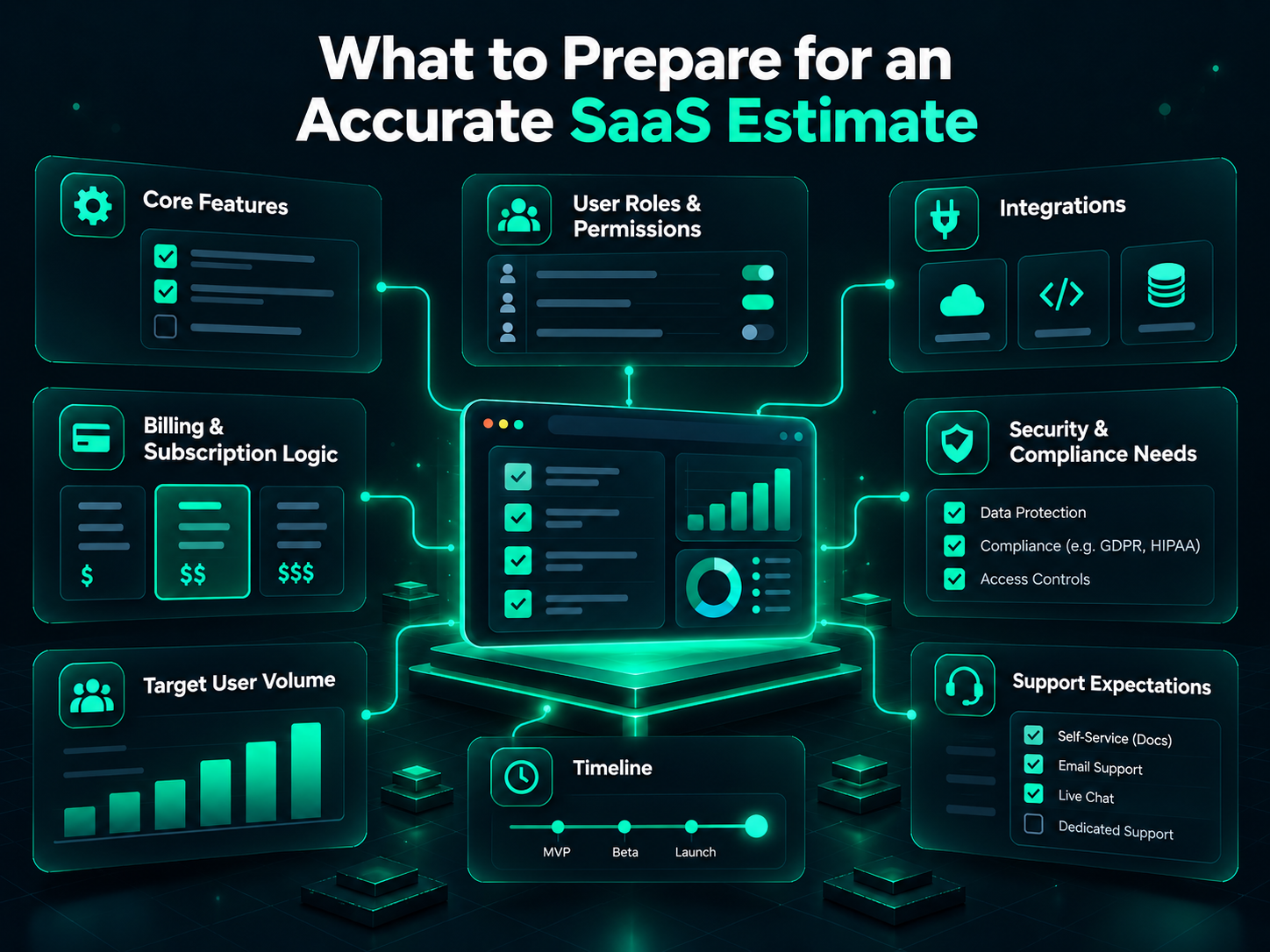
A SaaS estimate depends on defined features, roles, integrations, billing, security and support requirements.
how to choose a SaaS development companyMVP development cost guideGive every delivery partner the same technical scoping inputs. For qualifications and vendor evaluation, read how to choose a SaaS development company. For broader early-stage budgeting, consult the MVP cost guide after confirming its URL in your CMS.
Planning a SaaS Product? Start With a Realistic Scope
Discuss Your SaaS Development Requirements
A useful development estimate starts with your product requirements, not a generic package. Share your core workflows, customer organizations and user roles, planned integrations, billing model and launch priorities so Toadster Technologies can discuss your scope and delivery options.
Conclusion: Budget for the Product You Need to Operate
A useful SaaS budget is an explicit model of capabilities, assumptions and continuing obligations. Define the tenancy strategy, billing behavior, integrations, security checks, launch requirements and post-launch cost owners before treating an estimate as decision-ready. Use the SaaS company selection guide for the separate question of which provider to hire.
SaaS application development servicescontact the team about your product scopeExplore Toadster Technologies’ SaaS application development services or discuss your project requirements with the team.