


Modular Monolith vs Microservices: How to Choose Based on Real Scaling Needs
Your application is growing. Traffic is increasing, new features are becoming harder to release, and the engineering team is discussing whether the backend needs a different architecture.
One suggestion keeps coming up: move to microservices.
But does a growing application actually need independently deployed services? Or could a well-structured modular monolith support the same growth without introducing additional infrastructure and operational complexity?
The modular monolith vs microservices decision is not simply about which architecture can handle more traffic. Both approaches can support scalable applications. The difference lies in how they organize business functionality, allocate resources, deploy changes, and manage dependencies.
The short answer: A modular monolith is often a sensible choice when an application benefits from clear module boundaries but does not require independent service deployment or scaling. Microservices become more valuable when distinct business capabilities have different scaling, availability, ownership, or release requirements, and the organization can manage the complexity of a distributed system.
The better architecture is the one that addresses your application's actual constraints, not the one that appears more sophisticated.
Modular Monolith vs Microservices: The Differences That Matter
Before comparing scalability, it helps to understand what each approach actually changes.
What is a modular monolith?
A modular monolith architecture organizes an application into distinct functional modules while retaining a single deployable application.
For example, a SaaS platform might contain separate modules for authentication, billing, customer management, and notifications. Each module owns a clearly defined responsibility and communicates with other modules through controlled interfaces.
Unlike a tightly coupled monolith, a well-designed modular monolith limits unnecessary dependencies between these components.
However, the application is generally built and deployed as one unit.
This creates an important distinction: a single deployment does not automatically mean poorly organized code.
Microsoft's documentation on common web application architectures explains how applications deployed together can still benefit from logical separation.
Frameworks such as Spring Modulith provide mechanisms for organizing and validating internal application modules.
What are microservices?
Microservices divide an application into independently deployable services organized around specific business capabilities.
A billing service, for example, might have its own deployment pipeline, data ownership boundaries, runtime resources, and operational responsibilities. It communicates with other services through defined APIs or asynchronous messages.
This enables teams to deploy and scale selected services without necessarily redeploying the rest of the application.
However, independence introduces new responsibilities. Developers must account for network communication, distributed failures, data consistency, service monitoring, and deployment coordination.
Microsoft's microservices architecture guidance describes these capabilities and their accompanying operational considerations.
Key architecture differences
Factor | Modular monolith | Microservices |
|---|---|---|
Deployment | Typically one deployable application | Independently deployable services |
Code organization | Internal business modules | Separate services with defined boundaries |
Scalability | Typically scales application instances together | Can scale individual services |
Communication | Often in-process calls and internal events | Network APIs and asynchronous messaging |
Data management | Modules can have logical ownership boundaries within shared infrastructure | Each service should control its data access and schema boundaries; separate physical database servers are not universally required |
Testing | Module and application-level testing | Service, contract, and distributed integration testing |
Operations | Fewer distributed components to coordinate | More independently operating components to monitor and manage |
Release independence | Generally tied to the application release | Possible for individual services |
Neither architecture guarantees maintainability or performance.
A modular monolith with weak boundaries can become difficult to change. Similarly, a microservices system with excessive dependencies can require coordinated releases despite having separate deployments.
The distinction is not that monoliths share databases while microservices must always have separate database servers. Both approaches require careful data ownership. In microservices, the important principle is that services should not bypass one another's data-access boundaries, regardless of how the underlying infrastructure is deployed.
The architecture establishes possibilities. Engineering discipline determines whether those possibilities are realized.
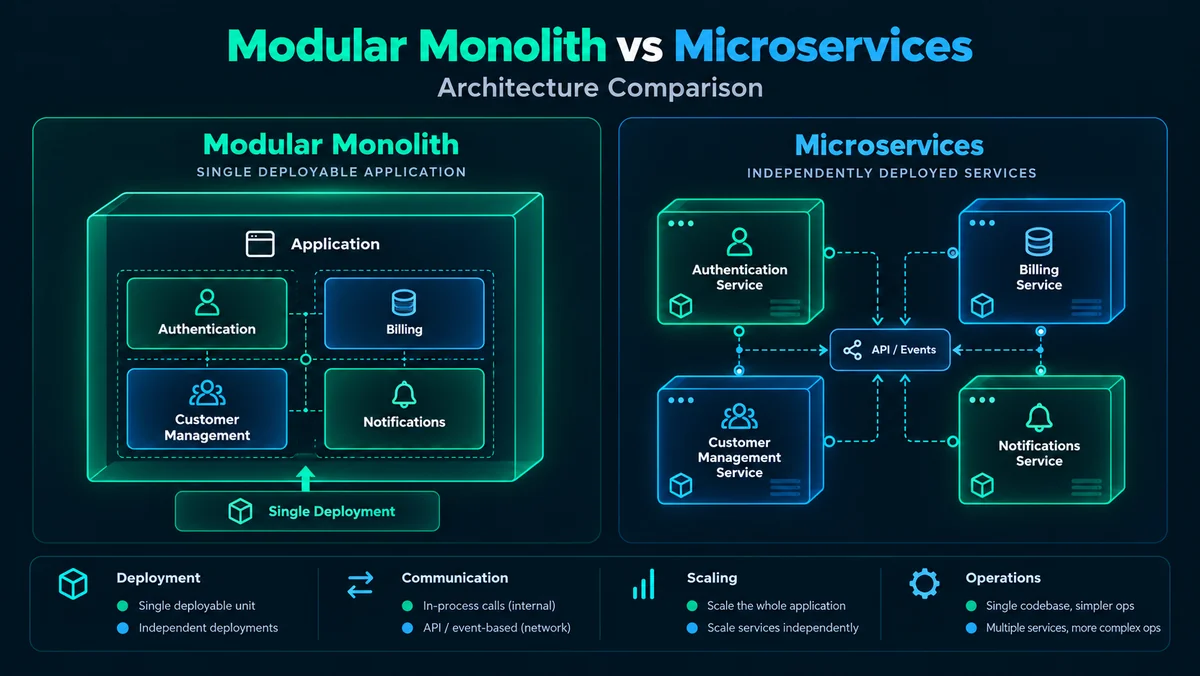
Figure 1. A modular monolith versus independently deployable microservices (conceptual illustration).
How Do Modular Monoliths and Microservices Scale Differently?
Scalability is frequently used to justify moving toward microservices, but the term can describe several different problems.
An application may need to process more requests, handle larger background jobs, support additional customers, or allow engineering teams to release changes independently.
Those requirements do not necessarily demand the same architectural response.
Can a modular monolith scale horizontally?
Yes. A modular monolith can scale horizontally by running multiple instances of the application behind a load balancer.
For example, if an application receives more API traffic, additional instances may help distribute incoming requests.
This requires suitable application design. Session handling, shared state, database capacity, caching, and coordination between instances must be considered.
The important limitation is scaling granularity.
When the application is replicated, its deployable components are generally replicated together, even if only one component is responsible for the increasing workload.
That does not necessarily make horizontal scaling inefficient. It depends on the size of the application, its resource usage, and the infrastructure supporting it.
When does independent microservice scaling become useful?
Independent scaling becomes attractive when different application capabilities place substantially different demands on infrastructure.
Consider a SaaS platform where customer-management operations remain relatively stable, but notification processing experiences large spikes.
A microservices architecture could allow the notification service to scale separately from customer management and billing.
Microservices allow teams to allocate resources to selected services independently, but the benefit depends on workload characteristics, service dependencies, and the infrastructure required to operate them.
However, the same problem does not automatically require a microservices migration.
A modular monolith can also use message queues, asynchronous processing, background workers, and event-driven communication. These patterns do not belong exclusively to microservices.
For example, notification processing could run in separate workers while the application's core business logic remains organized as a modular monolith.
The engineering team should first establish whether the existing deployment model is actually preventing efficient scaling.
The relevant question is not: Can microservices scale independently? They can.
The more useful question is: Does our application have a measured scaling requirement that makes independent deployment and resource allocation worth the additional complexity?
Why don't microservices automatically perform better?
When an application is divided into independently deployed services, communication that previously occurred inside one process may require network requests.
Those requests introduce additional considerations, including latency, serialization, retries, timeouts, and partial failures.
A request that depends on multiple services may also become harder to diagnose.
Microservices can improve system design when service boundaries align with genuine business and operational needs. But splitting an application into more services does not inherently make each request faster.
For performance decisions, engineering teams should evaluate their own workloads rather than relying on generic claims that one architecture is always faster.
Useful measurements include request latency, throughput, CPU and memory utilization, database performance, queue backlogs, and the behavior of the system under realistic load.
Microsoft's microservices architecture documentation explains why service independence must be considered alongside distributed communication and operational requirements.
For a complementary discussion of why distributed services do not automatically improve throughput, see why more services do not always mean better scalability. The article examines performance bottlenecks and the trade-offs of introducing network boundaries.
Maintainability, Deployment, and Operational Complexity
Scalability is only one part of the architecture decision.
An application also needs to remain understandable, testable, reliable, and practical to operate as its functionality grows.
How do module boundaries affect maintainability?
The main maintainability advantage of a modular monolith comes from separating responsibilities.
A billing module should expose an approved interface for relevant operations instead of allowing customer-management code to directly access its internal implementation or manipulate billing records.
Likewise, a customer-management module should not become dependent on the private implementation details of the notification module.
Clear boundaries make it easier to reason about changes, limit accidental coupling, and test individual responsibilities.
But naming folders after business functions is not enough.
Teams must actively enforce dependencies and review interactions between modules.
For Java applications using Spring Boot, Spring Modulith's official documentation describes structural validation, application-module models, module interfaces, and approaches to verifying modular arrangements.
These mechanisms demonstrate how modularity can become an enforceable engineering practice rather than a naming convention.
Developers looking for a hands-on implementation can explore enforcing module boundaries with Spring Modulith, including example interfaces and dependency-verification tests.
What changes when services deploy independently?
Microservices can allow separate engineering teams to release and operate different capabilities without rebuilding the entire application.
This becomes valuable when business functions genuinely require different release schedules or operational ownership.
However, independent deployment also requires reliable communication contracts.
Teams need to understand what happens when one service is unavailable, when an API changes, or when an operation involves data managed by several services.
Logging and troubleshooting also become more complex when a single user request crosses multiple service boundaries.
Distributed tracing, centralized monitoring, service-level health checks, and automated deployment processes become increasingly important.
These are established considerations in Microsoft's microservices architecture guidance.
For engineering teams without mature operational practices, introducing multiple services may create more work than the architecture currently saves.
Organizations evaluating deployment automation, monitoring, and infrastructure management can also explore DevOps services as part of that assessment.
The decision should account for the architecture the team can operate reliably, not merely the architecture it can implement.
For an example of distributed architecture in practice, explore Toadster Technologies' Ignis Analytics case study. It describes an event-driven AWS implementation using serverless services and automated deployment workflows. The project illustrates architecture selected for particular requirements, not a direct modular-monolith-versus-microservices benchmark.
Which Architecture Costs More to Build and Operate?
There is no reliable universal percentage showing how much more or less a modular monolith costs compared with microservices.
Actual costs depend on application size, workload, cloud infrastructure, deployment practices, engineering expertise, monitoring requirements, and service dependencies.
A meaningful comparison should separate several cost categories.
Cost category | Modular monolith considerations | Microservices considerations |
|---|---|---|
Application infrastructure | Resources commonly allocated to shared application deployments | Resources can be assigned per service, with additional infrastructure possible |
Deployment | Generally fewer independently deployed units | More deployment pipelines and service configurations |
Monitoring | Application and module-level observability | Cross-service tracing, monitoring, and correlation |
Networking | Many module interactions occur within the application process | Interservice communication can add network usage |
Testing | Module and integrated application tests | Additional contract and distributed integration testing |
Engineering operations | Shared release and runtime management | Service ownership, incident coordination, and operational automation |
Microservices may enable more targeted infrastructure allocation when workloads differ significantly.
At the same time, maintaining several independently operating services can increase operational responsibilities.
A modular monolith may simplify deployments and troubleshooting, but replicating a large application to support one heavily used function may create unnecessary resource consumption in some situations.
Neither outcome can be quantified without examining a specific application.
How should businesses compare the costs?
Start by documenting the current or expected workload.
Identify the resources required to run the application, the services or infrastructure it depends on, and the engineering effort needed to maintain reliable releases.
Then compare technically feasible deployment alternatives using equivalent workload assumptions.
The comparison should include both direct cloud charges and engineering effort.
Otherwise, a design that appears cheaper based on infrastructure billing alone may be more expensive to maintain.
The objective is not to prove that one architecture is universally cheaper. It is to understand which approach delivers the required performance, reliability, and flexibility at an acceptable total cost.
Architecture Example: A Growing SaaS Application
Consider a hypothetical B2B SaaS application with four functional areas:
- Authentication and user access
- Subscription billing
- Customer management
- Email and notification processing
The product initially has predictable usage patterns, a shared engineering team, and no clear requirement to release each capability independently.
This example is illustrative, not a description of a Toadster Technologies client project or a measured performance experiment.
For companies planning a subscription-based product, tenancy, authentication, billing, onboarding, and future feature requirements are also important parts of SaaS application development.
The application as a modular monolith
The engineering team could organize the application into four internally separated business modules.
Each module would expose controlled interfaces and limit access to its internal implementation.
The application would be built and deployed as a single unit.
This could allow the team to maintain clear domain boundaries while keeping deployment, monitoring, and infrastructure relatively straightforward.
If application traffic increases, the team might scale the deployment horizontally, optimize database queries, introduce caching, or move suitable background work into asynchronous processing.
These options should be investigated before concluding that a distributed architecture is necessary.
The application as microservices
Alternatively, the team could deploy authentication, billing, customer management, and notifications as separate services.
Each service would have defined responsibilities, communication contracts, and deployment processes.
The notification service could receive events from other services and process them independently.
For example, a completed subscription payment might trigger an event used to initiate a confirmation notification.
The architecture would also require decisions about delivery failures, duplicate events, data ownership, retries, security, and monitoring.
Microsoft's event-driven architecture guidance explains the relationships between event producers, consumers, and communication channels.
Event-driven processing is not exclusive to microservices. A modular monolith may also publish and consume events or process background messages.
The additional value of microservices would come from independently deploying and operating the selected capabilities when that independence is justified.
What happens when notification traffic increases?
Imagine the notification workload grows substantially while customer-management traffic remains stable.
The engineering team should first identify where the pressure is occurring.
Is the application consuming excessive CPU? Is the database becoming a bottleneck? Are external email providers limiting throughput? Is a background queue accumulating work?
If a background worker can process notifications independently while the main application remains modular, separating the entire system into microservices may be unnecessary.
If notification processing requires distinct deployment schedules, resource allocation, reliability controls, and operational ownership, extracting that capability into a separately deployed service may become more attractive.
The lesson is that observed constraints should shape architecture decisions.
The fact that an application is growing does not, by itself, establish that its modules need to become microservices.
What Should You Measure Before Choosing an Architecture?
This is where architecture discussions should move beyond preference and theory.
Before choosing modular monoliths or microservices, a CTO or engineering lead should gather evidence about how the product operates and where its actual constraints lie.
The following framework is a practical evaluation method, not a standardized industry scoring system.
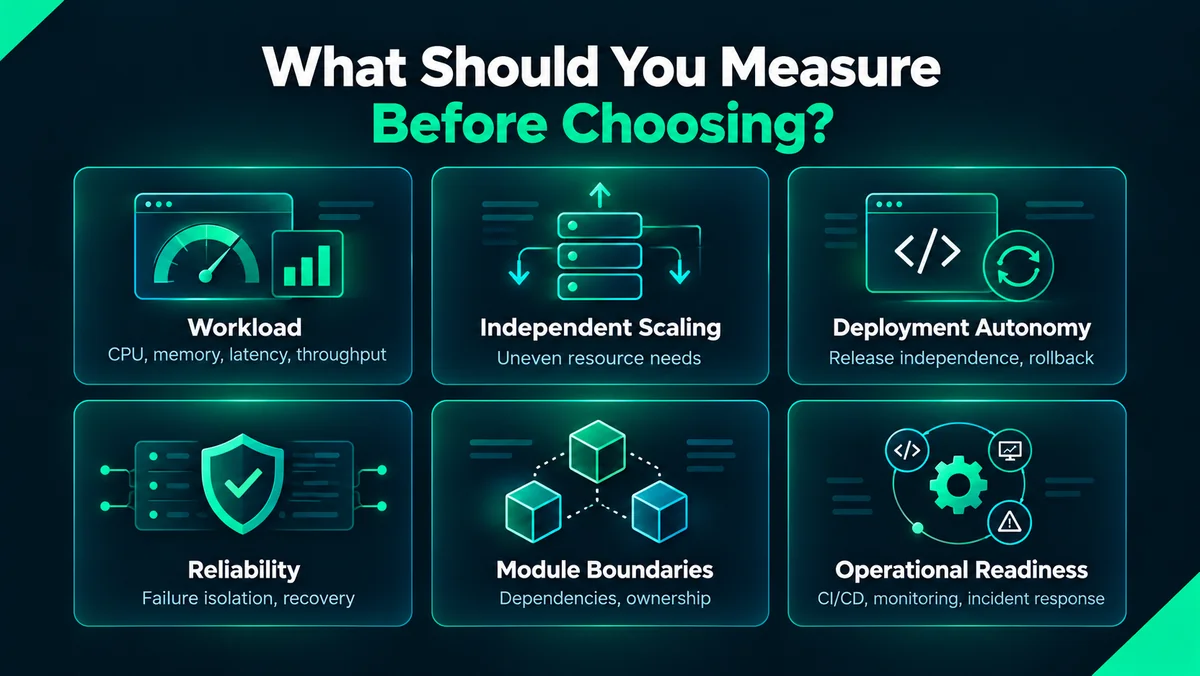
Figure 2. Six evidence areas to review before choosing a software architecture.
1. Measure workload characteristics and bottlenecks
Start with actual or realistically estimated usage.
- Request throughput and peak traffic patterns
- Response-time distributions, including p95 and p99 latency
- CPU and memory utilization
- Database contention and slow queries
- Queue lengths, processing delays, and retry rates
- Failure rates and service availability
Different bottlenecks call for different solutions. For example, slow database queries do not necessarily become faster simply because application code is separated into services.
Before changing architectural boundaries, establish which component is constrained and why.
2. Evaluate independent scaling requirements
Determine whether different parts of the application consume resources in meaningfully different ways.
Do some capabilities experience traffic spikes while others remain stable? Does a particular function require CPU-intensive processing while most requests are lightweight?
Could background processing or scaling application instances resolve the issue without separating deployments?
Independent scaling is an advantage only when it helps address a relevant workload constraint.
3. Examine deployment and ownership needs
Review how frequently application capabilities change and whether releases interfere with one another.
Ask whether separate teams need to deploy different capabilities independently.
Also investigate whether the current release process creates delays because unrelated features share the same deployment.
Useful evidence may include deployment frequency, release dependencies, rollback history, and incidents caused by coordinated changes.
Independent deployment can help, but only if service boundaries and contracts are designed to reduce coordination.
A distributed application that still requires synchronized releases may deliver less autonomy than expected.
4. Assess reliability and failure isolation
Consider what happens when an important component fails. Which user journeys must remain available? Can a failure be isolated, or do dependencies create a wider outage?
Review incident history, service dependencies, recovery objectives, and the consequences of critical component failures.
Microservices provide opportunities for fault isolation, but reliable isolation depends on communication design, timeouts, retry policies, resource limits, and operational controls.
Similarly, a modular monolith can use defensive design, background jobs, and external systems to improve resilience without fully distributing its business logic.
5. Evaluate operational readiness
Independent services require more than separate code repositories.
- Automated builds and deployments
- Centralized logging and tracing
- Monitoring and alerting
- Service authentication and access control
- Incident response
- API and event-contract changes
- Data consistency across service boundaries
If these practices are not sufficiently mature, additional services may increase operational risk.
6. Review business-domain boundaries
Finally, determine whether the application's responsibilities are understood well enough to separate them safely.
A service boundary should represent meaningful ownership of a business capability, not merely a desire to create smaller codebases.
If multiple proposed services continuously depend on each other's internal data or require tightly coordinated changes, their boundaries may need further refinement.
Useful evidence includes dependency maps, frequently coordinated code changes, ownership responsibilities, and cross-module access patterns.
This is one reason a modular monolith can be valuable during earlier stages of product development: it allows teams to organize business capabilities without requiring every boundary to become a network boundary immediately.
Architecture decision checklist
Decision area | Evidence to collect | What it helps determine |
|---|---|---|
Performance | Throughput, p95/p99 latency, CPU, memory, database bottlenecks | Whether current capacity or design is genuinely constrained |
Scaling | Resource usage and workload differences between capabilities | Whether independent scaling would solve a real problem |
Deployment | Release frequency, coupled changes, rollback requirements | Whether teams need independent deployment |
Reliability | Incident patterns, service dependencies, recovery objectives | Whether stronger failure isolation is required |
Modularity | Dependency maps, cross-module access, domain ownership | Whether safe architectural boundaries exist |
Operations | CI/CD maturity, monitoring coverage, incident ownership | Whether the team can operate distributed services reliably |
This framework is not intended to produce a universal numerical score. Its purpose is to make assumptions visible and support an evidence-based discussion.
If the team cannot yet demonstrate why independent services are necessary, collect the missing measurements or test a smaller architectural change before committing to a distributed redesign.
Document the observed bottlenecks, deployment requirements, architecture options, expected trade-offs, and assumptions that still need testing. Use that record to justify the decision and identify when it should be revisited.
When Should You Extract Microservices from a Modular Monolith?
A modular monolith does not need to become microservices simply because the product becomes larger.
Migration should address a specific problem that the existing design cannot solve effectively.
Potential reasons to consider selective extraction include a capability that repeatedly requires different scaling resources, a need for independent releases, or clearly separated operational ownership.
Before extracting a service, engineering teams should examine whether the problem can be solved through simpler changes.
Those changes might include improving module boundaries, optimizing database access, adding background processing, introducing caching, or adjusting deployment infrastructure.
When extraction is justified, begin with a well-understood business capability whose responsibilities and dependencies can be separated.
The migration also needs a plan for data ownership, service communication, monitoring, rollback, and failure handling.
For a focused explanation of the practical signals behind that decision, see the engineering guide on when a module should become a microservice. It expands on release independence, resource isolation, and operational readiness without replacing the criteria above.
Extracting a service without addressing those concerns may move complexity rather than reduce it.
The preferred end state does not have to be entirely monolithic or entirely distributed.
A product can retain a modular core while using separate services or workers for capabilities that genuinely benefit from independent operation.
The objective is architectural fitness, not adherence to a particular architectural label.
Final Recommendation: Choose Based on Constraints, Not Architectural Trends
A modular monolith offers organized business modules within a shared deployment. Microservices provide independent deployment and scaling when those capabilities address real needs.
Base the choice on measured workloads, reliability objectives, release requirements, domain boundaries, and your team's operational capacity. Document the trade-offs so the architecture can evolve as requirements change.
Not Sure Which Architecture Fits Your Software?
Choosing between a modular monolith and microservices depends on your product requirements, existing infrastructure, and long-term engineering priorities.
Toadster Technologies provides software development services for businesses planning new applications and evaluating existing systems.
Request an Architecture Consultation to discuss the technical requirements and trade-offs relevant to your software project.