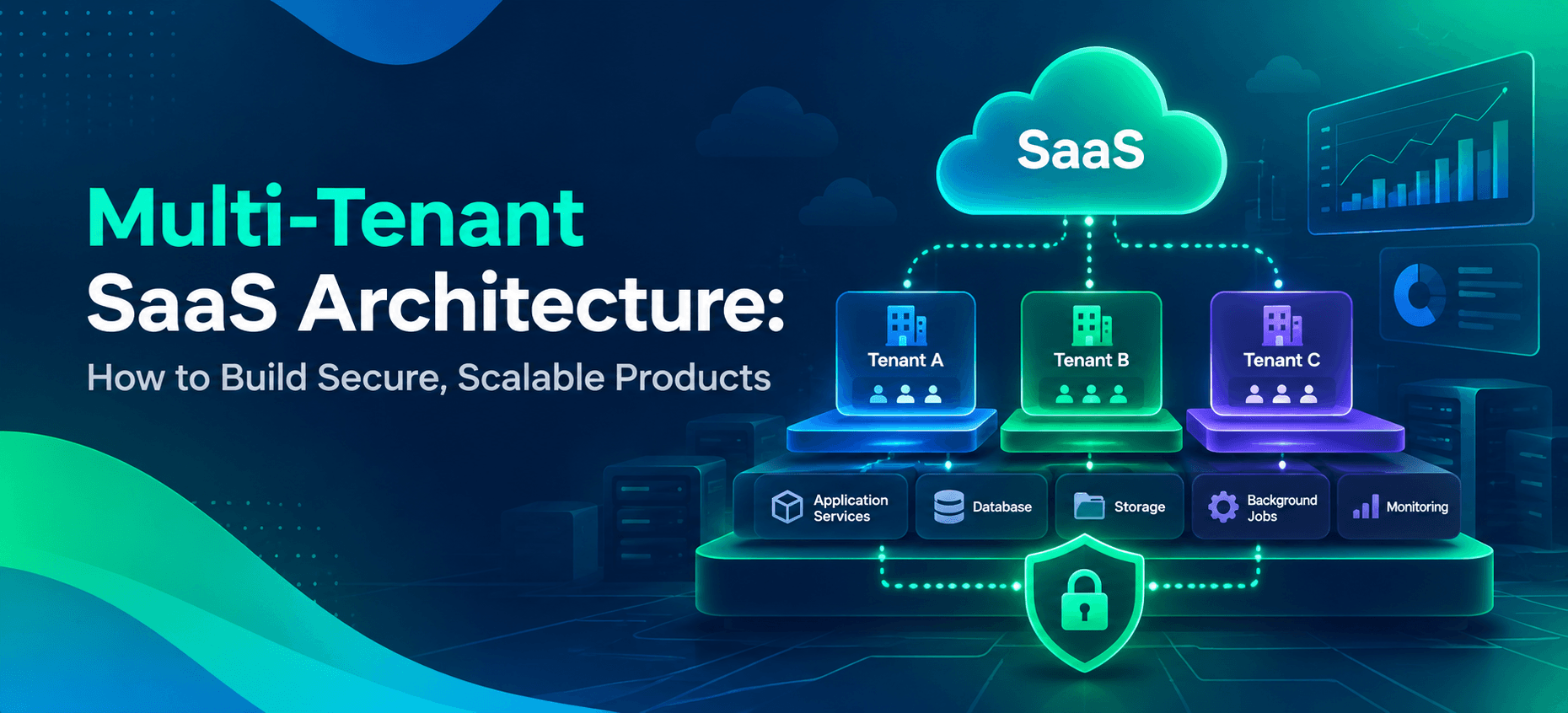
Multi-Tenant SaaS Architecture: How to Build Secure, Scalable Products
A SaaS product may work well for its first ten customer organizations. At a hundred customers, the engineering problems become less predictable. One company’s analytics job can slow down another company’s dashboard. An administrator may need access to two organizations without ever mixing their data. An enterprise buyer may ask for a dedicated database while smaller customers continue using shared infrastructure.
These are not simply hosting problems. They are decisions about multi-tenant SaaS architecture, the way a product shares application components while preserving each customer’s security and operational boundaries.
The short answer: To build a secure, scalable multi-tenant SaaS application, define tenant ownership and permissions first; select an appropriate infrastructure and database model; establish trusted tenant context on every request; enforce isolation in APIs, databases, files, caches, and jobs; then test cross-tenant access and resource contention before launch.
A shared platform can reduce duplicated infrastructure, but sharing alone does not make a product secure or inexpensive to operate. The architecture needs to match actual customer requirements, workload patterns, and the team’s ability to run it reliably.
What Is Multi-Tenant SaaS Architecture?
Multi-tenant SaaS architecture is a software design approach in which multiple customer organizations use shared application components while their identities, data, permissions, and resources are separated through defined controls. Each organization is called a tenant.
Consider a project management platform serving three businesses. All three use the same task, document, and reporting features. Company A should not be able to see Company B’s projects, even if both organizations’ records occupy the same database tables. Company C might need different subscription limits or a dedicated database without requiring a completely different product.
Multi-tenancy does not mean every layer must be shared. An application can share its API servers while keeping selected customer databases separate. Nor does a tenant_id field, by itself, enforce isolation. The boundaries must hold throughout the request lifecycle.
How does a tenant-aware request work?
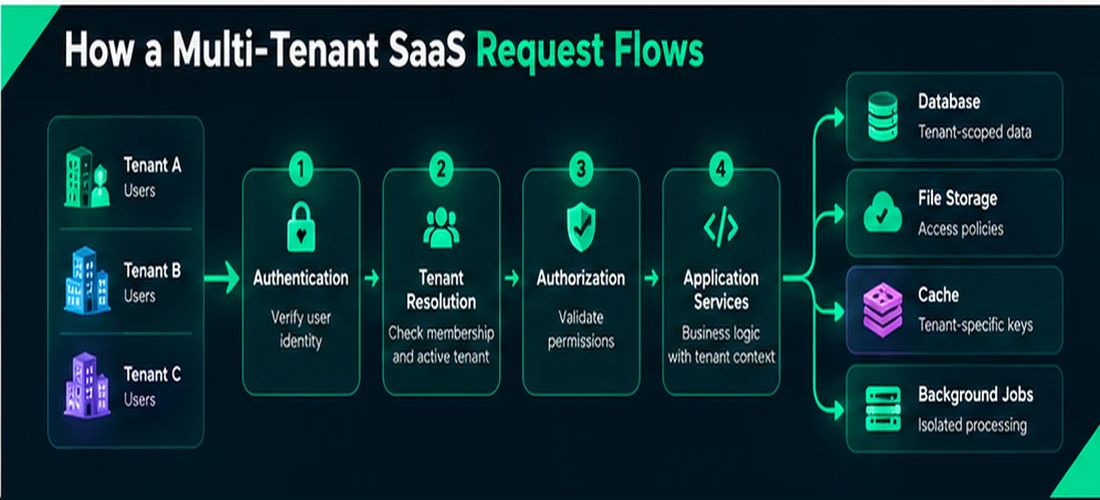
A typical request begins with authentication, which establishes the user’s identity. The application then determines the active organization, verifies membership, checks permissions for the requested resource, and executes the operation through tenant-aware services. Database policies and access controls at other storage layers provide additional safeguards.
The same requirements apply if the request launches a report-generation job, retrieves a cached result, or creates a signed document URL. A trusted tenant context must survive those transitions, rather than being inferred from an unchecked browser parameter.
Single-Tenant vs Multi-Tenant SaaS Architecture
A single-tenant deployment typically gives each customer a dedicated application environment. Multi-tenant SaaS lets customers share selected application or infrastructure components while enforcing tenant-specific boundaries. Both approaches can support enterprise products, but they place different demands on engineering and operations.
Decision factor | Single-tenant SaaS | Multi-tenant SaaS |
|---|---|---|
Application deployment | Commonly dedicated per customer | Shared components can serve many customers |
Data separation | Often dedicated resources | Logical or physical isolation, depending on model |
Deployment updates | Customer environments may need separate coordination | Shared components can be released centrally |
Customization | Environment-specific changes can be easier | Configuration-driven differences are usually preferable |
Resource utilization | More capacity may be allocated per customer | More opportunities to pool resources |
Performance isolation | Dedicated capacity can simplify boundaries | Contention controls are important |
Operating complexity | Many environments to provision and manage | Tenant-aware access and operations to manage |
Neither model wins by default. A product selling mostly standardized subscriptions may benefit from pooling. A customer with contractual isolation requirements may justify dedicated resources. Hybrid SaaS platforms can support both without maintaining separate application codebases.
Multi-Tenant SaaS Architecture Patterns and Database Models
Two related choices must be made: which application or infrastructure resources are shared, and how tenant data is partitioned. These decisions are related but not interchangeable.
Pooled, siloed, and bridge infrastructure patterns
In a pooled model, tenants share selected compute and application resources. This can improve utilization, but the platform needs authorization, observability, and safeguards against one tenant consuming disproportionate capacity.
A siloed model allocates resources to a particular tenant. It can support stronger separation or more predictable allocation, while increasing provisioning and management work.
A bridge, or hybrid, model mixes shared and dedicated components. For example, a SaaS platform may share its frontend and API but offer dedicated databases to enterprise customers. AWS describes these tenant isolation strategies in its SaaS Tenant Isolation Strategies guidance.
Shared schema, separate schemas, or databases per tenant?
Database pattern | Practical strength | Main responsibility |
|---|---|---|
Shared database, shared schema | One set of tables; efficient resource sharing | Consistent tenant-scoped authorization, queries and policies |
Shared database, separate schemas | Logical organization of each tenant’s tables | Schema migrations, permissions and object growth |
Database per tenant | Independent database operations and some recovery options | Automated provisioning, monitoring and migration across databases |
Hybrid database allocation | Different isolation levels for different customer tiers | Reliable tenant routing and controlled migrations |
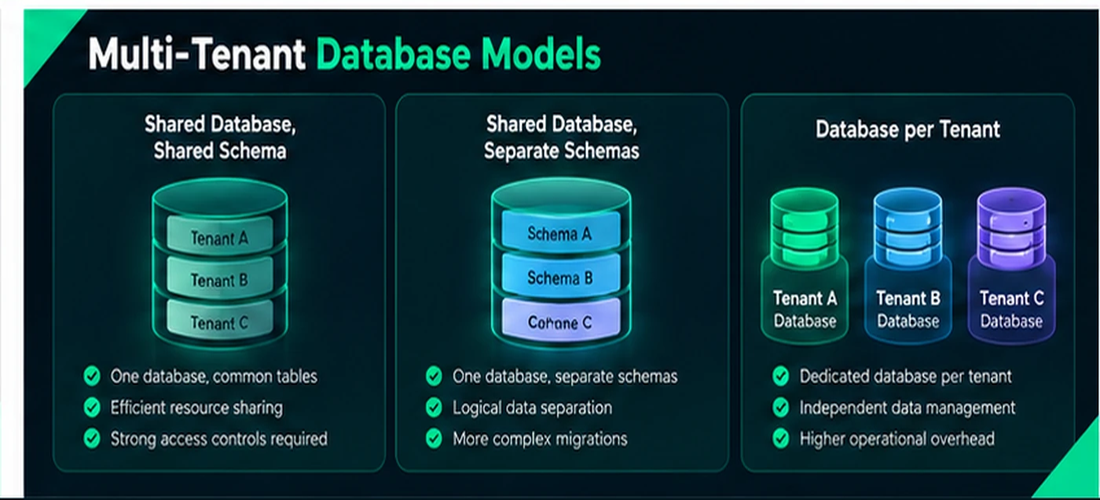
The trade-offs are significant. In a shared database, restoring one tenant’s records may require restoring a backup to a separate environment and selectively recovering that tenant’s data. Database-per-tenant may simplify that operation but requires managing many separate databases. Microsoft’s SaaS tenancy design patterns documentation discusses cost, monitoring, customization, and recovery implications.
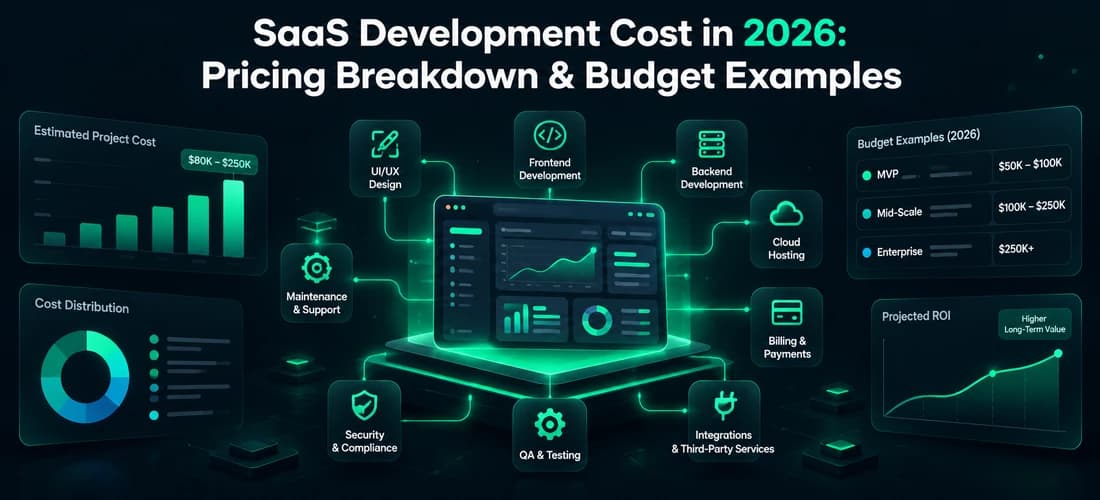
Cost estimates also depend on the isolation and recovery model: how SaaS product decisions influence cost estimates is a related discussion of the trade-offs that change implementation scope.
The starting decision should be written down, along with workload assumptions, isolation requirements, alternatives rejected, and conditions that would justify changing the model.
How to Build a Multi-Tenant SaaS Application: Step by Step
The following eight-step approach uses a hypothetical B2B project management product. It is an illustrative engineering framework, not a claim about a client implementation or a universal industry standard.
1. Define tenant boundaries and ownership
Start by specifying what a tenant represents, which users can belong to multiple tenants, and which records belong to an organization rather than an individual. A useful initial model includes tenants, users, tenant_memberships, roles, projects, and subscriptions.
For every protected resource, decide whether it is tenant-owned, globally shared, or intentionally shareable across organizations. Document allowed actions for administrators, managers, and ordinary users. A global reference table may be shared; a private contract should not be.
Deliverable: A tenant ownership model and authorization matrix.
2. Choose the infrastructure and database model
Use expected tenant counts, workload variation, customer isolation requirements, recovery objectives, and operating capacity to select a tenancy pattern. Our illustrative product could begin with shared application services and shared PostgreSQL tables, but only if suitable authorization and database controls are in place.
Design clear tenant-routing and data-access interfaces even if the first release supports only one storage model. This makes it easier to evaluate dedicated databases later, without pretending migration will be effortless.
Deliverable: An architecture decision record, including assumptions and future reassessment triggers.
3. Resolve the active tenant from trusted identity
A tenant-specific URL such as company-a.example.com can identify the organization the user wants to access. It must not, by itself, authorize access. The backend should authenticate the user, verify current organizational membership, establish the active tenant, and validate permissions for the specific operation.
For users belonging to multiple organizations, switching tenants requires a fresh authorization decision. An untrusted request header or user-editable tenant_id must never become the authority for tenant access.
Deliverable: A documented request flow with tested tenant switching.
4. Implement tenant-aware authorization
Authentication answers who is requesting access? Authorization answers which action may that identity take on which tenant-owned resource? A tenant administrator may manage members of Company A but not Company B. Even within Company A, a project manager’s access may be limited to assigned projects.
Apply checks at trustworthy service boundaries and maintain object-level authorization. Frontend visibility controls are useful for usability but are not access controls. Where services call other services, establish and validate the relevant security context again at the receiving boundary.
Deliverable: Testable membership, role, and resource-level permission rules.
5. Protect tenant-owned database records
A shared-schema table might contain an id, tenant_id, project name, and timestamps. A normal query should constrain records to the verified tenant. For defense in depth, PostgreSQL row-level security (RLS) can restrict which rows a database role can read or modify.
For example, a policy may compare a row’s tenant_id with a tenant context that the application establishes after server-side authorization. The policy alone is not a complete security system: application-defined session variables are not trusted identity mechanisms, and privileged roles can bypass some RLS restrictions. Connection pooling and transaction-local context require particular care.
The official PostgreSQL Row Security Policies documentation explains policy behavior, default-deny rules, ownership behavior, and bypass privileges. Production SQL and role design should be validated against the actual deployment environment rather than copied from a generic illustration.
Deliverable: Database access controls tested with the same roles and connection patterns used in production.
6. Automate tenant onboarding and lifecycle changes
Creating a tenant may involve recording its identity, assigning an initial administrator, provisioning storage, installing default settings, and applying subscription entitlements. Build the process so it can safely retry failed steps without activating a half-provisioned organization.
Account for suspension, upgrades, exports, cancellation, retention, and offboarding. Deleting an active tenant record without considering generated files, caches, backups, and credentials can leave customer data in unexpected places.
Deliverable: A repeatable onboarding and offboarding workflow with failure handling.
7. Scope APIs, caches, files, and background work
Tenant isolation extends beyond SQL queries. A report-generation worker receiving a queue message should re-establish trusted tenant context before loading records. A cache holding tenant-specific results needs appropriately scoped keys and authorization when the result is served. A file download URL must not be generated without validating ownership and access.
For example, tenant:A:report:123 is a more useful tenant-specific cache namespace than report:123, but namespacing by itself does not grant or verify authorization. The same principles apply to object storage, search indexes, exports, webhooks, and scheduled jobs.
OWASP’s Multi-Tenant Security Cheat Sheet provides a broader security review framework.
Deliverable: A map of all tenant-owned data paths and validated isolation controls for each.
8. Deploy, test, and validate tenant isolation
Use reproducible deployments, appropriate environment separation, migration procedures, secure secrets, monitoring, and rollback plans. Database changes in a shared schema may affect every tenant; changes in a database-per-tenant model may need coordinated automation across many databases.
Create two test organizations with separate accounts and records. Confirm that Tenant A can perform authorized operations on its own resources and is denied reads, updates, deletes, and downloads from Tenant B. Repeat tests through API endpoints, workers, storage access, and reused database connections.
Deliverable: A deployment checklist and automated isolation test suite that runs before release.
How to Secure Multi-Tenant SaaS Applications
The key security principle is to enforce tenant boundaries at every place that processes protected resources. A correct database query does not protect an unsafe file endpoint; a secure login does not prevent an API from accepting a cross-tenant document identifier.
Protect resource-level access, not just login sessions
An endpoint such as GET /api/projects/123 must check that the authenticated caller has permission to access project 123 in its actual owning organization. Guess-resistant identifiers do not replace this check. Read, write, delete, export, and administrative operations all need the appropriate authorization path.
Separate privileged operations from tenant requests
Billing administration, support investigations, and infrastructure management may require legitimate platform-level privileges. Those paths should be explicitly authorized, least-privileged, logged, and auditable. Normal customer requests should not run with unrestricted database administrator credentials.
Test the actual isolation boundaries
Test case | Expected behavior |
|---|---|
Tenant A reads its own permitted project | Allowed |
Tenant A requests Tenant B’s project | Denied |
Tenant A changes a tenant ID in the request | Does not bypass membership or object authorization |
A reused database connection handles a new tenant | Previous tenant context does not leak |
A report worker handles a tenant-scoped job | Permissions and resource ownership are re-established |
A file URL is requested for another tenant | Access denied |
Security guidance should not suggest that RLS, encryption, or separate databases alone guarantees safety. The final assurance comes from combined design controls, implementation discipline, and testing.
How to Scale Multi-Tenant SaaS Products
As the product grows, determine which shared resource is actually constrained before adding architectural complexity. The right answer to slow reports may be query optimization or queued processing, not necessarily a new cluster or a microservices rewrite.
Prevent noisy-neighbor resource contention
A noisy neighbor is a tenant whose activity disproportionately consumes a shared resource. Large exports could saturate workers or database connections while other customers wait for ordinary requests. Consider per-tenant concurrency limits, fair scheduling, background queues, query optimization, resource quotas, and selectively dedicated capacity.
These capacity decisions can also affect packaging and subscription tiers. A related perspective explores the noisy-neighbor problem and SaaS pricing from the product-economics side.
Scale services and storage deliberately
Stateless API instances can often scale horizontally behind a load balancer, but database connections, session handling, caches, and shared state still need management. Database improvements may include indexing, query tuning, suitable replicas, partitioning, or distributing tenants across databases. Sharding introduces tenant routing and data migration responsibilities, so it should answer a measured requirement.
Monitor tenant experience, not only platform averages
Signal | What it tells the team |
|---|---|
Tenant-level request latency | Which customers experience slow responses |
Error rates by tenant | Whether failures are isolated or widespread |
Database utilization and slow queries | Which operations constrain capacity |
Queue depth and processing time | Whether asynchronous work is falling behind |
Storage and transfer growth | Where costs or limits are rising |
Provisioning failures | Whether tenant lifecycle automation is reliable |
Plan recovery at the tenant level too. A database backup is not necessarily a way to restore one customer without changing the records of others. The recovery strategy must be exercised before the business depends on it.
Architecture Example: A Growing B2B SaaS Product
Imagine a project management platform with shared web and API services, a PostgreSQL database, a cache, file storage, and a queue for report generation. This is an illustrative product, not a Toadster Technologies case study.
When an employee from Company A creates a project, the system authenticates the employee, confirms Company A membership, checks the create permission, and writes a record scoped to Company A. An uploaded document receives its own tenant-aware access controls. If a report is requested, a worker checks the job’s authorized tenant context before producing an export.
Now imagine Company B’s large reports start to affect response times. The team measures which resource is constrained, introduces processing limits or separate report workers, and evaluates whether dedicated resources are necessary. Later, if Company C requires its own database, the team plans tenant routing, data migration, cutover, and rollback before moving that customer’s records.
A suitable architecture allows such decisions to be considered without redesigning tenant identity and ownership every time. It does not mean migrations become automatic or cost-free.
When planning those future changes, it helps to separate the build budget from the operating budget, since infrastructure, monitoring and maintenance continue after launch.
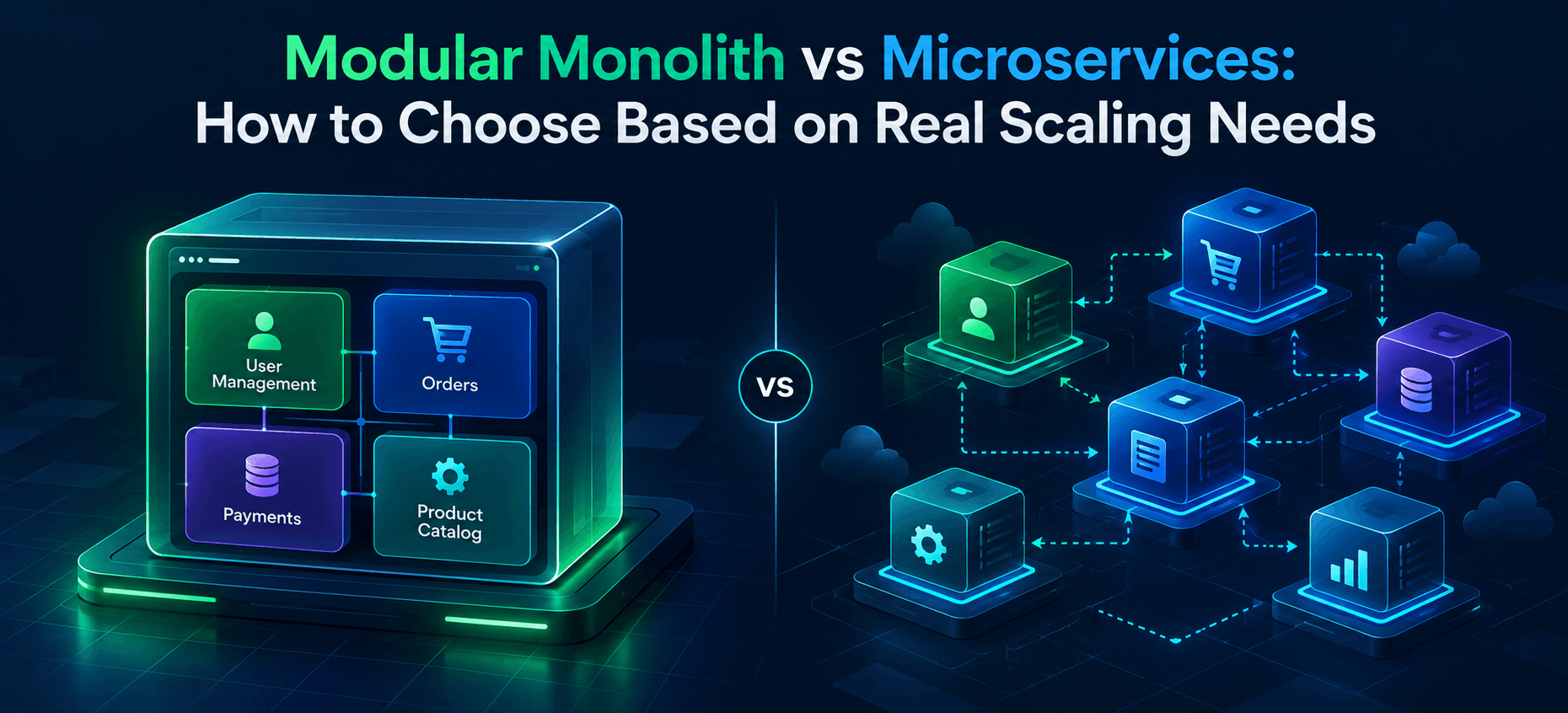
This also explains why multi-tenancy does not require microservices. A modular monolith can support tenant-aware access, queues, and shared services. The choice of deployment architecture should respond to real scaling and team-ownership needs. For a related analysis, see Toadster’s Modular Monolith vs Microservices guide.
What Should You Verify Before Launch?
A usable architecture review should produce evidence, not just an assurance that the system is “multi-tenant.” The following checks are practical release gates rather than a standardized industry certification.
Review area | Evidence to collect |
|---|---|
Tenant model | Documented ownership and membership rules |
Authorization | Cross-tenant and role-based negative tests |
Database isolation | Policy coverage and role privilege review |
APIs and files | Unauthorized access and object-reference tests |
Background processing | Tenant context checks in workers and retries |
Performance | Load tests with uneven tenant workloads |
Operations | Tenant-aware logs, metrics and alerts |
Recovery | Tested procedure for restoring an individual tenant |
Deployment | Migration, rollback and configuration validation |
Offboarding | Retention, export, credential and data-removal procedures |
If the application cannot demonstrate how it denies a cross-tenant request or recovers one organization’s data, those are unresolved engineering requirements, not merely documentation gaps..;
Final Recommendation: Build Around Explicit Tenant Boundaries
A secure, scalable SaaS product starts with a clear definition of tenant ownership. From there, choose a resource-sharing model that fits real customer requirements, enforce permissions through every data path, automate tenant operations, and test how the product behaves when workloads become uneven.
Shared infrastructure can support efficient growth, but it works only when customer boundaries remain trustworthy and the team can operate the platform reliably. The right architecture is not the most complicated one. It is the one that meets current obligations and can evolve as requirements change.
Planning a Multi-Tenant SaaS Product?
Tenant isolation, database design, and scalable operations are easier to plan before they become production problems. Toadster Technologies provides SaaS application development services for businesses evaluating new products and existing platforms.
Explore the service to discuss your project’s architecture and engineering requirements.