
Human in the Loop AI: The Complete Guide
Nobody talks about the failures.
They talk about the efficiency gains, the cost savings, the hours reclaimed from repetitive work. What gets mentioned less often is the customer service agent that automatically processed a refund four times the allowable limit because the approval logic had a gap nobody had thought to fill. Or the procurement workflow that committed budget to the wrong vendor because the AI classified an ambiguous request with complete confidence and zero hesitation.
These are not edge cases. They are what happens when organizations treat AI autonomy as the goal rather than the tool.
Human in the loop AI is the practice of deciding, deliberately and in advance, which decisions an AI system should make on its own and which ones need a person involved before anything executes. It sounds simple. Most organizations discover it is harder than it looks, usually after the first incident that could have been prevented.
Quick answer: Human in the loop AI keeps people actively involved at specific, predefined points in an AI system's decision or execution process. Not every decision, just the ones where a wrong call carries real cost. The system routes those decisions to a human reviewer, waits for input, then continues. Everything else runs without interruption. For agentic AI systems that operate across multiple steps and interact with external tools and data, getting these intervention points right is one of the most important design decisions in the entire build.
What It Actually Means, Without the Jargon
Human in the loop does not mean a human watches every AI action. That framing misses the point entirely and would make most of the efficiency argument collapse.
What it means is that the system has specific moments where human judgment is required, defined before go-live, and everything else passes through automatically. Think of it less like supervision and more like a well-designed exception handling system. Routine decisions flow. Consequential ones stop and wait.
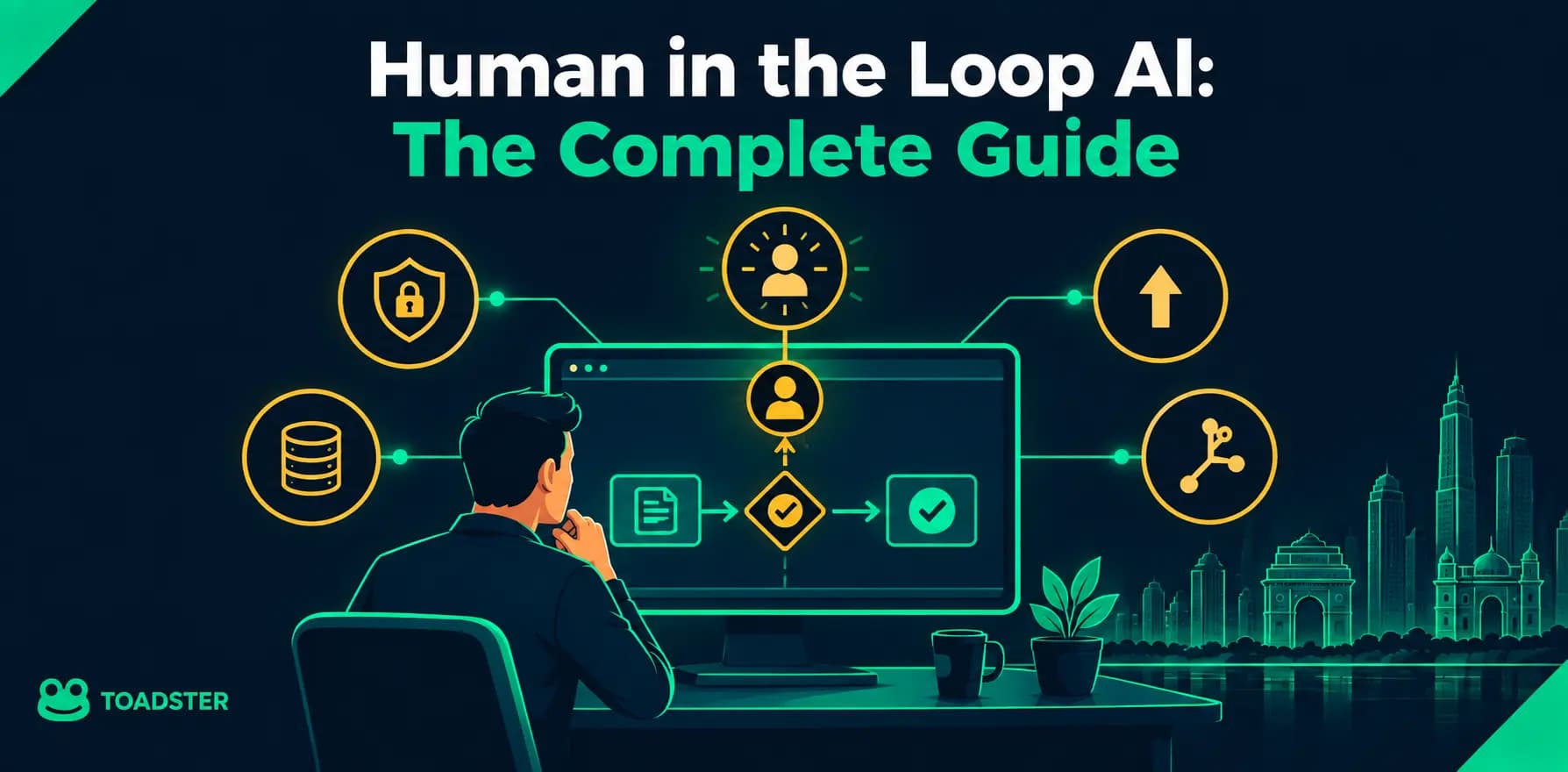
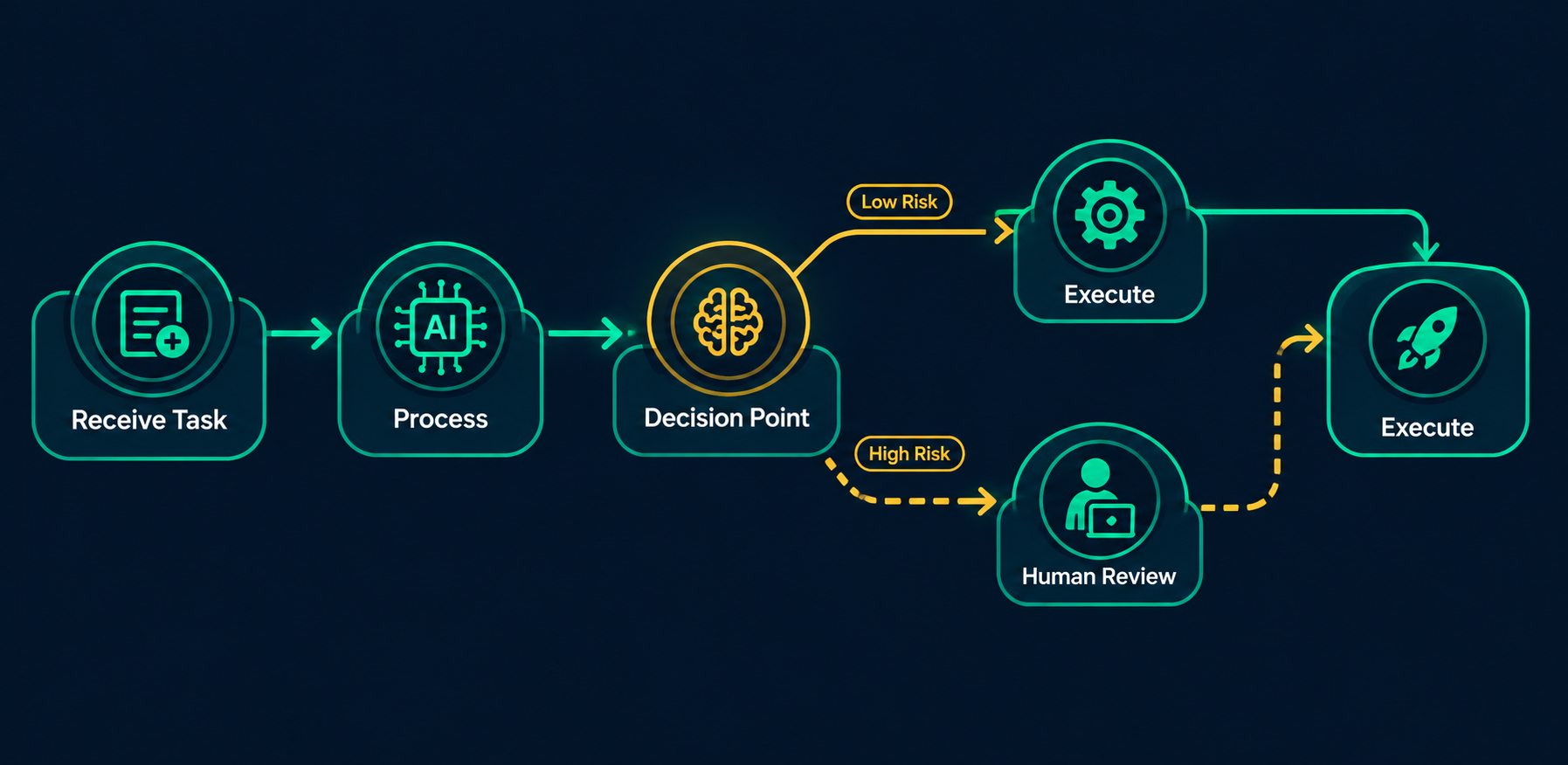
The basic sequence:
- AI receives a task
- AI processes and generates a recommendation or proposed action
- System checks whether this action meets the criteria for human review
- If yes, a human reviews and approves, modifies, or rejects
- AI continues from there
Where teams consistently get this wrong is treating the human review step as a safety net they add at the end rather than a design decision they make at the beginning. By the time a reviewer sees something in that setup, several other steps have already executed upstream. The context is thin, the options are limited, and the oversight is largely cosmetic.
Good human in the loop design starts with the intervention points. Everything else, the tooling, the interface, the escalation logic, gets built around them.
The Three Models of Human Involvement in AI
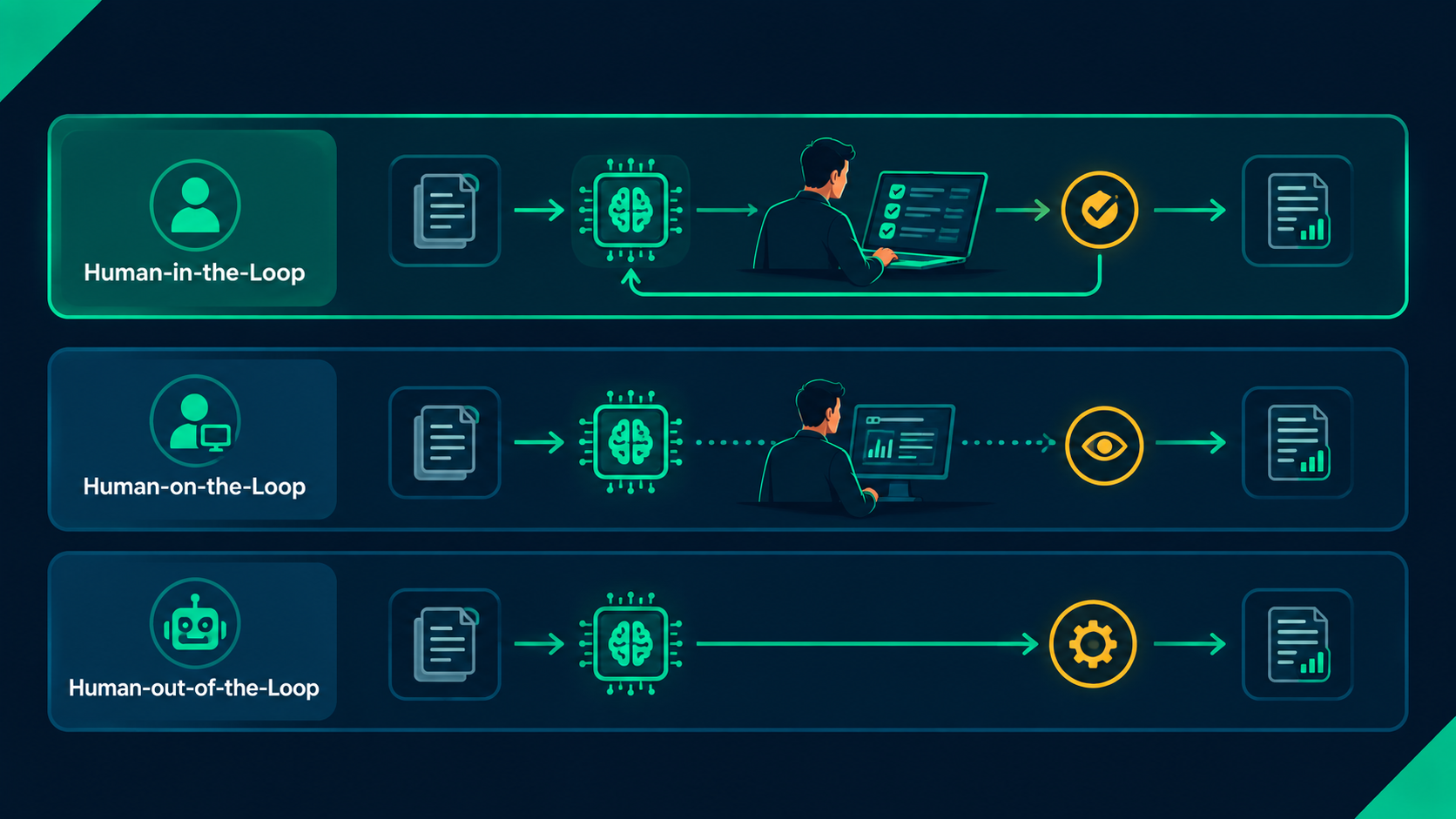
Human oversight in AI sits on a spectrum. Where your application needs to sit on that spectrum is a business risk decision, not a technical preference.
Model | What actually happens | Where it tends to fit |
|---|---|---|
Human in the loop | Human actively reviews or approves specific decisions before execution | High-stakes workflows, regulated industries, agentic systems |
Human on the loop | AI runs independently, human monitors and can intervene | Autonomous agents in lower-risk operational contexts |
Human out of the loop | AI executes without routine human involvement | Repetitive, low-risk, high-volume tasks with clear boundaries |
An AI that schedules internal meetings can run without much oversight. An AI that approves credit applications or sends legally significant communications needs explicit human sign-off before anything goes out. The oversight model should match the consequence of a wrong decision.
One thing worth noting: a single application can and often should use different models for different parts of the same workflow. Routine classification runs automatically. Anything above a defined risk threshold routes to a human. The architecture reflects the risk map.
For a broader view of how agentic AI is reshaping business operations and what that means for oversight design, the patterns emerging across industries are worth understanding before you finalize your own approach.
Why AI Agents Make This More Urgent
Older AI systems were mostly reactive. Input in, output out, human decides what to do next. The loop was short. The blast radius of a wrong output was contained.
Agents are different.
They plan. They break goals into sub-tasks, call external tools, retrieve information across multiple sources, and execute actions across systems, sometimes dozens of steps deep, without waiting for a human prompt at each stage. That is precisely what makes them useful. It is also what makes an unchecked error significantly more expensive than it would be in a simpler system.
An agent that can send emails can send the wrong email to a thousand contacts before anyone notices. An agent that can update records can update the wrong records across an entire database before the error surfaces. The autonomy that creates the value amplifies the cost of mistakes.
This is not an argument against agents. It is an argument for being deliberate about where boundaries sit before the system goes live rather than after.
Building an AI agent without mapping those boundaries during design is one of the most common and costly mistakes organizations make. The technical build and the oversight architecture are not sequential tasks. They are the same task.
The Guardrails That Make Human Oversight Actually Work
Human review is one layer. The system also needs technical controls that constrain what the AI can do and define how it behaves when it hits something outside its expected operating conditions.
- Approval gates are the most direct mechanism. Certain action types simply cannot execute without a confirmed human decision. Financial transactions above a threshold, changes to user permissions, external communications on sensitive topics. The AI prepares and presents. It does not proceed until someone approves.
- Confidence thresholds let the system recognize the limits of its own judgment. When certainty drops below a defined level, the action escalates rather than guessing through. The threshold needs to be calibrated to the actual risk profile of the application. An arbitrary number produces either too many escalations or too few.
- Escalation rules catch the situations nobody anticipated during design. Unusual requests, conflicting data, missing information, repeated failures on the same task. Rather than continuing indefinitely in conditions it was not built to handle, the agent hands off to a human. This is not a failure state. It is the system working correctly.
- Permission controls separate what the AI can recommend from what it can actually execute. Read access but not write. Draft but not publish. This means that even when the AI's recommendation is wrong, the damage is limited until a human authorizes the next step.
- Audit trails are unglamorous and essential. Every decision, every escalation, every human intervention, logged and accessible. Not for compliance theatre. Because you cannot improve a system you cannot observe.
Where Human in the Loop AI Is Being Applied
The pattern shows up across industries. What it looks like in practice varies depending on the workflow and what is at stake.
Financial services teams use AI to flag suspicious transactions and surface anomalies at scale. Human analysts review the flagged cases and make final calls on anything above a defined threshold. The AI handles volume and pattern recognition. The human handles judgment on the ones that matter.
Healthcare operations deploy AI for documentation support, information retrieval, and workflow routing. Where an AI output could influence a clinical decision, human review is a structural requirement, not an optional layer.
Enterprise operations teams use agents to classify documents, analyze datasets, draft internal communications, and route tasks. Human approval kicks in before anything consequential is sent externally or before data in a system of record is changed.
Security and IT teams run automated remediation for lower-severity incidents. Anything touching production systems, access controls, or data integrity routes to a human before execution.
For a detailed breakdown of how these patterns play out across specific sectors, the AI agent use cases across industries are worth reviewing before you design your own intervention criteria.
Designing a System That Works in Practice
There is a version of human in the loop AI that looks good on a whiteboard and fails in production. Usually because the review interface gives the human so little context that they are effectively approving whatever the AI suggested without actually evaluating it. That is not oversight. It is the appearance of oversight with the latency of the real thing.
Map decisions before you build anything. List every decision the system will make and rank them by the consequence of a wrong call. That ranking is your intervention point map. Everything else follows from it.
Give reviewers enough to actually decide. The review interface should surface the original request, what the AI analyzed, what it is recommending, why it was escalated, and what executing the action will do. A reviewer hunting for context will either take too long or approve without reading. Both are bad outcomes.
Track intervention frequency. A high rate usually means the system is poorly calibrated or handling things it should not be handling. A near-zero rate might mean the escalation criteria are too loose. Neither extreme is working correctly.
Treat every human intervention as data. When a reviewer modifies or rejects an AI recommendation, that decision contains information about where the model's judgment diverges from what a human would actually do. Capturing this systematically and feeding it back into agent evaluation is how HITL becomes a continuous improvement mechanism rather than just error containment.
What This Looks Like With Toadster
Toadster builds agentic AI systems where oversight is part of the design from the first conversation, not something added after go-live when an incident makes it unavoidable.
In practice that means defining intervention points during discovery, before a line of code is written. Building permission structures that reflect the actual risk profile of each action type. Setting up monitoring that gives teams real visibility into what the agent is doing, where it is escalating, and how often human judgment is diverging from the AI's recommendation.
The organizations that get the most out of agents are not the ones who gave them the most autonomy. They are the ones who were most precise about where the boundaries should sit.
If you are designing an agentic workflow and working through where the oversight structure should sit, talk to the team about what you are building.