
Introduction
The industries adopting AI agents fastest aren't doing it for novelty. They're doing it because a narrow, well-scoped agent can take over a specific, repetitive, rules-heavy workflow and run it end to end - faster than a team of analysts and without the 2 a.m. gap when no one's watching the queue.
But "AI agent" means something different in a bank's fraud team than it does in a hospital's scheduling department. The regulatory stakes, the tolerance for error, and the systems an agent has to plug into all shift by industry. This guide walks through what's actually working in fintech, healthcare, and logistics right now - the specific use cases, what makes each one hard, and where teams get it wrong.
If you're earlier in the process and want the underlying architecture first, our step-by-step guide to building an AI agent covers the technical build sequence this article assumes.
Why Industry Context Changes the Build
A support agent that refunds a $40 order and a treasury agent that flags suspicious wire transfers are built on the same underlying pattern - reason, act, observe, repeat - but they can't share a guardrail model. The refund agent's worst-case failure costs $40 and an apology email. The treasury agent's worst-case failure is a regulatory filing.
Three things shift by industry:
- Compliance surface - HIPAA in healthcare, PCI-DSS and SOC 2 in fintech, customs and carrier liability rules in logistics all constrain what an agent is allowed to decide autonomously versus what has to route to a human.
- Data sensitivity - patient records and financial account data need retrieval and memory layers built with access controls the agent itself can't override.
- Cost of a wrong action - a logistics agent booking the wrong carrier is expensive; a fintech agent approving a fraudulent transaction is a different category of expensive.
This is also why generic, off-the-shelf agent templates tend to underperform in regulated industries - the guardrail design has to be built around the specific workflow and its failure modes, not bolted on afterward. It's the main reason teams in these sectors end up working with an AI agent development company rather than adapting a general-purpose framework themselves: the domain-specific guardrails are where most of the real
engineering effort goes.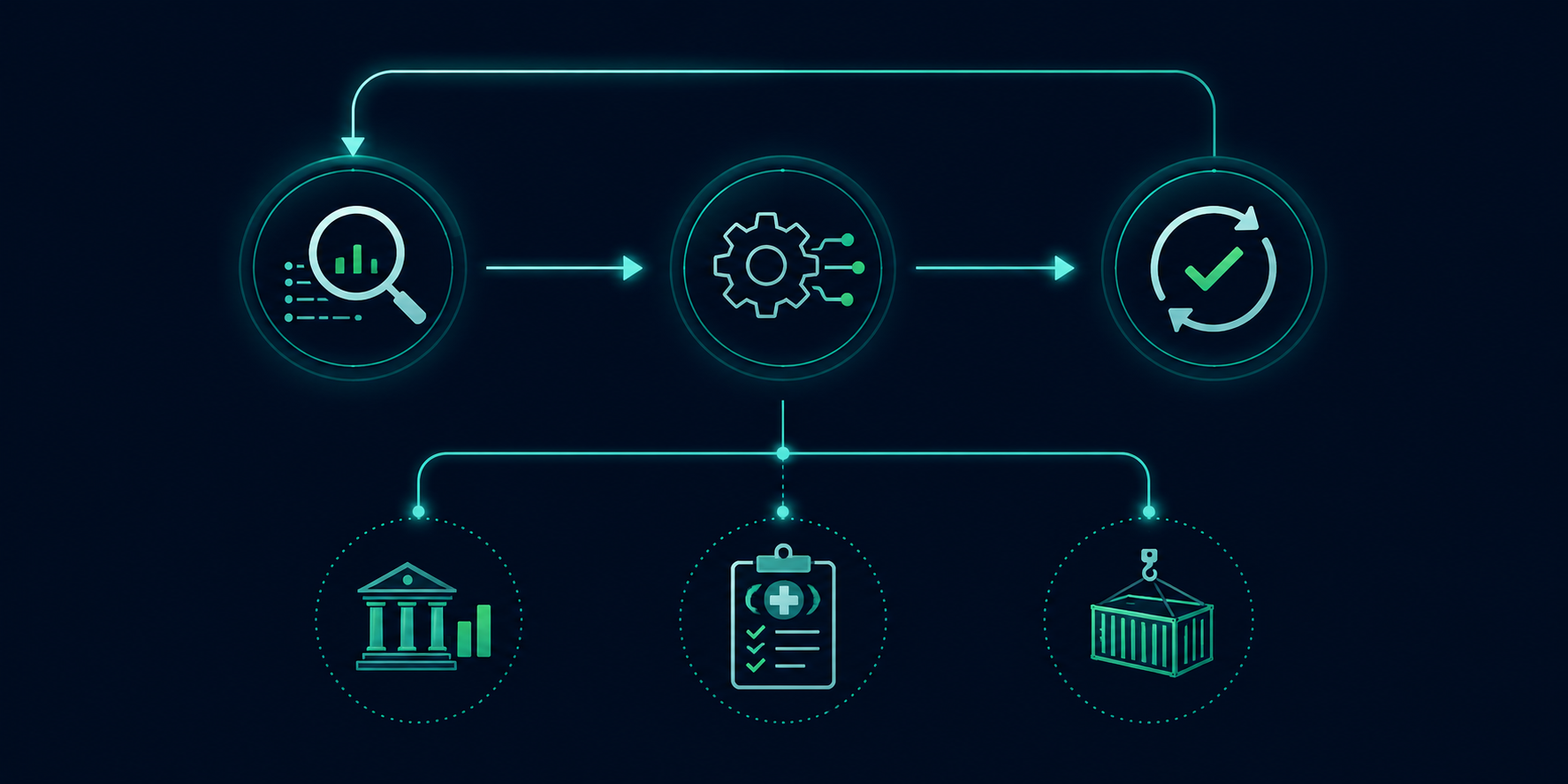
AI Agents in Fintech
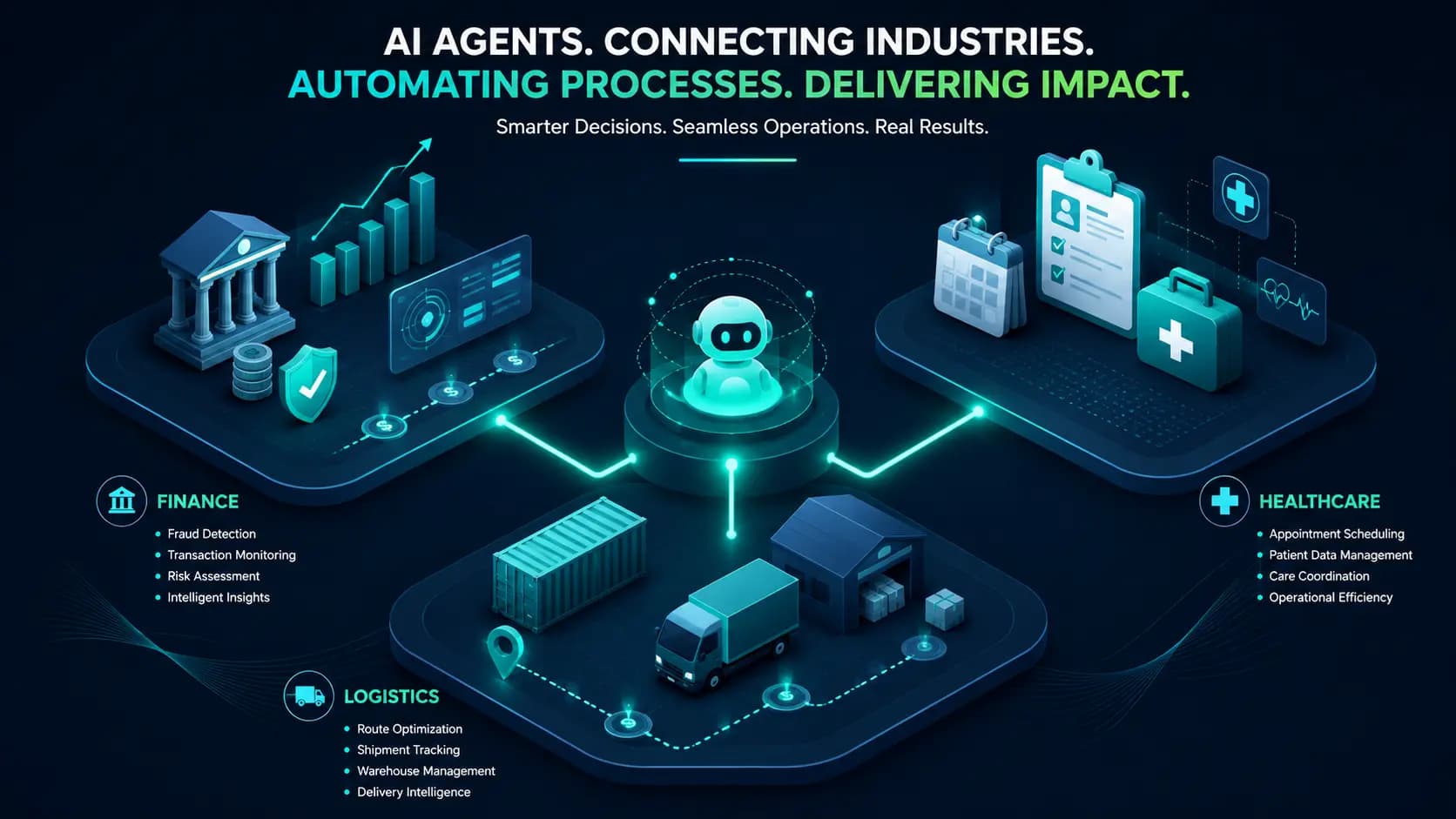
Fintech was one of the earliest serious adopters of agentic systems, mostly because the workflows are already rules-based and data-rich - exactly the conditions agents handle well.
Fraud detection and case triage. An agent monitors transaction streams, flags anomalies against a risk model, pulls the customer's transaction history and device fingerprint, and either auto-clears low-risk flags or escalates high-risk cases to a fraud analyst with a pre-built case summary. The agent doesn't make the final call on high-stakes cases - it compresses the analyst's investigation time from twenty minutes to two.
Underwriting and credit decisioning support. For small-business or personal loan applications, an agent gathers financial documents, cross-checks them against bank statement data via API, calculates debt-to-income ratios, and produces a structured recommendation with supporting evidence - leaving the actual approval decision to a human underwriter or a tightly scoped auto-approval rule for low-risk brackets.
Reconciliation and close automation. Agents match transactions across ledgers, general ledgers, and bank statements, flag discrepancies above a threshold, and draft the adjustment entries for finance team review - a task that used to consume days of a close cycle.
Customer account servicing. An agent handles account inquiries that require actual system access - updating a billing address, investigating a failed payment, adjusting a subscription tier - rather than just answering questions about policy, which is where it differs from a support chatbot.
Where fintech agents break: undocumented edge cases in regulatory reporting, and agents that are given too much autonomy over irreversible financial actions before the guardrail layer has been stress-tested against adversarial inputs.
AI Agents in Healthcare
Healthcare's agent adoption has been slower and more cautious than fintech's, and for good reason - but the use cases that have proven out are substantial.
Clinical documentation and coding support. An agent listens to or reads a clinical encounter note, extracts relevant diagnoses and procedures, and drafts the corresponding medical codes for a coder or clinician to review - reducing documentation time without putting the agent in the position of making a clinical judgment call.
Prior authorization automation. This is one of the highest-friction workflows in U.S. healthcare administration. An agent pulls the relevant clinical documentation, matches it against a payer's specific authorization criteria, assembles the submission package, and tracks the request through to a decision - a process that can otherwise take a staff member hours per case across dozens of payer-specific rule sets.
Patient scheduling and intake coordination. An agent handles appointment scheduling, insurance eligibility verification, and pre-visit intake forms, escalating anything ambiguous (a provider conflict, an insurance mismatch) to front-desk staff rather than guessing.
Care coordination follow-up. After a discharge or referral, an agent tracks whether a patient completed a follow-up appointment, sends reminders, and flags gaps in care to a care coordinator - persistent, multi-step tracking that's exactly the kind of task agents are suited for and staff time isn't.
Where healthcare agents break: anything that touches a clinical decision without a licensed human in the loop, and RAG systems grounded in outdated policy documents - a healthcare agent is only as reliable as the currency of the data it retrieves from.
AI Agents in Logistics
Logistics workflows are naturally agent-shaped: multi-step, tool-heavy, and full of decisions that depend on real-time external data (rates, capacity, weather, customs status).
Carrier selection and rate shopping. An agent pulls quotes from multiple carrier APIs, compares pricing against transit time and service-level requirements, and books the shipment - the example we've referenced elsewhere for a logistics client is exactly this pattern, connected to a warehouse management API, a carrier rate API, and an internal pricing rules engine.
Inventory and reorder management. An agent monitors stock levels across warehouses, forecasts depletion against historical demand, and places purchase orders with approved suppliers automatically when thresholds are hit - with a human-approval checkpoint for orders above a spend limit.
Shipment exception handling. When a shipment is delayed, misrouted, or held at customs, an agent investigates the cause across carrier tracking systems, determines the appropriate corrective action (reroute, expedite, customer notification), and executes it - a task that otherwise sits in a human dispatcher's queue until someone has time.
Customs and compliance documentation. For cross-border shipments, an agent assembles the correct documentation set based on product classification and destination country rules, flagging anything it can't resolve confidently rather than guessing at a customs code.
Where logistics agents break: event-ordering issues in event-driven architectures (a shipment status update arriving out of sequence), and agents given carrier-booking authority before idempotency safeguards are in place - a retry that double-books a shipment is a real, recurring failure mode.
What's Common Across All Three
Underneath the industry differences, the same guardrail principles apply everywhere:
- Least-privilege access - a fraud-triage agent doesn't need write access to core banking systems; a scheduling agent doesn't need access to full clinical notes.
- Human-in-the-loop checkpoints on anything irreversible - a payment, a diagnosis-adjacent action, a customs filing.
- Audit logging detailed enough to satisfy the industry's own compliance auditors, not just internal debugging.
- Domain-specific evaluation sets - a generic benchmark doesn't tell you whether an agent handles a partial-authorization insurance edge case or a multi-leg international shipment correctly.
This is the layer most first-time builders underestimate, and it's the layer an experienced AI agent development company has usually already solved across several clients in the same regulated space - which is a meaningfully different starting point than building the guardrail model from scratch.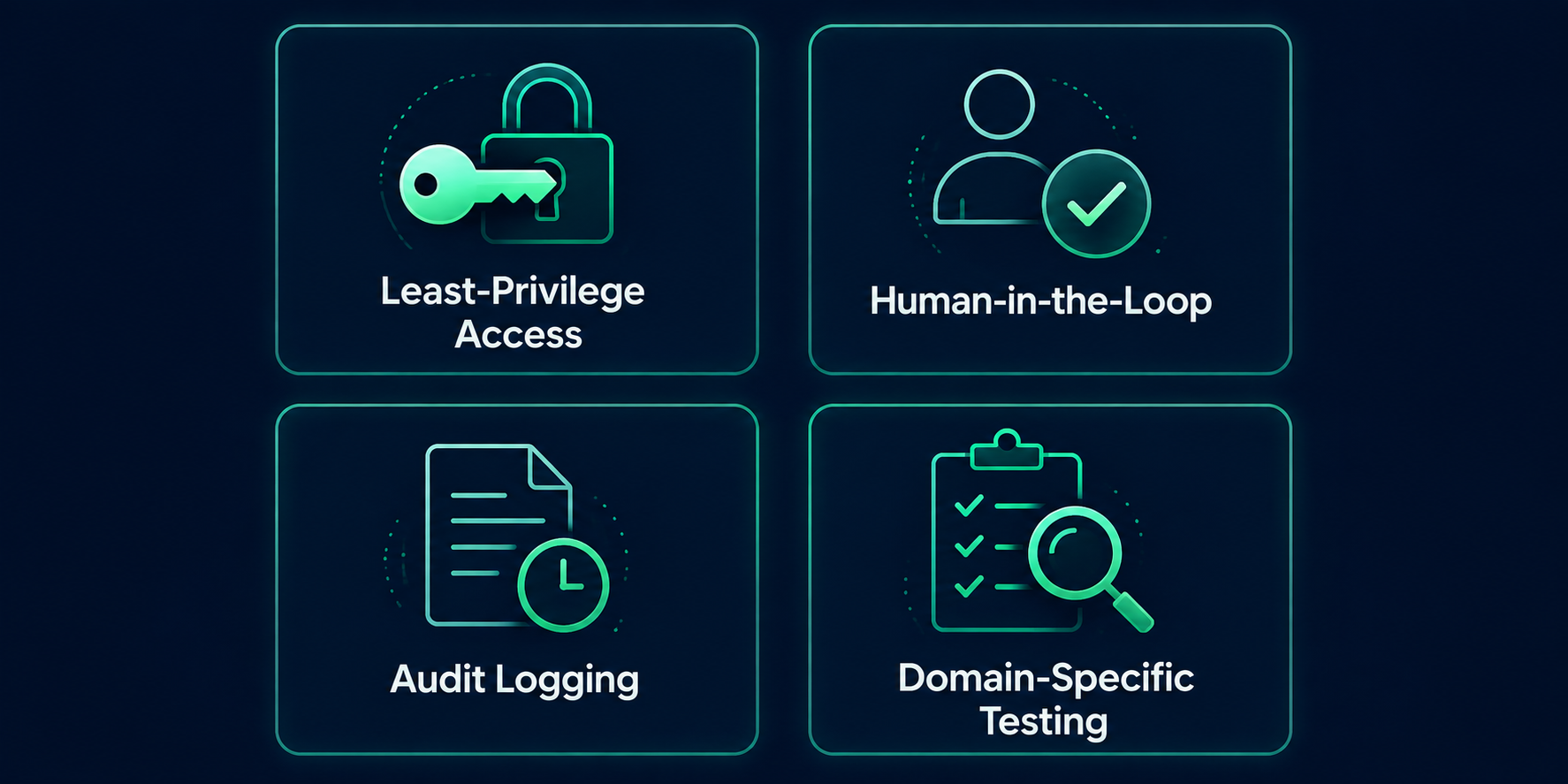
Choosing the Right Partner for Your Industry
Not every AI agent development company has actually shipped in regulated environments. When evaluating one for a fintech, healthcare, or logistics build, it's worth asking directly:
- Have they built agents that handle PCI-DSS-, HIPAA-, or customs-regulated data, specifically - not just "AI experience" in general?
- What does their human-in-the-loop design look like for irreversible actions in your industry?
- Can they show a case study in your sector, not just a generic agent demo?
- How do they structure the evaluation set before launch - do they test against your industry's actual edge cases?
Toadster builds agentic systems across fintech, healthcare, logistics, and SaaS, and the guardrail patterns above come directly from that work. If you're scoping an agent for one of these workflows, take a look at how Toadster works as an AI agent development company - the page covers how we approach the build from first workflow to monitored production. Our case studies and industries pages have more detail on specific engagements.
The technical patterns are learnable, but the guardrail and compliance design for a specific regulated workflow usually isn't something a team gets right on the first attempt. An AI agent development company that's already shipped in your industry has typically already solved the failure modes - audit logging requirements, human-approval thresholds, data access scoping - that a first-time in-house build discovers the hard way in production.
Conclusion
The industries getting real value from AI agents aren't the ones chasing the most impressive demo - they're the ones scoping a single, well-bounded workflow, building guardrails specific to their regulatory environment, and expanding only once that first agent is stable in production. Fintech, healthcare, and logistics each have their own failure modes, but the underlying discipline is the same: narrow scope, real guardrails, human checkpoints on anything irreversible.
If you're evaluating whether to build this internally or bring in a partner who's already navigated these guardrails in your industry, Toadster's agentic AI services are built around exactly this - scoping the first workflow, designing the compliance-aware guardrails your industry requires, and getting to a monitored, production-grade agent without the trial-and-error most first builds go through. Get in touch to talk through your specific workflow.