
Context Engineering for RAG Systems: A Practical Guide for Enterprise AI
A retrieval demo can look finished long before it is useful. Someone connects a model to a document store, asks a question the corpus happens to contain, and the answer comes back clean. Then a real user asks something messier-a policy exception, a product comparison buried across three outdated PDFs, a question that depends on who is logged in-and the same RAG system starts sounding sure about the wrong thing.
The model is often not the part that failed. It was handed a pile of loosely related chunks and told to answer anyway. Context engineering is the work of deciding what information reaches that model, in what order, under what constraints, and what gets left out.
This is a practical guide for teams evaluating an enterprise RAG system: what context engineering changes, where it sits next to retrieval, and the failure modes that show up after the pilot.
Quick answer: A RAG system retrieves external knowledge and passes some of it to a large language model so the answer can be grounded in your data, not only in what the model learned during training. Context engineering is the broader job of choosing, trimming, ordering, and constraining everything the model sees-retrieved passages, instructions, user state, permissions, memory, and tool results. Retrieval finds candidates. Context engineering decides the actual input. You need both. A correct document that never makes it into a clean context window does not improve the answer.
What context engineering actually means
Context engineering is the design of the model’s input, not the wording of a single prompt. Prompt engineering asks, “How should we phrase the instruction?” Context engineering asks, “What else is in the room when the model reads that instruction?”
Those are different jobs. A sharp prompt cannot rescue a packet full of stale, duplicated, or unauthorized text. And a beautiful retrieval score does not matter if the selected passage is buried under twelve others the model never really uses.
A production system is usually mixing several kinds of context at once:
- Instructions - what the system is allowed to do, and what it must refuse
- Retrieved evidence - passages pulled from a knowledge source for this query
- User and session state - who is asking, what they already said, what role they hold
- Memory - durable facts the product has chosen to keep, which is a smaller set than “everything ever said”
- Tool outputs - live results from a search, a database, a ticket system, a calculator
- Constraints - token budget, citation rules, tone, latency, permission boundaries
Treat “context” as one blob and you will optimize the wrong layer. A bad chunking strategy and a bad permission filter both produce wrong answers. They are not the same bug.
Context engineering vs. prompt engineering
Prompt work still matters. It is just no longer the whole job. If your team’s only lever is rewriting the system prompt every time an answer goes wrong, you are debugging the last inch of a pipeline and ignoring the rest.
What a RAG system is doing under the hood
Retrieval-augmented generation connects a language model to knowledge it did not memorize. That matters for private data, for facts that change, and for answers you want tied to a source your team can open and check.
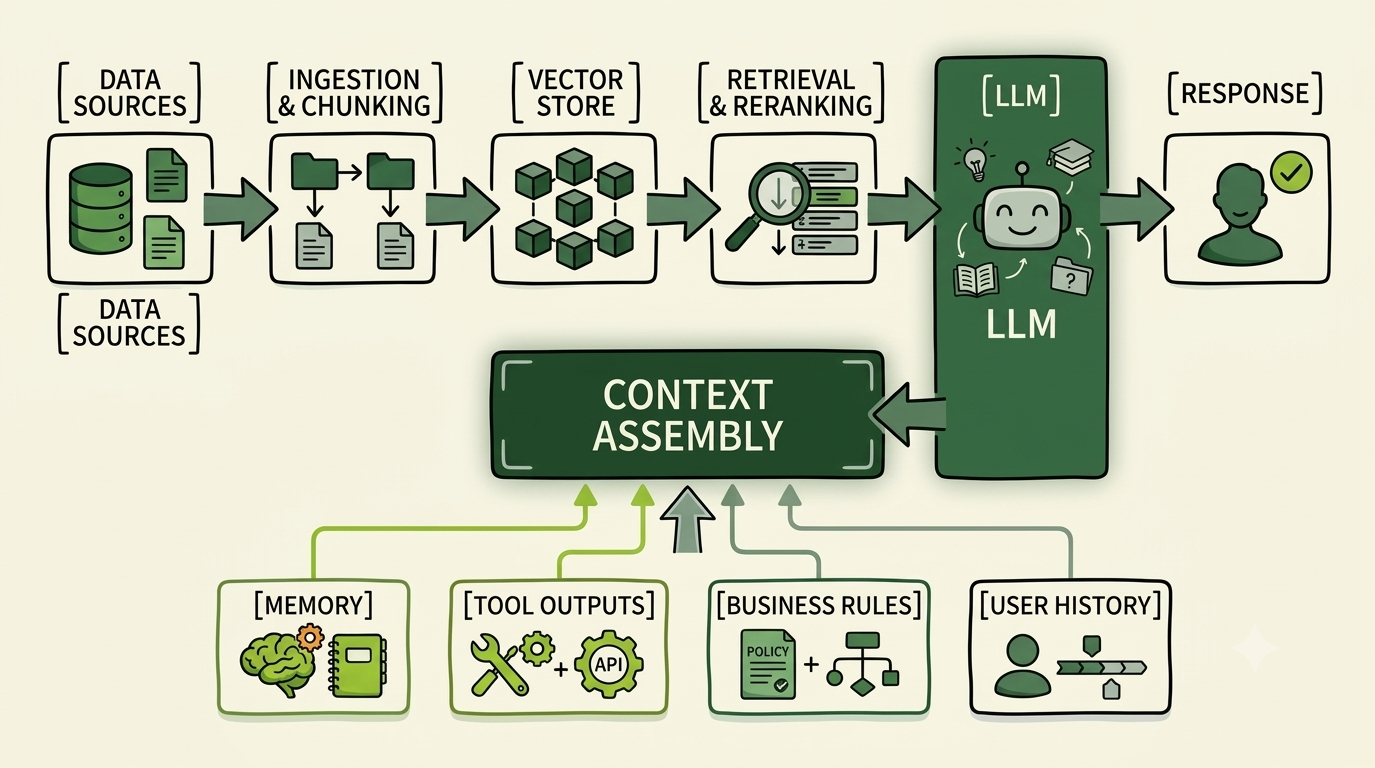
A RAG pipeline is the path from raw material to a generated answer. The common shape looks like this:
Documents → chunking → embeddings → vector store → retrieval → reranking → context assembly → model → response
Skip “context assembly” in that list and you have described a demo, not an architecture. The store can return relevant neighbors and the product can still fail, because nobody decided how those neighbors become an input.
What sits inside the RAG architecture
- Ingestion and document processing. PDFs, tickets, wiki pages, and HTML do not arrive clean. Headings, tables, and scanned pages need a deliberate pass before anyone embeds them.
- Chunking. Size and boundaries change what can be retrieved. Chunks that split a policy mid-rule will be retrieved faithfully and still be useless.
- Embeddings and the vector database. This is the retrieval index, not the product. Semantic search finds neighbors. It does not know your org chart.
- Retrieval. The first pass should be generous enough to avoid missing the right passage, and suspicious enough not to treat “nearby” as “true.”
- Reranking. A second scoring pass is where a lot of quality actually appears. Teams that skip it usually call the model unreliable.
- Generation. The model writes from the packet it was given. If the packet is wrong, fluent writing makes the failure harder to spot.
Here is the opinionated part. Owning a vector database is not the same as having a RAG framework you can operate. The framework includes refresh, evaluation, access control, and a rule for what happens when retrieval returns nothing useful. Without that last rule, the model improvises. Users experience improvisation as confidence.
How context engineering changes what a RAG system returns
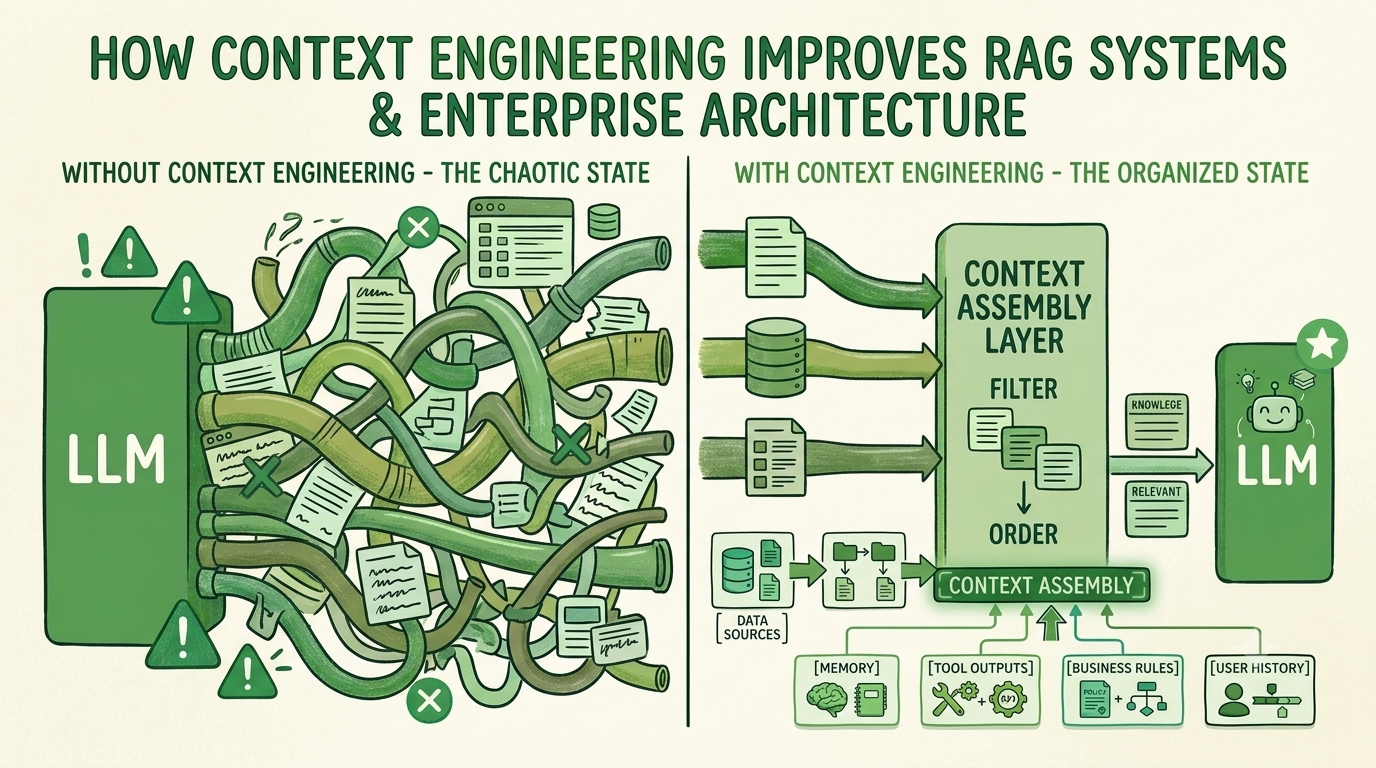
Retrieval proposes. Context engineering disposes. The difference shows up in four places.
- Selecting what is allowed to count as evidence. Relevance is not one number. A passage can be semantically close and still be the wrong source: older than the policy that replaced it, written for a different region, or belonging to a team the user cannot see. Metadata, recency, and source rank have to be explicit. If they live only in someone’s head, they will not survive the next deploy.
- Fitting the context window on purpose. More retrieved text is not a safer input. Past a point, extra passages dilute the one sentence that mattered. Context management means a budget: how many tokens for instructions, how many for evidence, how many for history, and what gets cut first when the budget is gone. Cut history before evidence for a factual lookup. Cut low-ranked evidence before the user’s constraint. Write the rule down.
- Combining sources without letting them argue unsupervised. A real query often needs more than one document. It may also need a tool result and a business rule. Dumping those into one undifferentiated block asks the model to invent a priority order. Give it one. Label the blocks. State which source wins when they conflict.
- Structure is part of the signal. Models are sensitive to order and labels even when the same facts are present. A packet with headings, source names, and a clear “answer only from the evidence below” line behaves differently from the same text pasted as a wall. This is not decoration. It is context assembly.
A support assistant, for example, might assemble context in this order: first the user’s entitlement, then the current product rule, then the help-center passage, then older ticket notes. Reverse that order and the model will quote a ticket from 2022 over the rule that replaced it.
Where people get this wrong: they keep adding retrievers. A second index will not fix a packet that has no hierarchy. If every source arrives with equal weight, the model will average them. Averaging is how policies turn into mush.
Context engineering is not a synonym for RAG
These terms get collapsed in sales pages. They should not be collapsed in a design review.
RAG | Context engineering | |
|---|---|---|
Main job | Bring external knowledge into generation | Decide the full input the model receives |
Center of gravity | Retrieval | Retrieval plus everything else in the packet |
Typical pieces | Chunking, embeddings, vector search, reranking | Those, plus instructions, memory, tools, history, permissions |
Problem it is built to solve | The model does not know your private or changing facts | The model is answering from the wrong, excess, stale, or forbidden context |
A RAG system can sit inside a context-engineering design. It should not be mistaken for the whole design. You can also do context engineering with no retrieval at all-a workflow that only assembles tool outputs, user state, and rules. The moment the answer depends on a private knowledge base, retrieval becomes the part you cannot skip.
RAG development is the implementation work: pipelines, indexes, evaluation, and the unglamorous refresh jobs. Context engineering is the design constraint on that work. If the two are owned by different people who never look at the same failed query together, you will get a fast index and a sloppy answer.
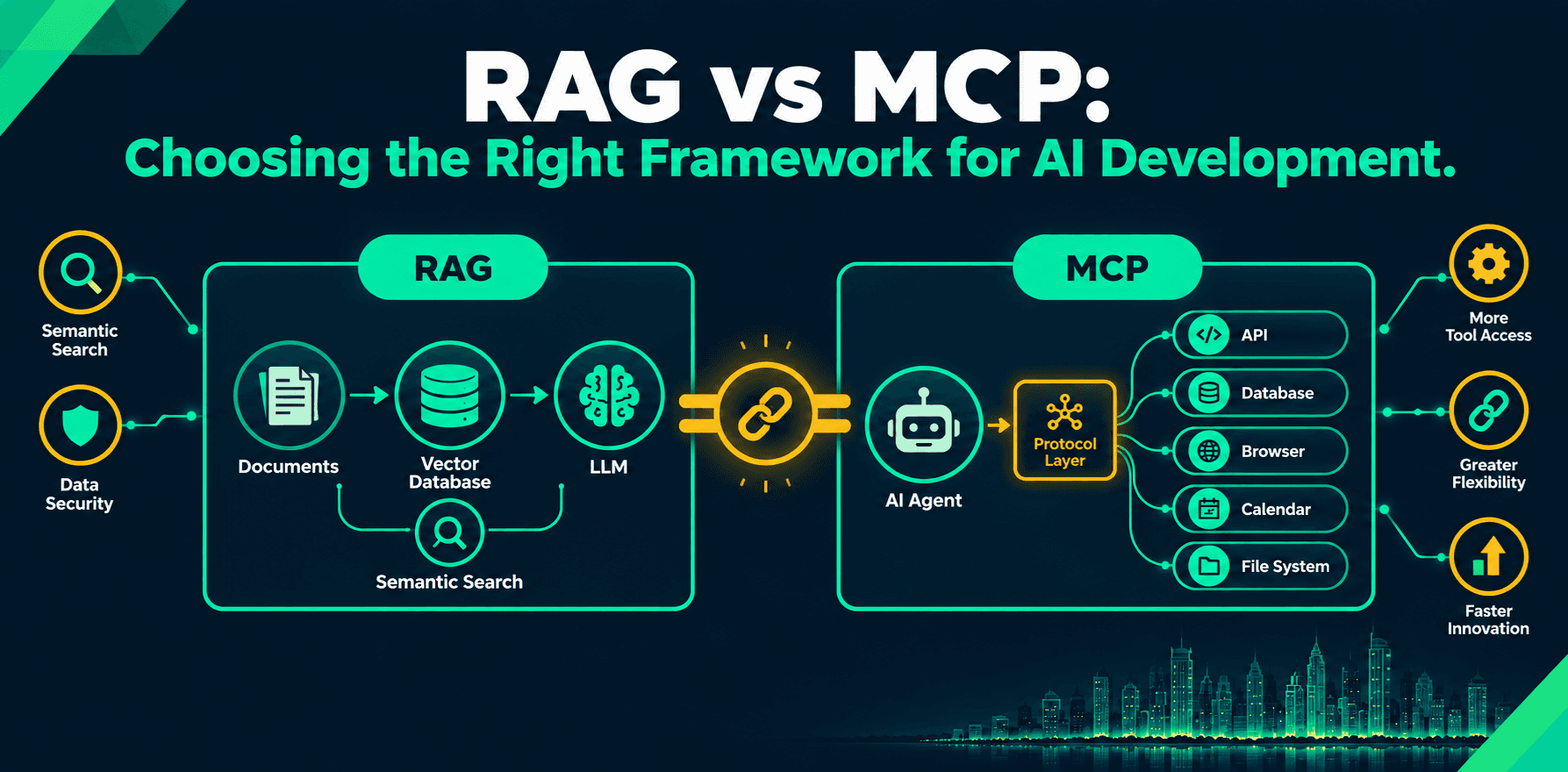
If you are also weighing RAG against other retrieval frameworks before you scope the packet, our comparison of RAG vs. MCP walks through that decision separately.
How to build one without boiling the ocean
Build in the order the failures actually happen. Not in the order the architecture diagram looks impressive.
- Name the information the answer is allowed to use. Before tools, write down the sources that may inform a reply, the sources that must never inform a reply, and the questions this product will refuse. If that list is “the whole drive,” you do not have a scope. You have a future incident.
- Stand up retrieval second, not first. Get a boring retrieval layer working on a narrow corpus. Measure whether the right passage appears in the top results for real questions your team has logged. If it does not, embeddings and chunking are the work. A larger model will not index a document you split in the wrong place.
- Add reranking before you add more data sources. One clean corpus with a reranker will beat three half-connected sources. Multi-source enterprise RAG is a later problem. It brings identity, sync, and conflict, not just “more knowledge.”
- Design the packet as its own component. This is the step teams leave as string concatenation. Give it an owner. Inputs: ranked passages, user constraints, tool results, memory. Output: a structured prompt under a token budget, with citations pointing at spans you can display. If you cannot show the packet that produced a bad answer, you cannot debug it.
- Add memory last, and narrowly. Conversation history feels helpful until it smuggles a wrong assumption into every later turn. Store what you can justify. Expire it. Do not let memory outrank a fresh retrieval on a factual question.
- Connect tools when the knowledge base is the wrong shape for the question. Inventory, account status, and “what is open on this ticket right now” are often database problems wearing a document-search costume. A RAG architecture that retrieves a stale export of a live system will lose to a tool call every time.
- Only then widen the corpus. New sources are a context-management change, not a drop-in. Each source needs a rank, a refresh rule, and a permission story.
Where these systems fail after the demo
The failures are repetitive. That is useful. You can test for them.
- Irrelevant retrieval. The neighbor is topical and still not the answer. Fix the chunk, the query rewrite, or the reranker-not the adjective in the prompt.
- Too much context. The right sentence is present and lost. Cap the packet. Drop duplicates. Prefer one complete section over five fragments of it.
- Missing context. The index never saw the document, or the chunk boundary cut the rule in half. This is an ingestion bug with a generation symptom.
- Stale context. The file changed. The index did not. Answers will keep citing the old world until refresh is someone’s job.
- Conflicting sources. Two true documents, two different dates, no winner. The model will pick one and sound finished. Your packet should have already picked.
- Permission leaks. Semantic search does not understand “this user cannot see HR.” Filter before the passage is eligible for the packet, not after the model has read it. A citation to a forbidden document is already a failure, even if the sentence looks harmless.
- Empty retrieval, full confidence. If nothing clears the bar, the product should say so. Silence from the retriever is not an invitation for the model to freelance.
Security belongs in this list, not in a later compliance appendix. Enterprise knowledge bases are full of material that is fine for one role and reckless for another. A RAG system that retrieves first and checks later will eventually quote the wrong person their own restricted file.
The empty-retrieval case is worth designing on purpose rather than leaving to the model. Routing a low-confidence answer to a person, instead of letting the model guess, is the same pattern covered in our guide to human-in-the-loop AI.
How to tell whether the system is actually working
Scoring only the final paragraph hides the layer that broke. Split the evaluation.
- Retrieval. Did the right passage show up at all? A pretty answer that never saw the source is a miss, even if a reviewer liked the prose.
- Context. Of what was retrieved, what made the packet? Was it redundant, stale, over the budget, or missing the clause the question turned on? This is the layer almost nobody logs. Log it.
- Generation. Is the answer grounded in the packet, cited to a span a human can open, and willing to stop when the packet is insufficient? Fluency is not a metric. Groundedness is.
- The business result. Did the ticket get resolved, did the analyst trust it enough to reuse it, did the task take less time without a cleanup pass afterward? A system that is “accurate” in a lab set and ignored by the team has not shipped.
Run this on questions from production, including the ugly ones. A golden set of friendly queries will certify a system your users do not have.
When the extra machinery is worth it
A single-document FAQ can stay small. Context engineering earns its cost when the product is an internal copilot, a support assistant over a changing help center, a research aid across many source types, or an agent that must mix retrieved knowledge with tool results and rules. If the workflow only repeats a fixed script against one database, you may not want a RAG system at all. Forcing retrieval onto a problem that wants a query is a common, expensive detour.
Agents raise the stakes, not the definition
An agent still answers from a packet. The packet is just wider: instructions, memory, retrieved knowledge, tool outputs, and a permission boundary that has to hold while it acts. That is why agent projects fail in the same place document chatbots fail-bad context-and then fail again when a tool call is made from that bad context. If the product has to act, not just answer, read how we approach agent workflows that have to act, not just answer before you add autonomy on top of an unevaluated retriever.
What this looks like with Toadster
We treat the packet as a product surface, not as glue code between a vector store and a chat window. On a RAG build, that means the retrieval layer, the reranker, the permission filter, and the context assembly step are designed together, then evaluated on failed queries rather than on a demo script.
The work usually starts narrower than the roadmap slide. One corpus. A written rule for which source wins. A logged packet for every answer someone flags. From there, a RAG system can grow into more sources without becoming a pile of indexes nobody can explain. If that is the build you are scoping, start with our RAG system.
We will not invent a client count or a percentage of tickets deflected to make this section louder. If a use case needs a private knowledge base, a permission boundary, and an answer a human can trace, this is the shape of the engagement. If it does not, we would rather say so before a pipeline gets built around the wrong problem.
A packet is a decision
The model will sound finished either way. The only choice is whether it finishes from a packet someone designed-ranked, permitted, bounded, and logged-or from whatever the retriever happened to drop on the floor.
If you are deciding whether a knowledge base, a support assistant, or an internal copilot should be built this way, talk through the use case before the index becomes the plan.