
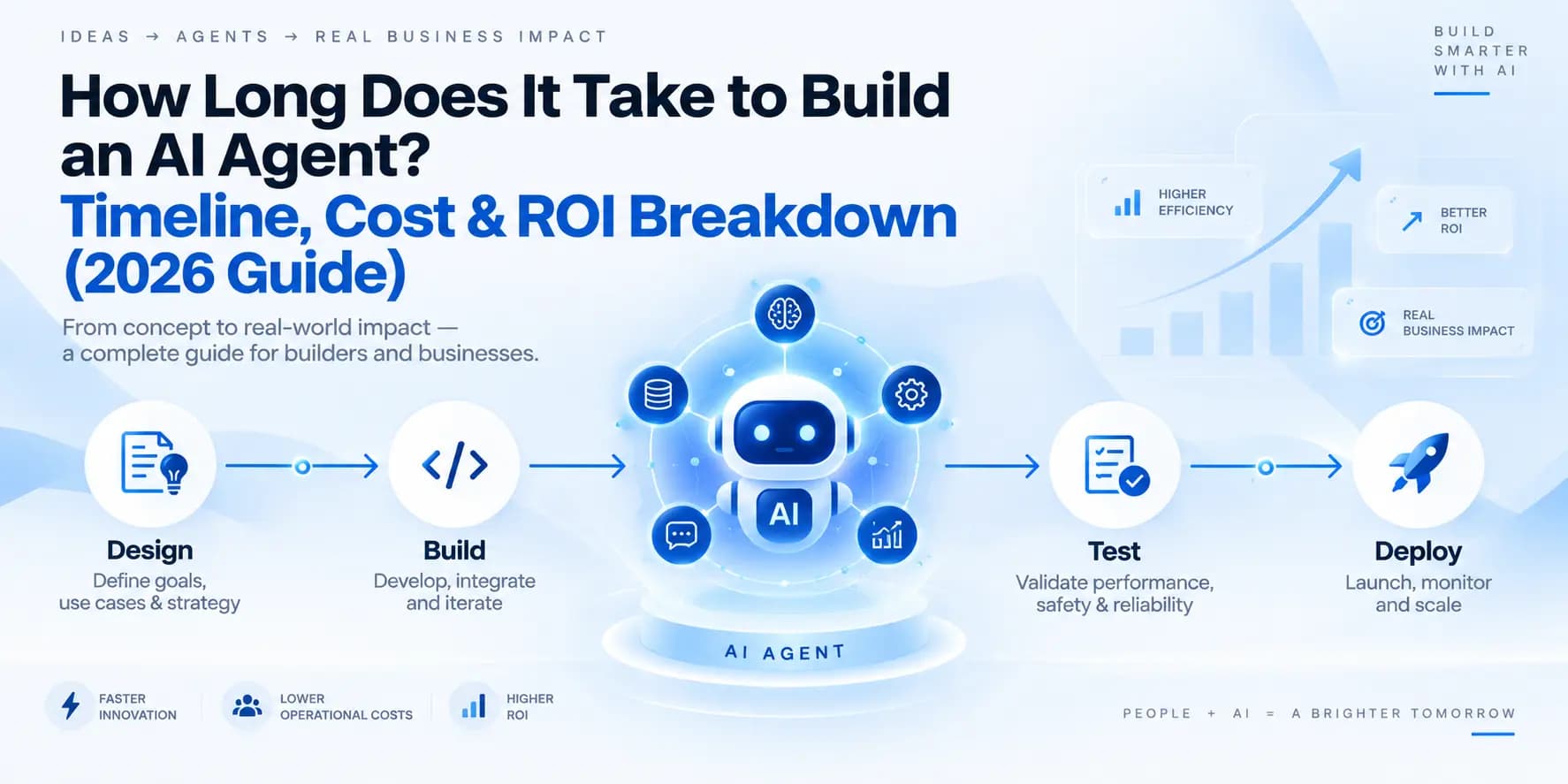
How Long Does It Take to Build an AI Agent? Timeline, Cost & ROI Breakdown (2026 Guide)
Who is this guide for? Founders, product managers, and IT decision-makers evaluating AI agent development. What you'll learn: realistic timelines, cost ranges, and ROI benchmarks. When: this 2026 guide reflects current agentic AI tooling. Where: applies whether you're building in-house or hiring a custom AI agent development company. Why: because "it depends" isn't a planning answer - you need numbers. How: we break it down by agent complexity, step by step.
If you've typed "how long does it take to build an AI agent" into Google, you already know the honest answer is: it depends on complexity. But "it depends" doesn't help you plan a launch date or a budget. Here's the real breakdown.
What Is an AI Agent? (Quick Definition)
An AI agent is software that can perceive input, reason over it, and take autonomous action - booking, replying, analyzing, or triggering workflows - without a human clicking every button. Unlike a simple chatbot, an agent can chain multiple steps together to complete a task end-to-end. It's one part of the broader shift toward agentic AI systems enterprises are now adopting at scale - Gartner projects that 40% of enterprise applications will embed task-specific AI agents by the end of 2026, up from under 5% in 2025.
How Long Does It Take to Build an AI Agent?
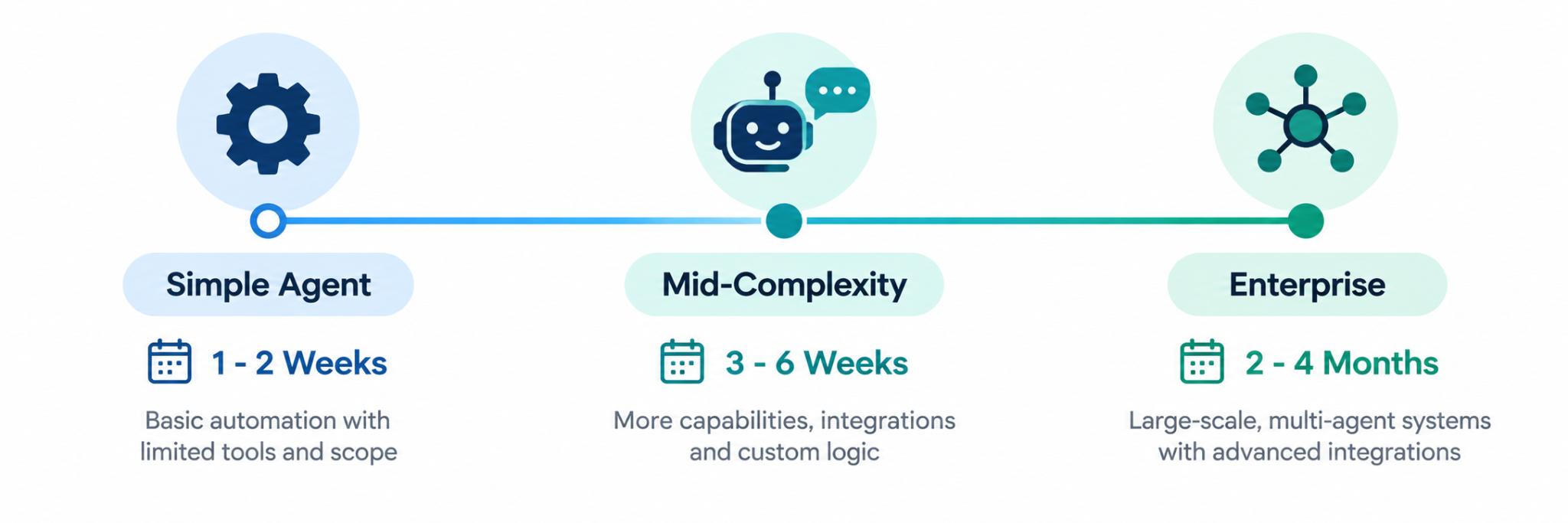
Simple Rule-Based Agent - 1 to 2 Weeks
A single-task agent (e.g., auto-replying to support tickets using one data source) is the fastest to ship. Minimal integrations, one model, narrow scope.
Mid-Complexity Agent - 3 to 6 Weeks
This is where most business use cases live - an agent that pulls from CRM data, makes decisions across a few conditions, and hands off to a human when uncertain. Expect design, prompt/tooling iteration, and QA cycles.
Enterprise-Grade Agentic System - 2 to 4 Months
Multi-agent systems with memory, tool orchestration, security review, and integration into legacy enterprise systems (ERP, fintech pipelines, compliance layers) take longer - and rightly so, given the stakes. These systems often lean on RAG (retrieval-augmented generation) development so the agent can reason over your company's own data instead of relying on the model's general knowledge alone.
What Determines the Timeline?
- Who is using it - internal team vs. external customers changes QA depth.
- What it needs to do - one task vs. multi-step reasoning.
- Where it lives - standalone app vs. embedded in existing enterprise software.
- When it needs to launch - compressed timelines mean tighter scope, not magic.
- Why you're building it - cost-saving automation vs. customer-facing product changes risk tolerance.
- How it's built - no-code agent builders are faster; custom agentic architecture takes longer but scales better.
How Much Does It Cost to Build an AI Agent?
- Simple agent: budget-friendly, often a few thousand dollars if outsourced, less if built on existing platforms.
- Mid-complexity agent: mid five-figure range typical for a dedicated development team, depending on integrations.
- Enterprise agentic system: six-figure investment isn't unusual once security, compliance, and custom infrastructure are factored in.
Cost scales less with "AI" itself and more with integration complexity and the number of systems the agent has to talk to.
What ROI Can You Expect From an AI Agent?
Businesses typically measure AI agent ROI through: hours of manual work automated per week, reduction in response/resolution time, error-rate reduction versus manual processes, and revenue-generating actions (leads qualified, upsells triggered) the agent completes autonomously. Most teams see measurable time savings within the first month post-deployment, with fuller ROI visible over one to two quarters as the agent is tuned. According to McKinsey's State of AI research, 62% of organizations are already experimenting with AI agents, and companies that redesign workflows around agents - rather than bolting them onto existing processes - see the strongest returns.
How to Create an AI Agent - Step by Step
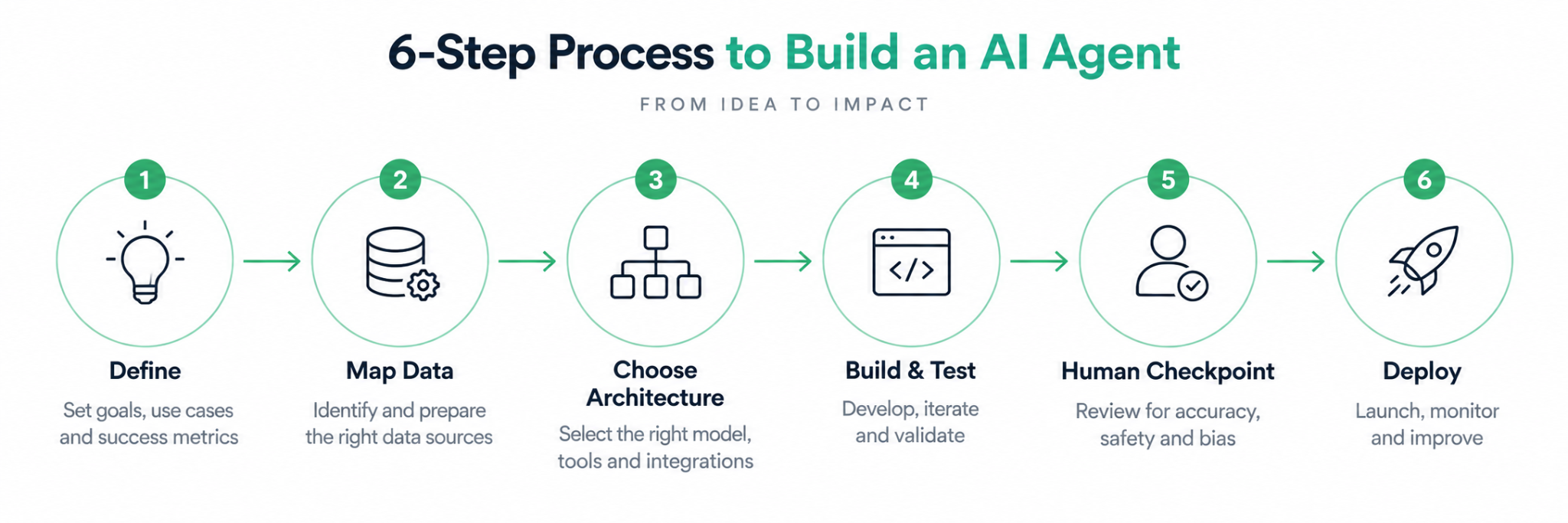
- Define the task - pick one workflow, not five.
- Map the data sources the agent needs access to.
- Choose the architecture - single-agent vs. multi-agent orchestration, often built by AI/ML developers who specialize in LLM integration and agent orchestration.
- Build and test in a sandboxed environment.
- Add human-in-the-loop checkpoints for high-stakes actions.
- Deploy, monitor, and iterate based on real usage data - see how this played out in our Gemini GYM case study, where we built an evaluation and orchestration platform for LLM workflows at scale.
Final Thoughts
There's no single answer to "how long does it take to build an AI agent" - but now you have real ranges to plan against instead of guesswork. If you're scoping a custom agentic AI project, working with a team that's shipped enterprise-grade AI development projects before can shrink both the timeline and the cost overruns that come from learning on the job.
Ready to scope your own AI agent? Talk to our team and get a realistic timeline and cost estimate for your specific use case.