
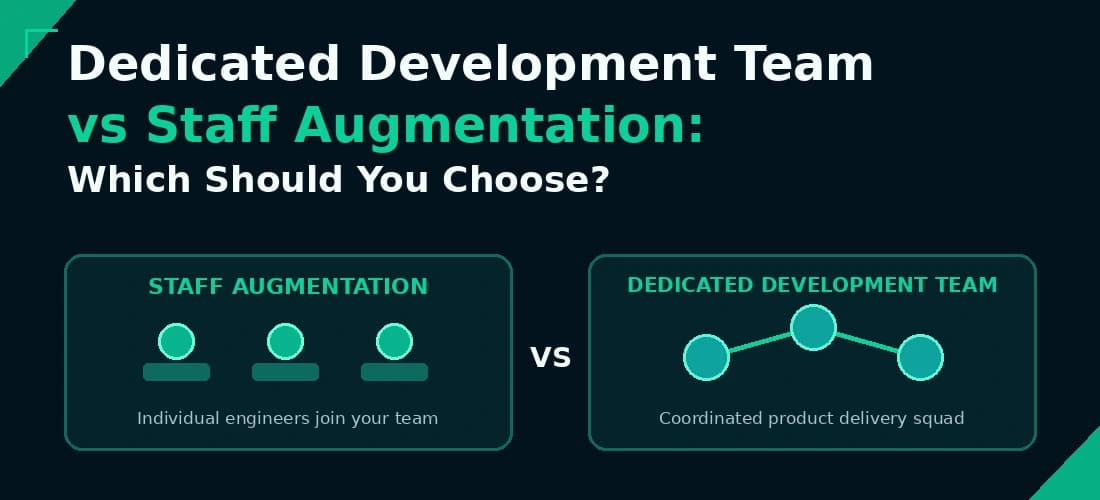
Dedicated Development Team vs Staff Augmentation: Which Should You Choose?
Your roadmap is growing, but your engineering capacity is not. Hiring more developers may seem like the obvious answer, yet additional capacity changes the demands on your technical leadership. The choice between a dedicated development team and staff augmentation is therefore about ownership as much as headcount.
Quick answer: Staff augmentation works well when you already have a capable engineering manager and delivery processes and need one or more specialists. A dedicated development team is attractive for an ongoing product or workstream needing multiple coordinated roles. A dedicated team can be client-managed or provider-managed; the term does not itself transfer delivery accountability.
What Is a Dedicated Development Team?
A dedicated development team is a stable group of software professionals allocated to a client, product or continuing workstream. It might include backend and frontend engineers, QA, DevOps and technical leadership. Team composition depends on scope and contract. In a client-managed dedicated team, the client directs engineering work. In a provider-managed arrangement, an external technical or delivery lead coordinates agreed responsibilities.
A product organization developing a SaaS platform with regular releases, testing, integrations and maintenance may prefer a coordinated team that retains shared product knowledge. Yet the customer still owns business priorities and must clarify approval rights, intellectual property and acceptance criteria.
What Is Staff Augmentation?
Staff augmentation brings external engineers into an existing client development process. The client generally owns task allocation, architecture, code reviews, QA and release decisions. It can address a temporary skill gap or a continuing capacity need. Its duration is not necessarily short.
For example, a software company with a functioning delivery organization may add one Python integration specialist to work in its repositories and sprint ceremonies. The company does not need a new managed squad if it already has the capacity to direct the work.
Dedicated Development Team vs Staff Augmentation: Key Differences
Factor | Staff augmentation | Dedicated team |
|---|---|---|
Primary purpose | Individual capacity or expertise | Stable product/workstream group |
Daily coordination | Usually client-led | Client-led or provider-led |
Architecture and QA | Usually client process | Assigned by agreement |
Pricing | Per person or allocation | Team or capacity fee |
Release ownership | Client or defined owner | Agreed release authority |
The most consequential distinction is who coordinates work and carries the management burden. A monthly team fee does not prove that a provider is accepting delivery accountability. Review the actual role matrix and acceptance obligations.
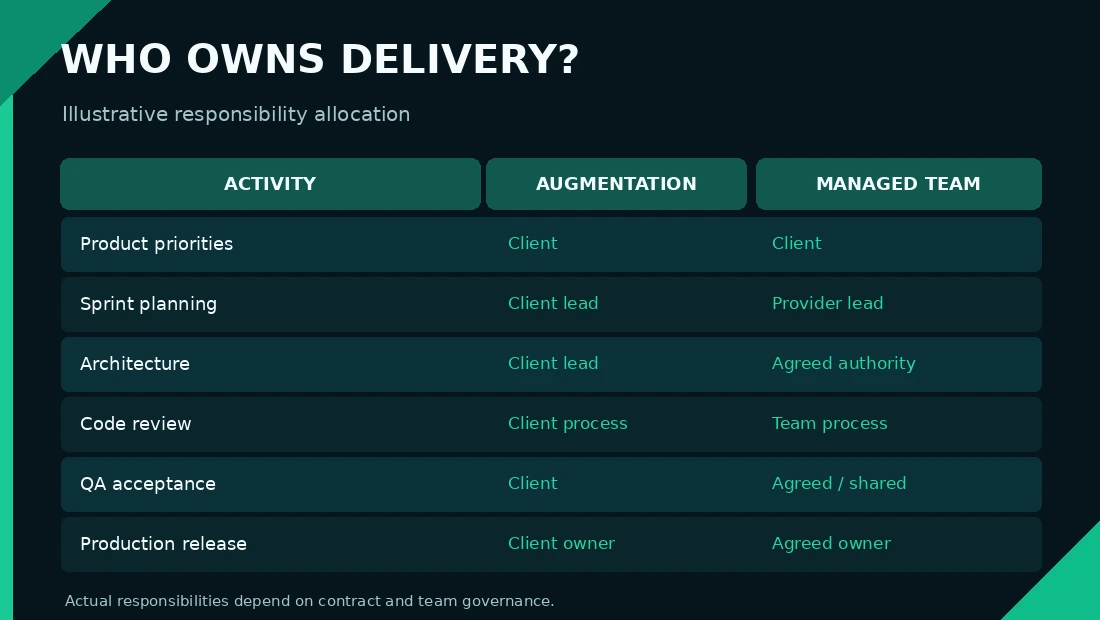
Illustrative role ownership for staff augmentation versus a provider-managed dedicated team.
How Much Does Each Model Actually Cost?
Headline hourly rates and monthly team fees omit important expenses. A defensible total-cost comparison includes client technical management, QA, onboarding, tool access, replacement support and final handover. Use consistent staffing and responsibility assumptions before treating the resulting totals as comparable.
For a closer look at how a buyer’s own engineering-lead time affects the real total, read the hidden weekly cost of engineering management. It illustrates why an hourly or monthly supplier quote is not the same as the full cost of delivery.
Six-Month Hypothetical Scenario
Assumption | Staff augmentation | Managed dedicated team |
|---|---|---|
Provider fee | $129,600 | $156,000 |
Client leadership | $16,627 | $8,314 |
Illustrative total | $146,227 | $164,314 |
Augmentation: 3 engineers × 160 hours/month × $45/hour × 6 months = $129,600. Client leadership: 8 hours/week × 4.33 weeks/month × $80/hour × 6 months = $16,627 rounded. Total $146,227 rounded.
Managed team: $26,000/month × 6 months = $156,000. Client governance: 4 hours/week × 4.33 weeks/month × $80/hour × 6 months = $8,314 rounded. Total $164,314 rounded.
These are deliberately hypothetical figures, not prevailing US market prices or a provider quotation. The managed squad composition and QA coverage are unspecified, so the two examples are not equivalent bids. Real comparisons require matching roles, seniority, capacity, security obligations and delivery responsibility.
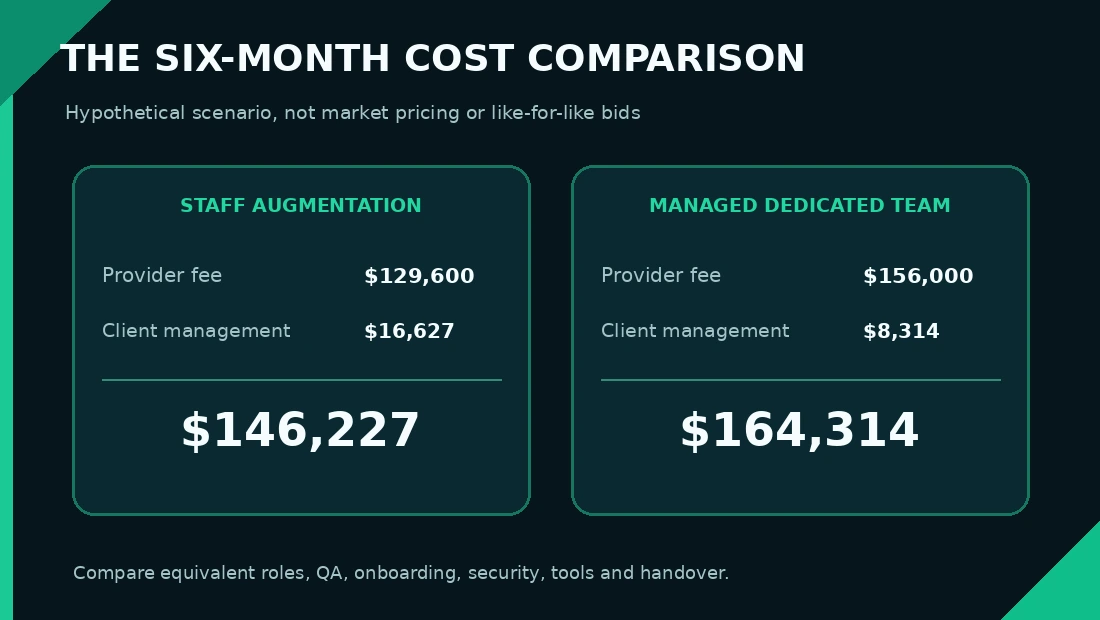
Illustrative six-month spending model. Totals do not include all possible onboarding, tools, QA and exit costs.
Three Buying Scenarios
Two-month specialist gap: an established CTO and team need one engineer for a defined integration. Staff augmentation is often simpler. Six-month product workstream: multiple roles and ongoing coordination may justify a provider-managed team if the client lacks management time. Twelve-month evolving roadmap: continuity may favor a stable team, but long-term augmentation remains viable under strong client leadership.
Which Model Fits Your Project?
Begin with five questions: Do you have a technical lead who can review additional work? Are planning, code review and QA processes already effective? Is the need one specialist or several complementary roles? Who should coordinate work each day? Who will handle replacements, documentation and final handover?
If you have strong internal leadership and a narrow skill gap, augmentation is the natural starting point. If you need a coordinated group and external management, evaluate a genuinely managed team. Mixed answers suggest a hybrid structure.
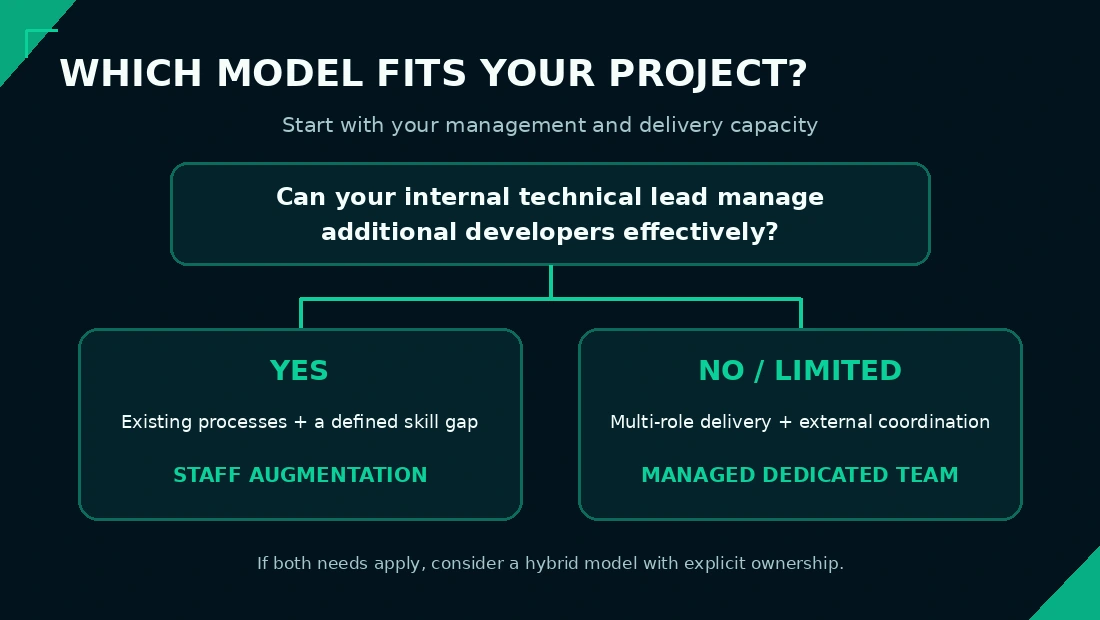
Illustrative decision flow for technical management capacity. Consider a hybrid where both external coordination and internal specialist support are needed.
When Should You Choose Staff Augmentation?
Additional capacity can also increase review queues, handoffs and dependency management. The companion discussion of why adding more developers can slow product delivery explores this organizational risk; it is a reason to assess management bandwidth, not a claim that expanding a team is always harmful.
Choose augmentation when engineers can join an established backlog, repository, testing workflow and decision structure. It is particularly effective for specialist gaps and client-controlled architecture. The main risk is management bottlenecks: external engineers can be available while work remains blocked by missing requirements, slow reviews or unclear permissions.
When Is a Dedicated Development Team Better?
A stable group can suit multi-role product delivery where engineering, QA and operational responsibilities interact over several releases. Provider-led coordination may reduce some client management work, but the provider must explicitly commit to a lead, deliverables, review standards and escalation process. A full squad is often unnecessary for a one-person skill gap or an unready backlog.
Before day one, identify who can approve architecture changes, unblock access and accept completed work. The practical checklist of warning signs that external developers lack clear ownership provides a useful companion to the responsibility assignments above.
How to Set Up Either Model for Successful Delivery
Before onboarding, appoint a product owner, technical decision-maker, security approver, review owner and release authority. Agree which organization handles CI/CD, QA acceptance, incidents, documentation and staffing changes. For client-managed teams, more roles remain internal.
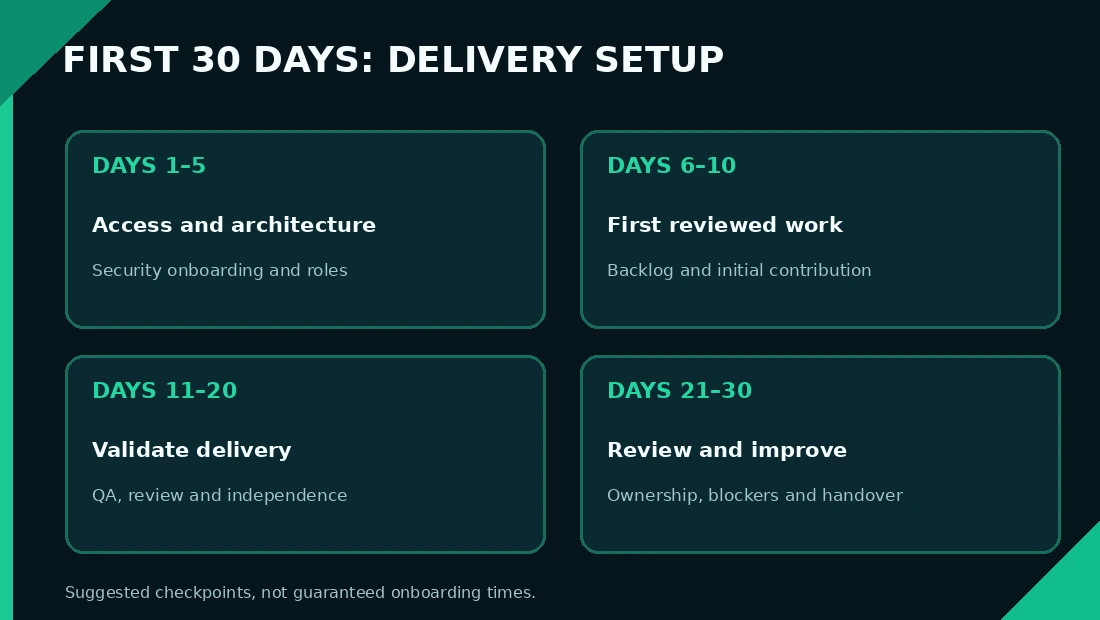
Suggested 30-day operating checkpoints, not guaranteed productivity timelines.
First-month evidence should include approved access, security induction, a named technical owner, an accepted contribution following normal review, documented decisions, a reporting cadence and a written replacement and exit procedure. Avoid using story points or commit counts as universal individual productivity measures.
What Should Your Contract Include?
Specify allocation and role seniority, times of availability, billing treatment, management responsibilities, change control, acceptance criteria, QA and security requirements, code ownership, repository control, staff replacement, notification periods, documentation and termination assistance.
Security controls should follow agreed engineering standards. The NIST Secure Software Development Framework outlines secure development practices (https://csrc.nist.gov/pubs/sp/800/218/final), and OWASP ASVS provides application security verification requirements (https://asvs.owasp.org/). Neither model automatically guarantees security or intellectual property rights.
Can You Combine or Switch Between the Models?
Yes. A client might retain an internal platform group, add a temporary DevOps specialist through augmentation, and engage an external managed squad for a customer-facing workstream. The key is to document shared architecture ownership, release dependencies and who resolves cross-team blockers. Reconsider the arrangement when management overhead, number of connected roles or ongoing delivery scope materially changes.
Final Decision Checklist
Confirm whether you are buying engineering hours or coordinated delivery; who owns product and architecture decisions; whether the quote includes management and QA; how replacements work; who controls code and infrastructure; and how the product can continue safely after the engagement ends.
Choose staff augmentation for well-managed internal delivery organizations needing extra skills. Choose a dedicated team for a continuing, coordinated product scope and clarify whether that team is vendor-managed. If neither contract makes the desired outcome accountable, evaluate a project-based delivery agreement instead.
Conclusion
Choosing between a dedicated development team and staff augmentation is ultimately a decision about management capacity, project complexity, and long-term product ownership. Staff augmentation fits organizations that already have strong engineering leadership and need focused additional skills. A dedicated team may work better when several roles must coordinate across continuing product delivery, provided the agreement clearly states who manages engineering decisions and outcomes. Before signing, compare total costs, responsibilities, onboarding requirements, and the conditions for a successful handover.
At Toadster Technologies, businesses can explore software developer hiring and team augmentation solutions based on their project scope, internal leadership capacity, and preferred level of delivery support.