
Fintech App Development Cost in 2026: Banking, Payments and Compliance
How much does it cost to build a fintech app in 2026? The answer depends less on the number of screens than on what the application is expected to do, which financial systems it must connect to, and who is responsible for the financial activity behind it.
A read-only banking dashboard is fundamentally different from a payments application that initiates transfers, processes refunds and reconciles settlements. A compliance workflow platform introduces another set of requirements, including sensitive document handling, reviewer permissions, audit trails and reporting.
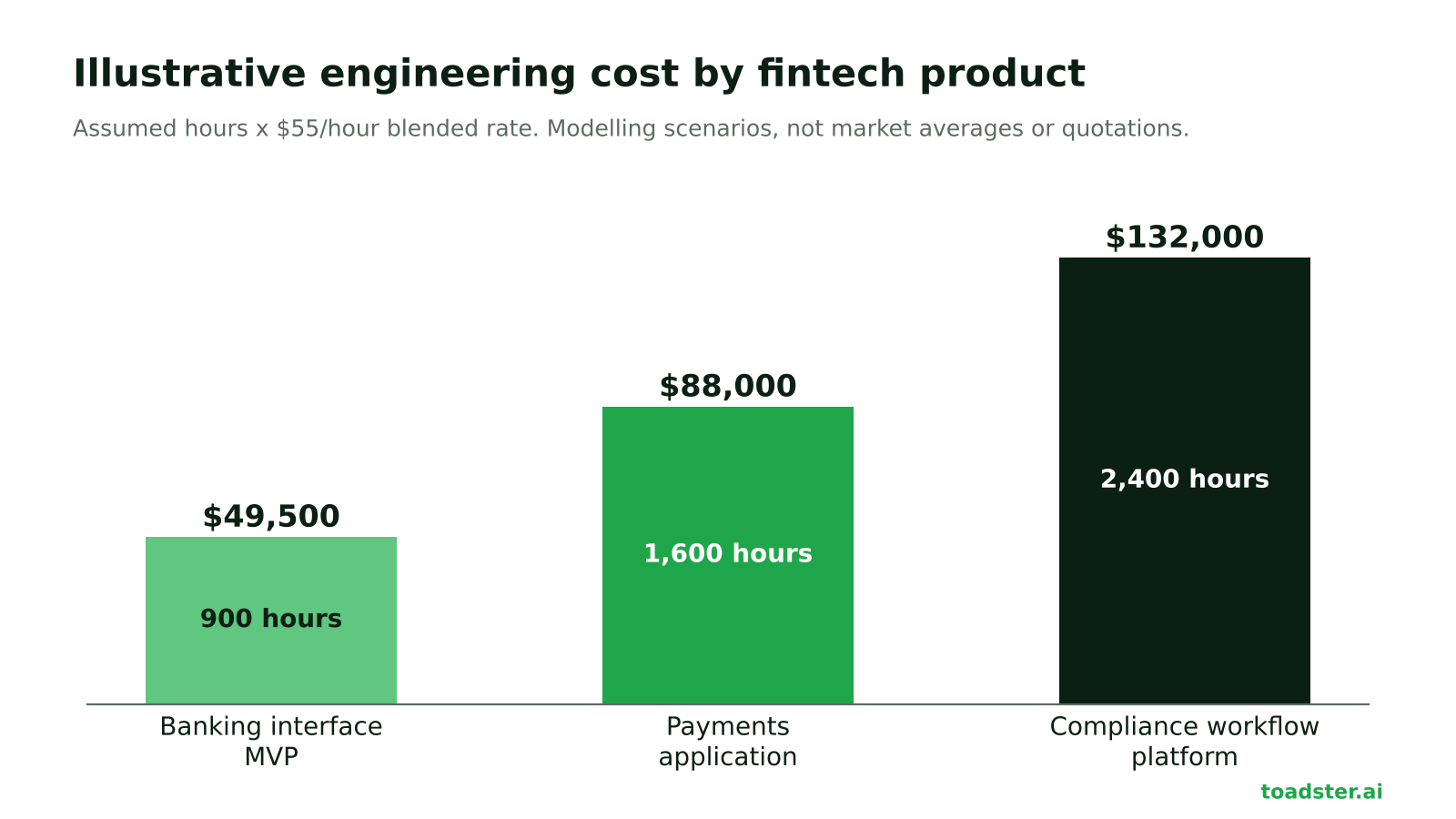
For initial budgeting, this guide uses three illustrative engineering scenarios:
Fintech product | Assumed engineering effort | Assumed hourly rate | Illustrative engineering cost |
|---|---|---|---|
Banking interface MVP | 900 hours | $55 | $49,500 |
Payments application | 1,600 hours | $55 | $88,000 |
Compliance workflow platform | 2,400 hours | $55 | $132,000 |
These are modelling scenarios, not verified market averages, vendor quotations or complete launch budgets. The assumed hours and hourly rate are provided to demonstrate how project scope affects engineering expenditure.
Discovery, product design, independent security assessments, licensing, legal advice, provider charges, infrastructure and ongoing operations can increase the total investment.
For businesses planning a banking interface, payments product or compliance platform, understanding these requirements before development begins is essential. Toadster's fintech software development services can help businesses translate product requirements into an appropriate technical scope.
Key findings
- Financial permissions influence development effort. An application that only displays account information generally requires a different architecture from one that initiates transactions or supports financial decision-making.
- Integrations involve more than API connections. Provider onboarding, authentication, retries, duplicate events, settlement and reconciliation all contribute to engineering work.
- Security and compliance must be considered during discovery. Retrofitting access controls, auditability and data-handling workflows can increase development effort.
- The initial development budget is not the total cost of ownership. Infrastructure, third-party services, maintenance, security reviews and customer support continue after launch.
- The lowest initial quotation may not represent the lowest overall investment. White-label platforms and financial infrastructure partners can reduce engineering requirements while introducing licensing, transaction or contractual costs.
- Reliable estimates require transparent assumptions. Project hours, hourly rates, deliverables and exclusions should be documented before comparing development proposals.
Research methodology: How these fintech development costs were estimated
This guide combines published industry research, official regulatory documentation and illustrative engineering calculations.
It does not represent a survey of fintech development projects or a statistical analysis of vendor quotations.
The three project scenarios use the following calculation:
Illustrative engineering cost = Assumed engineering hours × $55 per hour
The $55 blended hourly rate is a modelling assumption. It is not a verified global development rate or a representation of Toadster's commercial pricing.
Similarly, the engineering hours are hypothetical estimates used to demonstrate differences in project scope. They should not be interpreted as standard delivery timelines or guaranteed development requirements.
The estimates exclude several potentially significant expenses:
- Product discovery and business analysis, unless included in the engineering scope.
- UI/UX design and user research.
- Independent penetration testing and security certification.
- Regulatory licensing and legal consultations.
- Banking, payment processing and identity verification fees.
- Cloud infrastructure and third-party subscriptions.
- Customer support and post-launch operations.
All industry statistics are identified by their original reporting period. Historical data is used to explain the development of digital financial services, not to imply that it represents measurements collected in 2026.
Before using these figures for procurement or financial planning, businesses should obtain project-specific estimates based on their actual requirements.
Why fintech app development costs deserve closer attention
Digital financial services have expanded significantly, creating opportunities for businesses developing banking, payment, lending and financial management applications.
According to the World Bank's Global Findex Database 2021, 76% of adults worldwide had an account with a financial institution or mobile money provider in 2021, compared with 68% in 2017. Approximately 1.4 billion adults remained unbanked at the time.
The same research reported that two-thirds of adults worldwide made or received digital payments in 2021.
These are historical figures, not 2026 market measurements. They nevertheless provide useful context for understanding the expansion of digital financial services.
India provides a more recent example of the scale of digital payment activity.
According to NPCI's September 2026 UPI statistics:
- UPI processed approximately 24.07 billion transactions during the month.
- The transaction value was approximately ₹29.37 lakh crore.
- 756 banks were live on the UPI network.
These figures describe UPI ecosystem activity, not the number of fintech applications or individual fintech users. They demonstrate the scale of the payment infrastructure with which many Indian financial products interact.
For product teams, this growth creates several technical considerations:
- Customers may have different levels of financial and digital literacy.
- Identity verification requirements can vary by market.
- Applications must accommodate different devices and connectivity conditions.
- Payment failures and transaction delays require clear customer communication.
- Financial records must remain consistent across applications and external providers.
These considerations influence product architecture, integration complexity, testing requirements and operational planning.
What determines fintech app development cost?
Fintech app development costs depend on several interconnected factors. The most important are product scope, financial permissions, integrations, security requirements, infrastructure and team responsibilities.
1. Product scope and financial permissions
The first step in estimating a fintech application is understanding what users are permitted to do.
Can customers only view account information? Can they initiate transfers, manage beneficiaries, apply for credit or upload identity documents? Does the application automatically make decisions, or does it support human reviewers?
Each additional financial capability can introduce backend workflows, permissions, integrations and operational responsibilities.
For example, an account dashboard might require:
- Secure authentication.
- Account information retrieval.
- Transaction history.
- User profile management.
- Basic notifications.
A payment application may additionally require:
- Beneficiary management.
- Transaction authorization.
- Payment initiation.
- Transaction status tracking.
- Refund and reversal workflows.
- Reconciliation and settlement support.
A useful project scope should distinguish between read-only functionality, financial actions, automated decisions and workflows requiring human approval.
2. Third-party integrations and external dependencies
Most fintech applications depend on external financial infrastructure.
Depending on the business model, these integrations may include:
- Banking APIs.
- Payment gateways and processors.
- Identity verification providers.
- Credit information services.
- Fraud detection platforms.
- Messaging and notification services.
- Accounting and reporting systems.
Connecting an API is only one part of the work. Production onboarding, authentication, testing, monitoring and failure handling must also be considered.
One particularly important issue is transaction idempotency.
Consider a payment request that times out after the payment provider has already accepted it. If the application automatically retries the request without appropriate safeguards, it could initiate a duplicate transaction.
The architecture must account for such scenarios through idempotency controls, transaction-state management and reliable reconciliation.
Other integration requirements include:
- Webhook authentication and validation.
- Duplicate and out-of-order event handling.
- Retry policies and timeout management.
- Sandbox and production environment testing.
- Provider approval and onboarding.
- API version changes.
- Settlement reporting and exception management.
The number of integrations alone does not determine cost. Their reliability, documentation, complexity and operational requirements are equally important.
3. Security, compliance and auditability
Financial applications handle sensitive information and may support activities subject to regulatory requirements.
Security architecture should therefore be considered during product discovery rather than treated as a final development-stage feature.
Depending on the application, technical requirements may include:
- Multi-factor authentication.
- Role-based access control.
- Encryption and secrets management.
- Session and device management.
- Secure API communication.
- Audit logging.
- Vulnerability testing.
- Data retention and deletion workflows.
- Monitoring and incident response.
Payment-card data introduces additional considerations under the PCI DSS framework maintained by the PCI Security Standards Council.
The applicable scope depends on how the business stores, processes or transmits cardholder data and how its service providers are involved.
It is important to distinguish between implementing security controls and achieving regulatory compliance. A KYC screen, encryption feature or audit log does not independently make an application compliant.
The business model, jurisdiction, financial partners and actual operating activities determine the obligations that need to be assessed with qualified advisers.
4. Platforms, usage and reliability requirements
The decision to develop for Android, iOS, web or multiple platforms affects the project scope.
A business targeting enterprise customers may need a web-based administrative portal alongside a mobile application. A consumer payments product may require native mobile experiences and additional device-security controls.
Platform selection should consider:
- Target customer demographics.
- Device preferences.
- Accessibility requirements.
- Offline and low-connectivity scenarios.
- Security expectations.
- Maintenance requirements.
- Future platform expansion.
Expected transaction volume also influences architecture and infrastructure decisions.
A limited pilot and a high-volume payments product may require different monitoring, database capacity, scaling and recovery arrangements.
Even an MVP needs an appropriate baseline for reliability, backups, access control and failed-transaction handling.
5. Team structure and project readiness
Development costs also depend on the responsibilities included in a vendor's proposal.
One company may quote only for engineering, while another includes discovery, UI/UX design, testing, project management and deployment.
Before comparing quotations, establish whether the following roles are included:
- Business analyst or product manager.
- UI/UX designer.
- Backend developers.
- Mobile or frontend developers.
- QA engineers.
- DevOps engineers.
- Security specialists.
- Project manager.
A lower quotation may simply reflect a narrower scope rather than greater development efficiency.
Fintech app development cost by product type
The following scenarios demonstrate how different product requirements can influence engineering expenditure.
They are illustrative models, not market benchmarks or quotations for specific projects.
Banking interface MVP: $49,500
Calculation: 900 engineering hours × $55/hour
A limited banking interface may allow customers to view financial information supplied by a banking partner.
Its initial scope could include:
- User registration and secure login.
- Account summaries.
- Transaction history.
- Profile management.
- Basic notifications.
- Banking partner integration.
This scenario assumes an interface built around partner-provided banking information. It does not include the development of a core banking platform.
The scope can increase significantly if users need account opening, card management, fund transfers, statement generation, dispute handling or additional banking services.
Payments application: $88,000
Calculation: 1,600 engineering hours × $55/hour
A payments application requires more than a checkout screen or payment initiation API.
A possible MVP scope includes:
- Payment initiation.
- Beneficiary management.
- Transaction status tracking.
- Payment provider integration.
- Webhook processing.
- Refund workflows.
- Basic reconciliation.
- Operational dashboards.
The final engineering effort depends on the transaction lifecycle and the responsibilities handled by the fintech business versus its payment partner.
Multi-provider routing, settlement management, disputes, recurring payments and advanced fraud controls may increase the scope.
This scenario does not represent the cost of establishing or operating a regulated payment network.
Compliance workflow platform: $132,000
Calculation: 2,400 engineering hours × $55/hour
A compliance workflow application may support internal teams responsible for customer onboarding, identity verification and case reviews.
Its scope could include:
- Document collection and storage.
- Customer onboarding workflows.
- Review queues.
- Role-based reviewer permissions.
- Case management.
- Escalation workflows.
- Audit trails.
- Reporting and administrative dashboards.
Development effort depends on the number of workflows, external data sources, jurisdictions and levels of automation.
A platform supporting human reviewers has different requirements from one that automatically evaluates customer risk or generates decisions.
Importantly, software can support compliance operations, but it does not independently guarantee regulatory compliance.
Fintech app development cost by feature and complexity
Individual features can have very different engineering requirements depending on their implementation.
Feature | Basic implementation | Advanced implementation | Factors affecting effort |
|---|---|---|---|
Authentication | Email or OTP login | Multiple authentication factors and device controls | Risk model, recovery and session management |
Identity verification | One verification provider | Document checks, liveness and manual reviews | Country coverage and provider capabilities |
Payment processing | Single-provider payment flow | Multiple providers, routing, refunds and reconciliation | Transaction lifecycle and funds flow |
Fraud detection | Basic rules and alerts | Risk scoring and real-time monitoring | Data availability and review workflows |
Banking integration | Display of partner account information | Multiple institutions and broader account capabilities | API access and provider requirements |
Compliance reporting | Basic reports and exports | Configurable audit trails and monitoring | Retention, reporting and access requirements |
These descriptions are intended to demonstrate differences in scope. They are not standalone cost estimates.
Feature estimates should also account for shared components. For example, authentication, monitoring and audit logging may support several workflows simultaneously. Adding separate estimates without considering shared functionality can result in double-counting.
How security and compliance influence development budgets
Security expenditure should be connected to the risks and responsibilities associated with the application.
Risk or requirement | Possible technical response |
|---|---|
Unauthorized account access | Authentication, authorization and session controls |
Payment fraud | Transaction monitoring and investigation workflows |
Sensitive information exposure | Encryption, access controls and data minimization |
Audit requirements | Traceable actions, logging and retention controls |
Provider outages | Monitoring, fallback arrangements and escalation procedures |
Security incidents | Alerting, incident response and recovery testing |
The appropriate controls depend on the product and applicable regulatory requirements. This is not a universal compliance checklist.
A realistic budget should distinguish between three categories:
Product security: Controls implemented as part of the application, such as authorization, encryption and audit logging.
Independent assurance: Penetration testing, vulnerability assessments and other external security reviews.
Ongoing operations: Monitoring, incident response, access reviews, maintenance and periodic testing.
For Indian fintech businesses, the applicable regulatory requirements depend on the activity being performed.
For example, the RBI's Digital Lending Directions, 2025 address regulated entities and their arrangements with Lending Service Providers. They cover areas such as partner due diligence, borrower disclosures, data requirements, grievance redressal and responsibilities that remain with regulated entities.
The Directions also make clear that outsourcing digital lending activities does not automatically remove the regulated entity's responsibilities.
This distinction is important when estimating the development of lending platforms and related applications.
For further guidance on the regulatory considerations involved in Indian fintech products, see Toadster's RBI compliance guide for fintech apps.
Banking and payment integrations: Estimate the entire transaction lifecycle
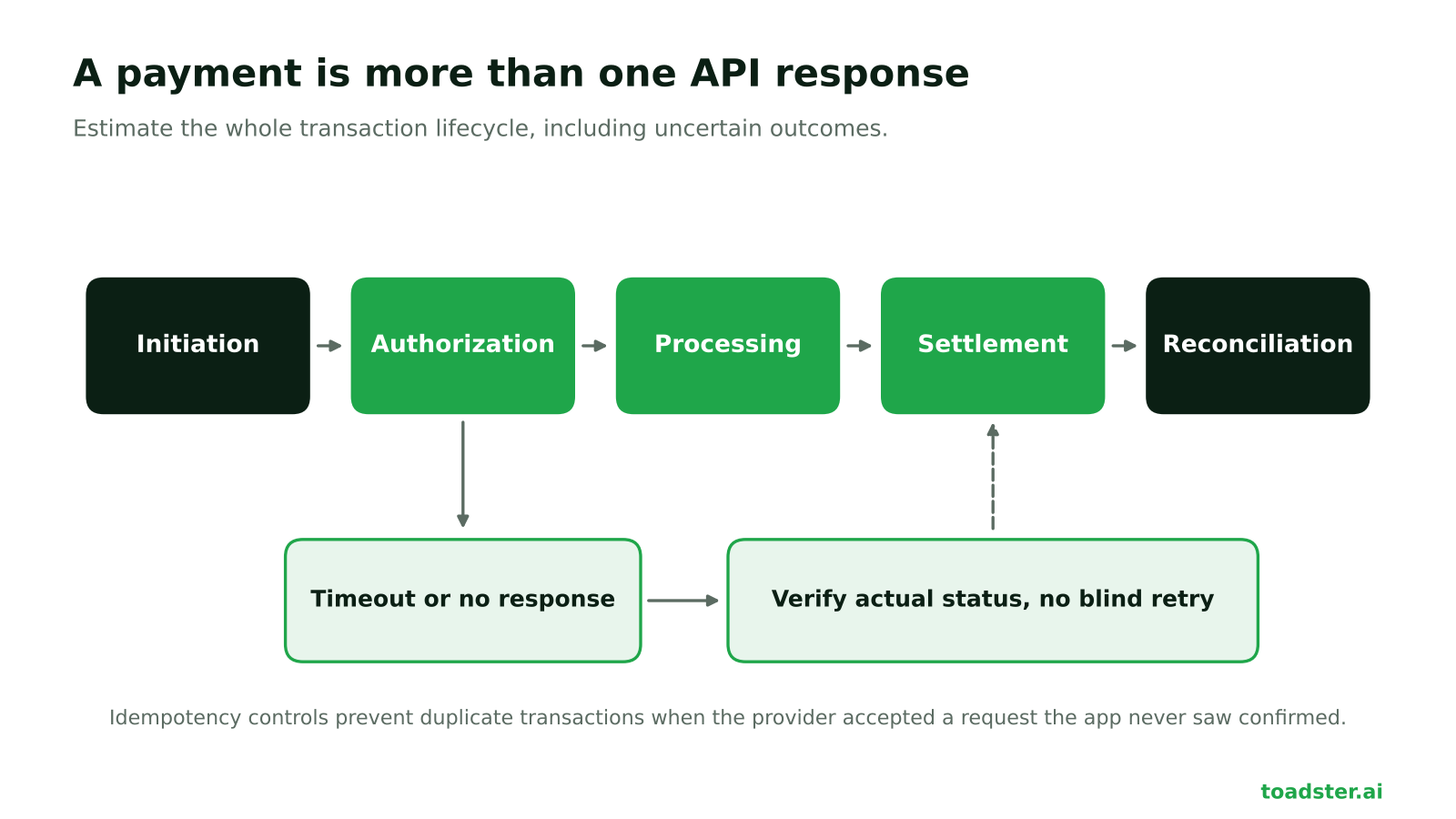
A common estimation mistake is treating a successful API response as the end of a financial transaction.
In practice, a payment may pass through several states, including initiation, authorization, processing, settlement and reconciliation.
The application must also handle unsuccessful and uncertain outcomes.
For example, a customer may see a timeout even though the payment provider has accepted the request. The application must be able to establish the actual transaction status rather than simply displaying a failed-payment message.
Before approving an integration estimate, ask:
- Which system maintains the authoritative balance and transaction record?
- How are payment initiation, authorization and settlement represented?
- How are duplicate requests and webhooks prevented or handled?
- What happens when events arrive late or out of order?
- How are internal records matched against provider reports?
- Who investigates reconciliation discrepancies?
- What are the provider's production approval and support requirements?
These questions influence engineering effort as well as operational readiness.
Fintech app development cost by country
Development costs vary between countries, but comparing locations using a single hourly rate can be misleading.
An employee's salary is not equivalent to an agency's billing rate. Agency pricing may include project management, recruitment, administrative overhead, infrastructure, commercial risk and other operational expenses.
Rates also vary according to:
- Developer experience and seniority.
- Technology specialisation.
- Project complexity.
- Engagement model.
- Team composition.
- Contract duration.
- Scope of responsibility.
Businesses comparing development teams in India, the United States, the United Kingdom, the UAE or Eastern Europe should request quotations based on the same project requirements.
A useful comparison should disclose:
- Roles and seniority included.
- Estimated hours by workstream.
- Design, QA and project management coverage.
- Currency, taxes and payment terms.
- Third-party and infrastructure charges.
- Security and compliance-related exclusions.
- Post-launch maintenance arrangements.
Official salary and labour statistics can provide employment-cost context, but they should not be presented as software development agency quotations.
Without comparable, independently sourced pricing data, publishing precise country-level development rates would create a misleading impression of accuracy.
Hidden and ongoing costs of running a fintech application
The initial development quotation is only one part of the investment required to launch and operate a fintech product.
Once the application is live, the business may incur recurring expenses related to infrastructure, third-party providers, maintenance and operational teams.
Common expenses include:
- Cloud hosting and database services.
- Backups and disaster recovery.
- Monitoring and logging tools.
- Payment processing charges.
- Identity verification and screening.
- Messaging and notification services.
- Security testing.
- Application maintenance.
- Customer support.
- Dispute and chargeback management.
- Compliance operations.
- Legal and advisory services.
Maintenance is particularly important because financial applications depend on changing external systems. Mobile operating systems, banking APIs, payment providers and security requirements can all change over time.
For a more detailed breakdown of recurring application expenditure, read Toadster's guide to mobile app maintenance costs in 2026.
Illustrative monthly fintech operating model
The following example demonstrates how transaction activity and identity verification volumes can influence recurring expenditure.
Assumed monthly model:
Monthly operating cost = $3,500 fixed platform expenditure + $0.08 per event + $1.50 per identity verification
Scenario | Monthly events | Identity checks | Illustrative monthly cost |
|---|---|---|---|
Lower volume | 5,000 | 350 | $4,425 |
Base volume | 20,000 | 1,000 | $6,600 |
Higher volume | 50,000 | 2,000 | $10,500 |
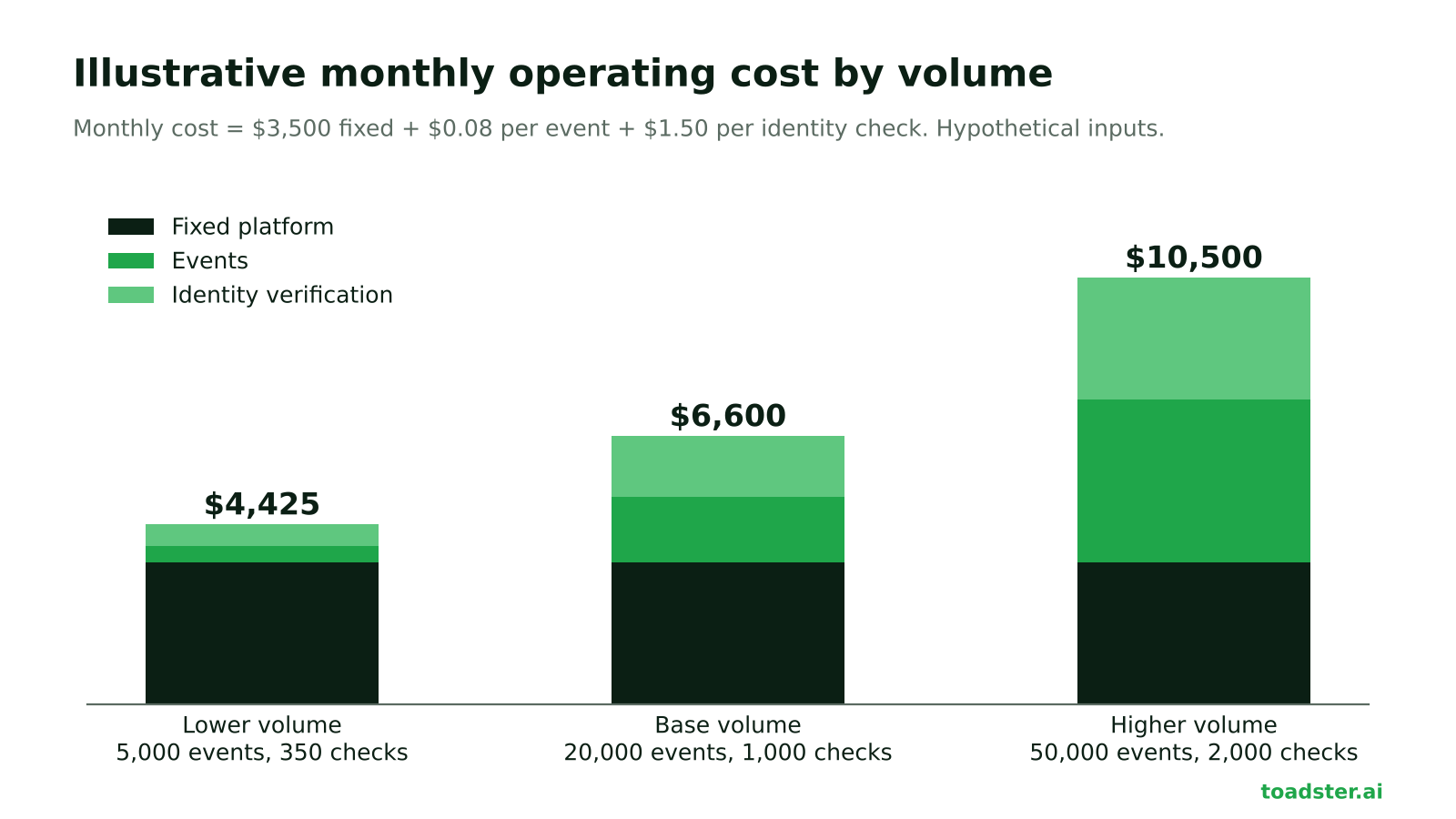
For the base scenario:
- Fixed platform expenditure: $3,500.
- Event expenditure: 20,000 × $0.08 = $1,600.
- Identity verification: 1,000 × $1.50 = $1,500.
Total illustrative monthly expenditure: $6,600.
All figures are hypothetical inputs, not published provider prices.
The model excludes payment processing percentages, interchange, scheme fees, chargebacks, fraud losses, taxes, regulatory capital, legal advice and other potentially material expenses.
Businesses should replace these assumptions with actual provider contracts and usage forecasts before using the model for financial planning.
Build, buy or use a banking-as-a-service partner?
Fintech businesses do not necessarily need to build every financial capability themselves.
The right decision depends on which parts of the product create competitive value and which capabilities are better provided by established specialists.
Custom fintech software development
Custom development can be appropriate when the application requires specialised workflows, unique customer experiences or integrations that are central to the business model.
It offers greater control over architecture, functionality and future expansion.
However, the business must also plan for software maintenance, infrastructure, security and the management of external dependencies.
Custom development does not automatically eliminate the need for licensed financial partners or regulatory approvals.
White-label fintech platforms
A white-label solution can reduce initial engineering effort by providing an existing product that businesses can configure and rebrand.
This approach may suit businesses with standard requirements and limited time for custom development.
Before selecting a platform, evaluate:
- Customisation limitations.
- Integration capabilities.
- Data ownership and portability.
- Security documentation.
- Licensing and transaction fees.
- Upgrade schedules.
- Vendor dependency.
- Exit and migration provisions.
A lower setup cost may be offset by recurring licensing charges or limitations that become expensive as the product evolves.
Banking-as-a-service and payment infrastructure partners
Financial infrastructure partners can provide banking or payment capabilities that would otherwise require substantial operational and technical arrangements.
The fintech business can then focus on its customer-facing experience, business workflows and supporting technology.
However, selecting a partner requires careful evaluation of geographic coverage, permissions, contractual responsibilities, service levels and continuity arrangements.
A partnership does not automatically transfer every regulatory obligation away from the fintech business.
Which approach should a fintech business choose?
For many businesses, a hybrid approach is worth evaluating.
The company can use established financial infrastructure for standard banking and payment capabilities while investing in custom software for its distinctive workflows and customer experience.
The decision should be based on total cost of ownership, long-term flexibility, regulatory responsibilities and the business's ability to maintain the technology.
How to estimate your fintech app development budget
A reliable development estimate starts with a defined product brief rather than a list of screens.
The following steps help businesses prepare requirements before approaching development partners.
1. Define the target customer and business problem
Identify who will use the application, what financial problem it solves and which markets it will serve.
Customer demographics, financial literacy, device preferences and accessibility requirements can all influence the product experience.
2. Map financial permissions and funds flow
Document what customers can do within the application.
Distinguish between viewing information, initiating transactions, making financial decisions and maintaining financial records.
Identify the organisation responsible for each activity.
3. Identify external partners
List the banks, payment processors, identity verification providers and other services required.
Document whether production access and integration documentation are already available.
Unconfirmed provider dependencies should be recorded as estimation risks.
4. Define MVP functionality and exception handling
Separate essential launch functionality from future improvements.
For important workflows, document unsuccessful transactions, reversals, disputes, manual reviews and customer support requirements.
A scope that describes only successful customer journeys is incomplete.
5. Obtain a workstream-level estimate
Request a breakdown covering:
- Discovery and business analysis.
- UI/UX design.
- Backend development.
- Mobile and web development.
- Third-party integrations.
- Quality assurance.
- Security implementation.
- Deployment and infrastructure.
Identify independent assessments, legal consultations and external provider charges separately.
6. Calculate first-year operating expenditure
Include recurring infrastructure, provider charges, maintenance, customer support and compliance operations.
Model different usage levels rather than assuming that initial launch volumes will remain constant.
7. Revisit assumptions as the project progresses
An estimate should evolve as the business selects providers, receives sandbox access, validates regulatory responsibilities and finalises the launch scope.
Review the budget whenever a material requirement changes.
How to compare fintech app development company quotations
Comparing vendors solely on their headline price can result in incomplete budgets and unexpected delivery costs.
A useful proposal should explain what is included, who is responsible for each deliverable and how the application will be tested.
Ask potential development partners:
- Which features and deliverables are included in the quotation?
- Which roles will work on the project, and what is their estimated involvement?
- How will the team handle payment retries, reconciliation, reversals and disputes?
- Which external provider costs are excluded?
- Who owns the source code, infrastructure, documentation and application data?
- How will security requirements be incorporated into the architecture?
- What happens when integrations or project requirements change?
- What maintenance and support are available after launch?
- What milestones and acceptance criteria determine completion?
The strongest proposal is not necessarily the cheapest or the most detailed. It is the one that makes project assumptions, technical responsibilities and commercial exclusions sufficiently clear for an informed decision.
Conclusion
The cost of developing a fintech application in 2026 depends on more than the features visible to customers. Financial permissions, transaction responsibilities, external integrations, security requirements and post-launch operations all influence the investment required.
A banking interface, payments application and compliance workflow platform may appear similar in an early product specification, but their underlying technical and operational responsibilities can be very different.
Before approving a development budget, define what customers can do, identify who owns the financial records, map the transaction lifecycle and establish which security and regulatory requirements apply.
Then separate engineering expenditure from provider fees, independent assessments, infrastructure and ongoing operational costs.
A reliable fintech development estimate is not simply a number. It is a breakdown of the work, assumptions, dependencies and responsibilities behind that number.
If you are planning a fintech product, Toadster's fintech software development team can help assess your requirements, identify integration dependencies and establish a practical development roadmap.