
AI Agent Development Cost in 2026: What You'll Actually Pay
Ask five vendors what an AI agent costs and you'll get five different answers, and probably not because anyone's lying to you. "AI agent" gets used for a $4,000 script that reads one inbox and for a $200,000 system that coordinates six specialized agents across a regulated workflow. Both are technically AI agents. Neither number tells you what your project costs - and neither does a generic quote from an AI agent development company that hasn't asked what you're actually trying to build.
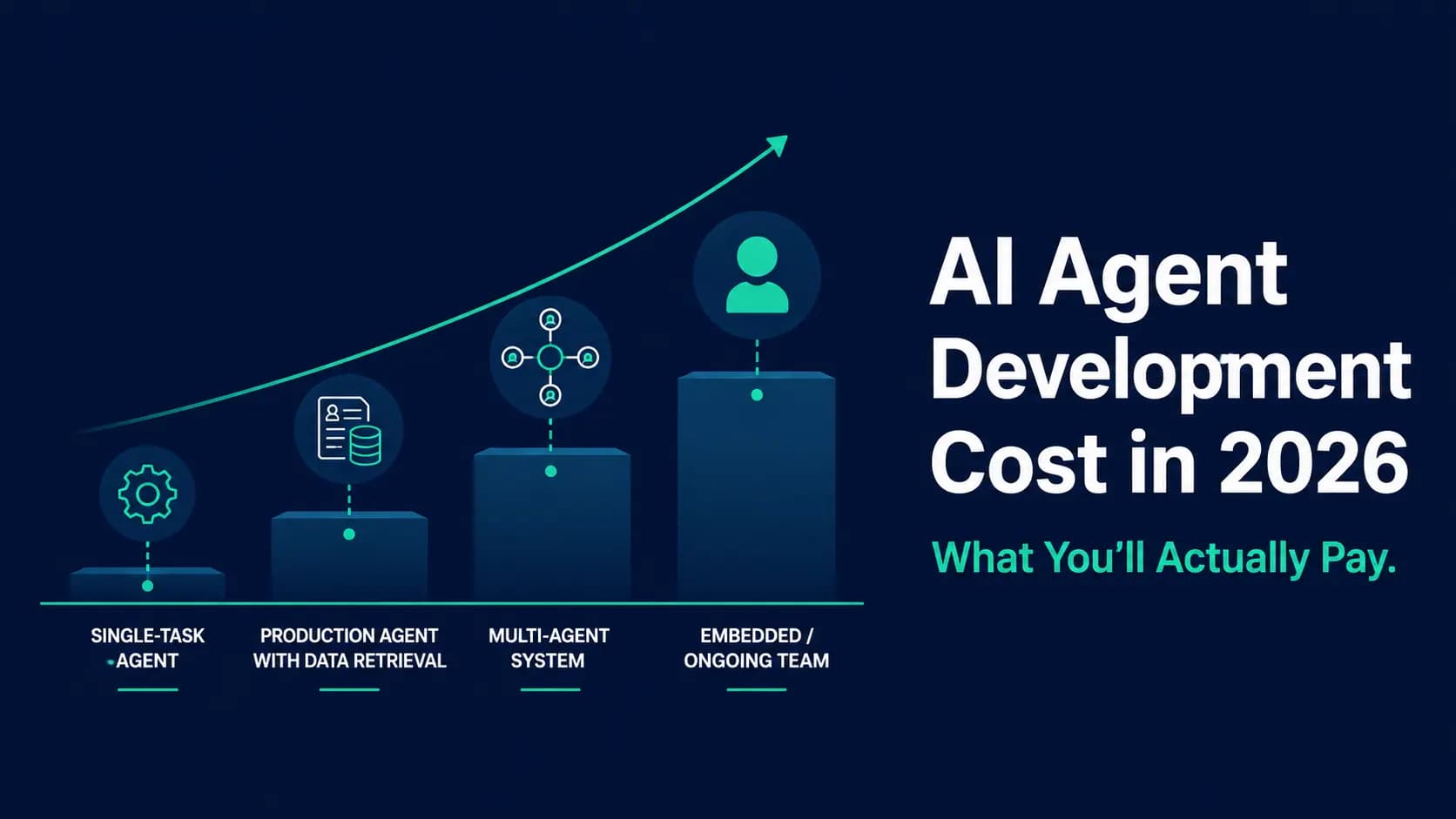
Quick answer, if that's all you need: most custom AI agent builds in 2026 fall between $5,000 and $180,000, depending almost entirely on how many systems the agent touches, whether it needs to reason over your private data, and how much autonomy it's given before a human checks its work. A narrow, single-task agent usually lands under $20,000. A production agent with real data retrieval and several integrations is where most mid-market companies actually spend - typically $25,000 to $90,000. Multi-agent, compliance-heavy builds go north of that.
The rest of this article breaks down where those numbers come from, so you can scope your own project before a sales call rather than after one.
What You're Actually Paying For, by Project Size
There's no universal price sheet for this kind of work - anyone who quotes you a flat number without asking a single question about your workflow is guessing. But the market has settled into rough bands that are worth knowing before you start comparing quotes.
A narrow, single-task agent - one job, one or two system connections, no memory or retrieval layer - is the cheapest and fastest thing to build. Think: an agent that reads support tickets, tags them by category, and routes them to the right queue. These typically run somewhere in the low five figures and ship in a couple of weeks, because most of the work is integration plumbing rather than novel reasoning design.
A production agent with retrieval is where things get real. This is an agent that needs to reason over your own documents, contracts, product catalog, or customer history - which means a retrieval pipeline (chunking, embeddings, a vector store, relevance tuning) sitting underneath it, plus several live integrations and at least one human-review checkpoint before anything ships to a customer. This tier is genuinely the most common first production build we see, and it's where the bulk of a mid-market company's first agent budget actually goes.
A multi-agent system coordinates several specialized agents against a shared workflow - one agent researching, one drafting, one verifying, an orchestrator deciding what happens next. This is where cost climbs fastest, because you're not just building agent logic, you're building the coordination layer, the evaluation harness that proves each agent behaves correctly on its own before you trust the system as a whole, and usually a compliance or audit-logging layer if the industry demands it.
An embedded engineer or ongoing team is a different purchase entirely - not a fixed deliverable but continuous capacity, priced more like a retainer than a project. This is the right model if agent development isn't a one-time initiative for you but an ongoing part of the roadmap.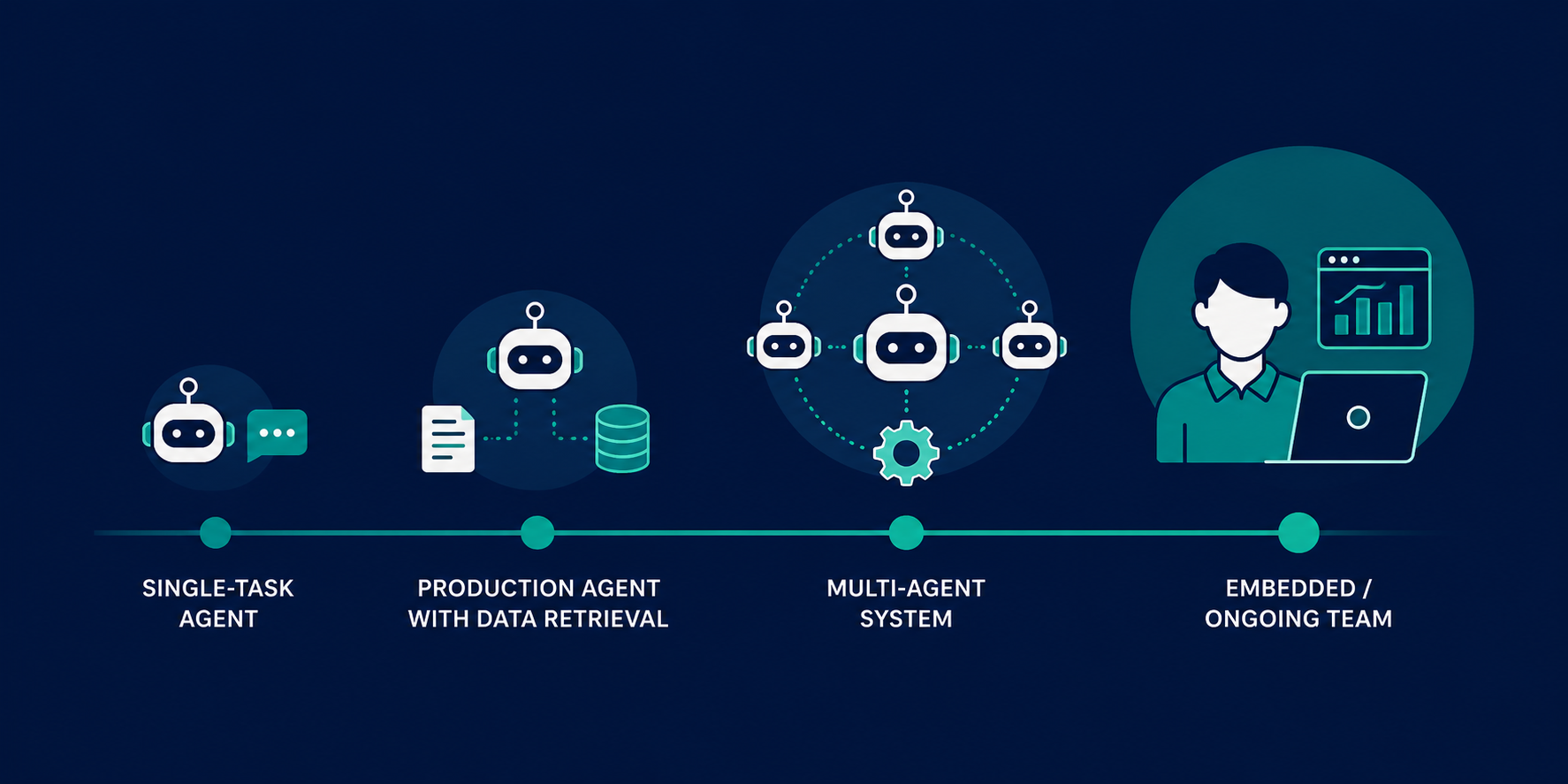
The Four Things That Actually Move the Price
Strip away the marketing and it comes down to a short list.
How many systems the agent has to touch. Every integration is authentication, error handling, and a new set of edge cases - a CRM connection behaves nothing like a warehouse API, and an agent talking to three systems isn't three times harder than one, it's closer to five or six times harder once you count the interactions between them.
Whether it needs your private data. An agent answering from general knowledge is comparatively simple. An agent that has to reason over your actual contracts, patient records, or transaction history needs a real retrieval pipeline underneath it - and tuning that pipeline so it retrieves the right passage instead of a plausible-sounding wrong one is where a lot of unbudgeted time disappears.
How much autonomy it's given. An agent that drafts something for a human to approve can ship with lighter guardrails. An agent that takes an irreversible action on its own - sends the email, files the claim, books the shipment - needs evaluation infrastructure and audit logging before anyone should trust it in production, and that safety layer is frequently a bigger line item than the agent's core logic.
Regulatory exposure. Healthcare, finance, and legal workflows add data-handling and access-control requirements that don't exist in a simple internal tool. If your use case touches regulated data, expect to land at the higher end of whatever range a vendor first quotes you - and be skeptical of anyone who doesn't ask about this at all.
The Hidden Costs Nobody Quotes You Up Front
The build fee is the part everyone budgets for. It's rarely the whole bill.
- Model API usage scales with how much the agent actually gets used, not with your one-time build cost - a moderately active agent can run anywhere from a few hundred to a few thousand dollars a month depending on volume and which model it's calling.
- Monitoring and observability tooling, so you know what the agent is actually doing in production and catch a failure before a customer does, is an ongoing line item most first-time buyers forget to ask about.
- Maintenance. Models get deprecated, upstream APIs change their schemas, and an agent's prompts quietly drift out of tune with new edge cases nobody anticipated at launch. An agent with zero maintenance budget degrades - not dramatically, just steadily, until someone notices it's been wrong for a month.
- Evaluation sets. Anything customer-facing or compliance-adjacent needs a held-out set of test cases you re-run before every change ships, so a "small" prompt tweak doesn't silently break something that was working.
None of this means the sticker price you're quoted is misleading - it just means it's a build cost, not a total cost of ownership, and the two aren't the same number.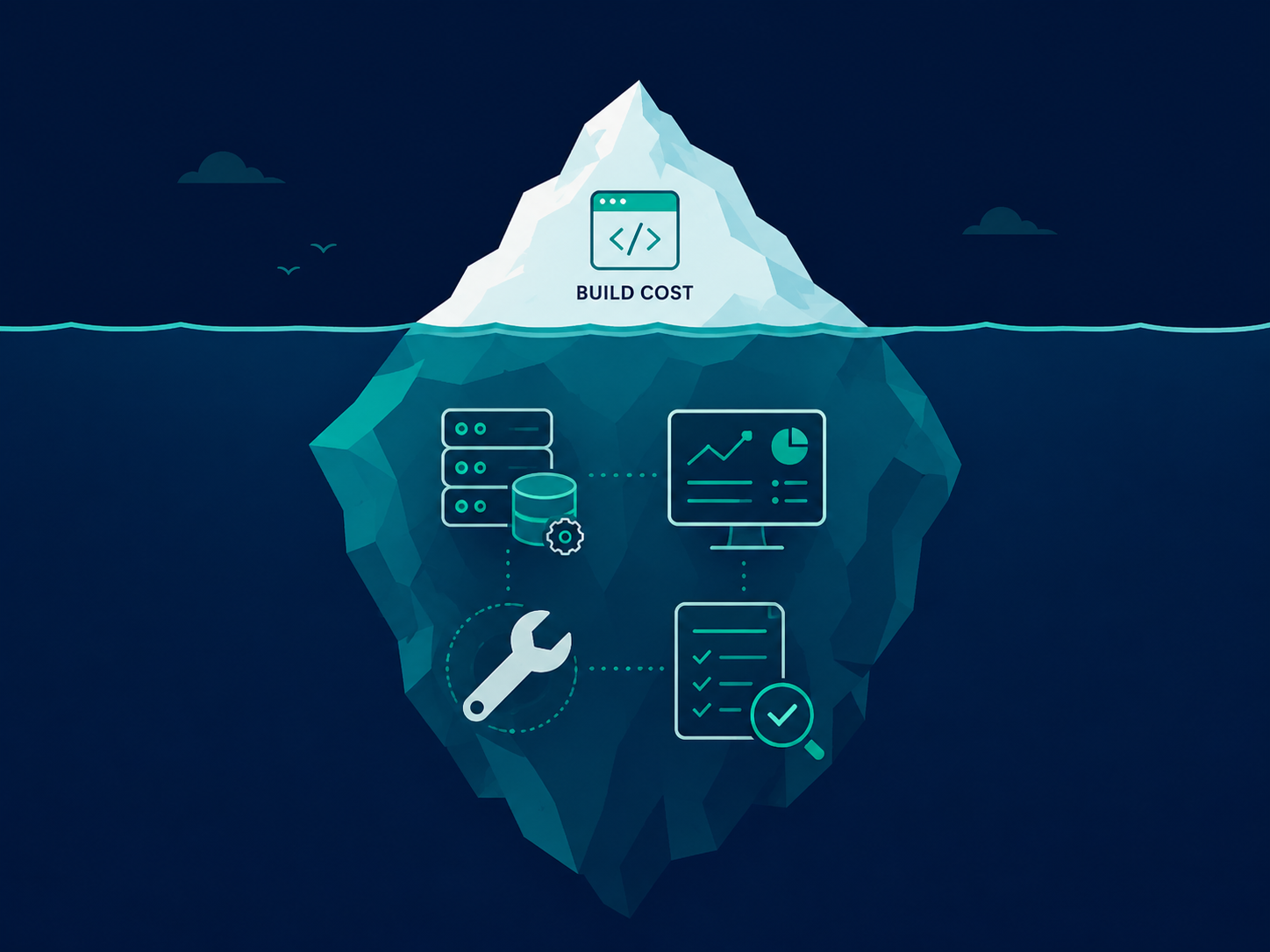
Build In-House, Hire a Freelancer, or Hire an AI Agent Development Company?
Three real paths exist here, and they trade off differently.
Building in-house makes sense if agents are becoming core to your product, not a one-off tool. It's also the slowest and most expensive path to a first production agent, once you count hiring, ramp time, and the infrastructure a team needs before shipping anything reliable - often six months to a year before the first real result, even with strong engineers.
A freelancer or independent contractor is fast to start and cheap on paper, but you're carrying the project management, the quality bar, and - critically - the long-term maintenance yourself, since most freelance engagements end at delivery, not at "still works in six months."
An AI agent development company sits in the middle: scoped delivery or embedded capacity without the recruiting pipeline, the ramp time, or the risk of a single contractor disappearing mid-project. The trade-off is that you're paying for a team's overhead, not just an individual's hourly rate - which is worth it when the guardrail and evaluation work is substantial, and less worth it for something genuinely trivial.
None of these is universally "right." A single internal tool for your ops team might genuinely be a weekend project for a contractor. A customer-facing agent handling account changes is a different conversation entirely.
How to Scope Your Own Project Before You Talk to Anyone
Before any sales call, write down four things: the single task the agent needs to do, stated in one sentence; every system it has to read from and write to; whether a human reviews its output before anything ships or it acts on its own; and whether this is a one-time build or the start of an ongoing agent roadmap for your team.
Those four answers put you in one of the tiers above before anyone's pitched you anything - and a vendor who won't give you a real range once you've answered them is telling you something worth paying attention to.
Toadster scopes agent projects the same way - an architecture conversation before a number, because "AI agent" genuinely does mean different things depending on what you're trying to automate. If you want that conversation, our page on AI agent development company services walks through how we approach scoping, and our step-by-step build guide covers the technical process behind the number.
The Real Question Isn't the Number
Most people asking "what does an AI agent cost" are really asking "am I about to get overcharged for something simple, or underquoted for something complicated." The honest answer is that you can't know until you've scoped the actual workflow - the four questions above will get you further than any price table, including this one.
If you'd rather skip the guesswork and scope the project directly, talk to Toadster about what your specific use case would actually take to build.