
How Long Does AI Agent Development Take? A Realistic Timeline for 2026
The short answer
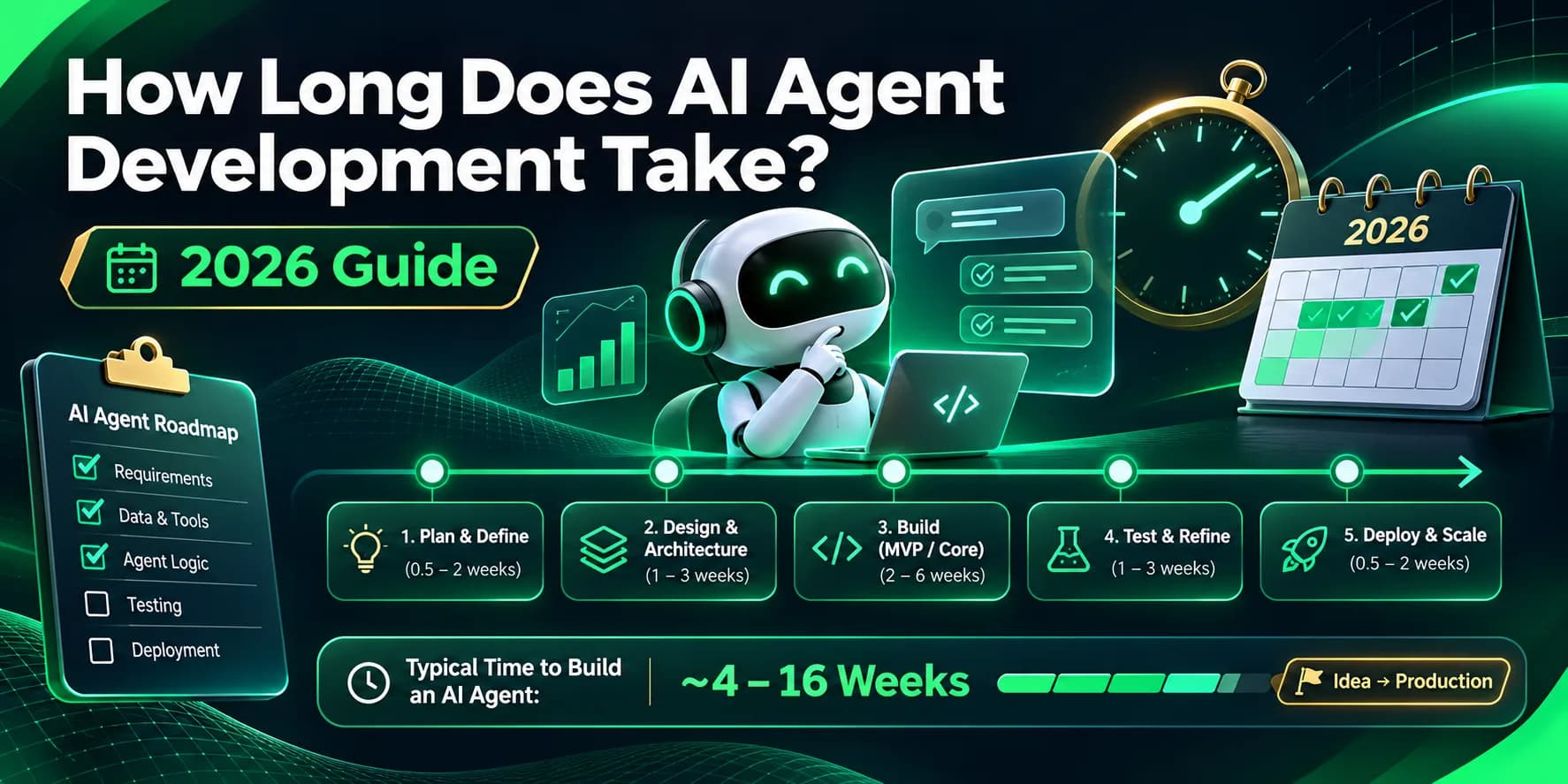
AI agent development usually takes 2 to 4 weeks for a simple proof of concept, 6 to 12 weeks for a production-ready MVP, and 4 to 6 months or more for a complex, multi-agent enterprise system. The exact timeline depends on how clear your use case is, how ready your data is, how many systems the agent must connect to, and how much testing and compliance work your industry needs.
That's the quick version. The rest of this guide explains where the time actually goes, so you can plan a budget and a launch date without nasty surprises.
Quick summary (for busy readers)
- A simple, single-task agent can be live in a few weeks. A business-critical agent that touches your CRM, ERP, WhatsApp or payment systems takes months.
- Most delays don't come from coding. They come from unclear requirements, messy data, slow approvals and late-stage testing.
- Starting with a narrow use case and expanding later is the fastest and safest route.
- Budget 20 to 30 percent of the timeline for testing, evaluation and guardrails. Skipping this is how agents fail in production.
What do we mean by an "AI agent"?
An AI agent is software that uses a large language model (LLM) to understand a goal, decide what steps to take, use tools such as APIs, databases or search, and complete a task with little human supervision. A basic chatbot answers questions. An agent actually does things: books the meeting, updates the CRM, qualifies the lead, drafts and sends the follow-up.
This is why agentic AI development takes longer to build than a standard chatbot. You're not just writing prompts. You're designing decision logic, connecting tools, setting safety limits and proving the agent behaves well across hundreds of real scenarios.
AI agent development timeline by complexity
Type of AI agent | Typical timeline | What's included | Example |
|---|---|---|---|
Proof of concept (PoC) | 2 to 4 weeks | One use case, limited data, basic interface, no heavy integrations | An agent that answers product questions from your documents |
Production MVP | 6 to 12 weeks | Real integrations, security, evaluation, a proper user interface, monitoring | A lead-qualification agent connected to your website form, CRM and WhatsApp |
Advanced single agent | 3 to 5 months | Complex workflows, RAG over large data, role-based access, audit logs | A support agent handling refunds, escalations and account changes |
Multi-agent enterprise system | 5 to 9 months or more | Several specialised agents, orchestration, compliance, custom dashboards, phased rollout | An operations system where agents handle sales, support and reporting together |
These ranges are industry-typical estimates, not promises. Your own project could sit above or below them depending on the factors below.
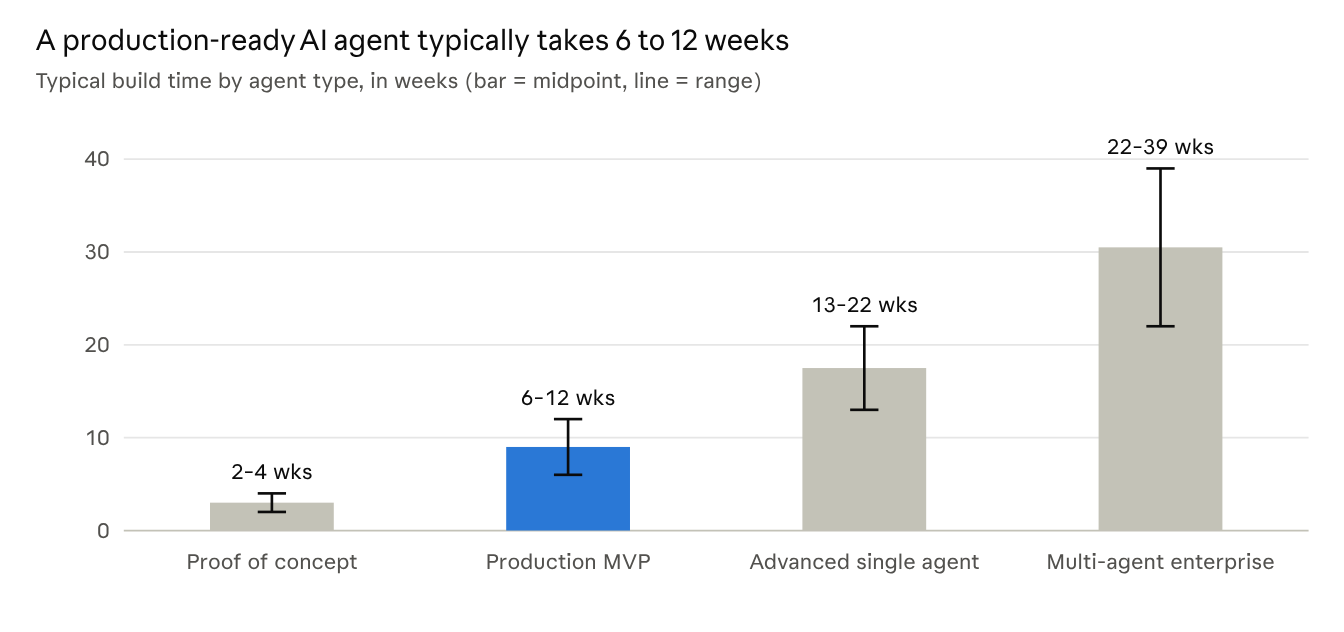
Illustrative typical ranges for common project scopes; actual timelines vary by project
The 6 stages of AI agent development (and how long each takes)
1. Discovery and use-case definition: 1 to 3 weeks
This is the most underrated stage. Here you decide what the agent should do, what it must never do, who will use it and how you'll measure success. A vague brief such as "we want an AI agent for sales" can add weeks later. A sharp one such as "qualify inbound leads in under two minutes and book calls for qualified ones" saves them.
2. Data preparation and knowledge setup: 1 to 4 weeks
Agents are only as good as the information they can reach. If your answers live in scattered PDFs, old emails and spreadsheets, someone has to clean, structure and index them. If you use retrieval-augmented generation (RAG), this is where your knowledge base is chunked, embedded and tested, which is the core of any RAG development project. Clean, well-organised data can cut this stage to days. Messy data can double it.
3. Architecture and design: 1 to 2 weeks
This covers picking the right LLM, the orchestration approach, memory, tool-calling design, hosting and security setup. Good AI development teams settle these early because they affect cost and speed later. It also covers a key decision: one capable agent or several specialised ones? A simpler design is almost always faster and easier to maintain.
4. Development and integration: 3 to 10 weeks
This is the build itself: prompts, workflows, tool connections, APIs, the user interface and the back-end logic, much like any custom software development project, plus the AI-specific parts. Integrations are the biggest time variable. Connecting to a modern, well-documented API might take days. Connecting to a legacy system with poor documentation can take weeks.
5. Testing, evaluation and guardrails: 2 to 6 weeks
Traditional software behaves the same way every time. AI agents don't. So you need to test them against realistic scenarios, edge cases and deliberate misuse, then measure accuracy, hallucination rate, response time and cost per task. You also add guardrails, such as approval steps for sensitive actions, fallback to a human, and limits on what the agent can access. Teams that rush this stage usually pay for it after launch.
6. Deployment, monitoring and improvement: ongoing
Launch is the start, not the finish. After go-live you monitor conversations, fix failure cases, tune prompts and watch your API costs. Many teams roll out to a small group first, then widen access over several weeks. Solid DevOps practices such as CI/CD, monitoring and cost tracking make this phase far smoother.
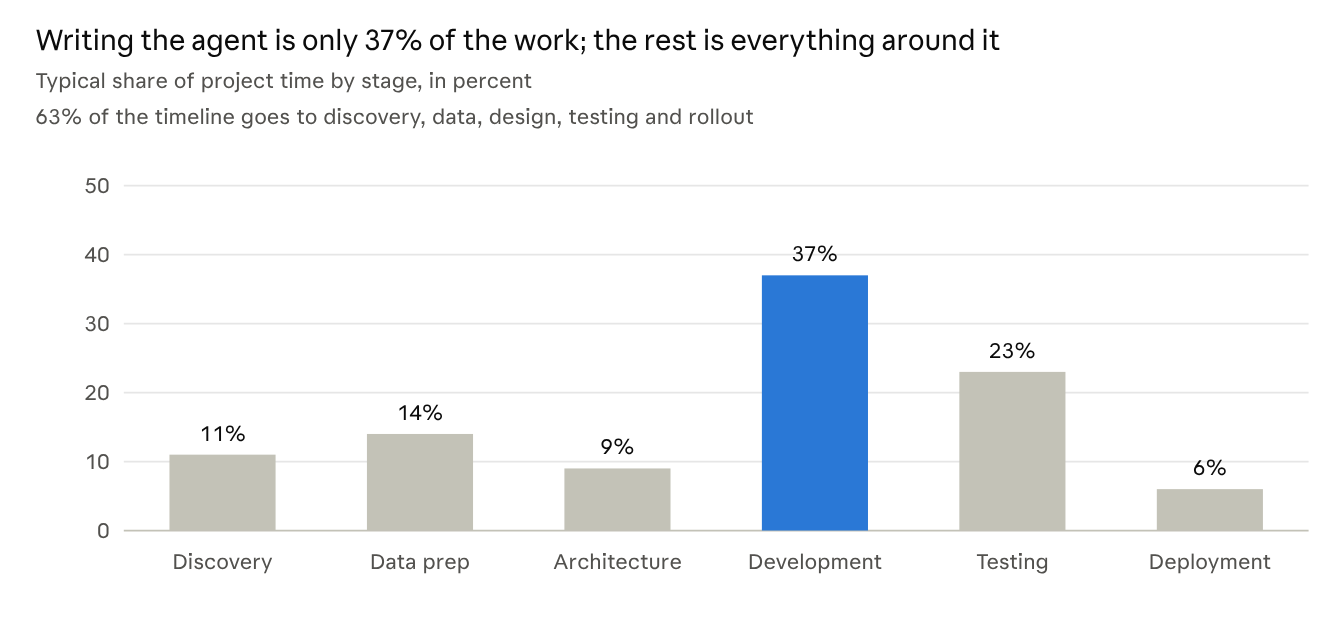
Illustrative split based on the midpoints of the stage ranges above, plus about one week for initial rollout
7 factors that make AI agent development faster or slower
1. Scope clarity. One well-defined task is far quicker than "an agent that handles everything."
2. Data readiness. Structured, current, accessible data speeds everything up. Scattered or outdated data slows it down.
3. Number and type of integrations. Each extra system (CRM, ERP, WhatsApp, payment gateway, calendar) adds build and testing time.
4. Level of autonomy. An agent that suggests actions is quicker to ship than one that acts on its own and spends money or changes records.
5. Compliance and security needs. Healthcare, banking and finance and legal projects need more review. Data-protection rules such as the UAE's PDPL, Saudi Arabia's PDPL, South Africa's POPIA and Canada's PIPEDA can affect where data is stored and how consent is handled. If you're building in the UAE, Saudi Arabia or Canada, plan for this early.
6. Decision speed on your side. A project can stall for weeks waiting on approvals, access credentials or feedback. A single point of contact who can decide quickly is worth a lot.
7. Team experience. A team that has built RAG pipelines, LLM applications and agent workflows before will avoid mistakes that cost others weeks. If you need extra capacity, you can hire dedicated AI/ML developers who plug straight into your workflow.
Why some AI agent projects take much longer than planned
Industry analysts have warned that a large share of agentic AI projects get cancelled or stall because of unclear business value, rising costs and weak risk controls. Gartner, for example, predicted in 2025 that over 40 percent of agentic AI projects would be cancelled by the end of 2027. The pattern behind most delays is the same:
- Scope creep. "Can it also do this?" gets added every week.
- Starting with the most complex use case instead of a small win.
- Treating the demo as the finish line. A demo that works on five examples can fail on the five hundred real ones.
- No clear success metric, so nobody knows when the agent is "done."
- Underestimating ongoing costs such as API usage, hosting and maintenance.
How to build an AI agent faster (without cutting corners)
- Start with one narrow, high-value use case. Prove it, then expand.
- Build a PoC first. Two to four weeks of testing with real data is cheaper than finding problems after a six-month build.
- Prepare your data early, even before development starts.
- Name one decision-maker on your side who can approve things quickly.
- Define success metrics up front, such as resolution rate, lead qualification accuracy or hours saved per week.
- Keep a human in the loop for high-risk actions at launch, then reduce oversight as trust builds.
- Plan for iteration. Treat the first release as version one, not the final product.
Build vs. buy: does a pre-built agent save time?
If your need is common, such as a basic website chatbot or FAQ assistant, a ready-made tool can go live in days. The trade-off is flexibility. Pre-built tools struggle when you need deep integration with your own systems, custom workflows, specific data-residency rules or full control over how the agent behaves. If the agent is central to how your business runs, custom development usually pays off over time, even though it takes longer to launch. If you're comparing vendors, this guide on how to compare MVP development quotes will help you spot hidden costs.
See how we build AI systems
Real examples make these stages easier to picture. Juristo AI is an AI-driven legal platform for document review, contract analysis and legal research. Bloombrain is an AI-powered market intelligence platform that connects fragmented commerce and marketing data. Gemini GYM is an evaluation and orchestration platform for large-scale LLM testing. Browse all our case studies to see more of our work.
How Toadster approaches AI agent development
At Toadster Technologies, we build custom AI solutions including agentic AI, RAG systems and AI and ML products, backed by software development and DevOps capabilities. Our approach follows the stages above: a short discovery phase, a quick proof of concept, then a phased build with testing and guardrails before anything goes live. That way you see working results early and can adjust before major spend.
Want a realistic timeline for your own project? Share your use case with our team and we'll tell you honestly what's achievable and how long it should take.
Final thoughts
There's no single number that fits every project. A focused agent can be live in a month, while a business-critical, multi-system platform needs a few months of careful building and testing. The fastest route is almost always the same: start small, prove value, then scale.
If you're planning an AI agent and want a timeline based on your actual requirements rather than a generic range, talk to the Toadster team.